
Celestial Enchantress, Mother of Warriors, The Divine Dancer Whose Grace Shaped Kingdoms
“घृताची नाम वै दिव्या नृत्यगीतविशारदा।
यस्याः स्मरणमात्रेण मोहः कामश्च जायते॥”
— Ancient Verse
Meaning: Ghritachi by name, the divine one, skilled in dance and song; by whose mere remembrance, infatuation and desire arise.
🌸 Introduction: The Dancer Who Moved the Cosmos
She glides through the celestial courts like moonlight on water. Her arms move like serpents in a trance. Her anklets chime the rhythm of creation itself. She is Ghritachi—the apsara whose dance could make gods forget their divinity and sages abandon their austerities.
But she is more than a dancer. More than a temptress. More than a footnote in the stories of great men.
Ghritachi is the weaver of destiny. In her embrace, kingdoms are conceived. From her womb, warriors are born. Through her curse and blessing, dynasties rise and fall. She is the celestial enchantress whose brief encounters on earth leave ripples that shape the course of history.
“नृत्यन्ती देवसदने मोहयन्ती सुरानपि।
घृताची कामरूपेण सर्वलोकेषु गीयते॥”
— by Author
Meaning: Dancing in the celestial courts, enchanting even the gods, Ghritachi, in her form of desire, is celebrated in all worlds.
In the vast tapestry of Hindu mythology, where gods and demons wage eternal war, where sages accumulate power that threatens the cosmic order, the apsaras serve a specific function. They are sent to break the austerities of sages who are becoming too powerful, to remind the celibate of desire, to bring the transcendent back to the earthly. Among these celestial dancers, Ghritachi stands out—not for her beauty alone, but for the extraordinary sons she bore, the dynasties she founded, and the intricate dance of destiny she choreographed across the mortal realm.
📜 Who Was Ghritachi? The Star of the Celestial Court
Ghritachi is one of the most renowned apsaras in Hindu mythology, celebrated in the Puranas, the Mahabharata, and classical Sanskrit literature. Her name derives from “ghrita” (clarified butter, ghee), symbolizing purity, nourishment, and the essence of sacrifice. Like ghee offered into the sacred fire, she is the offering that connects the earthly to the divine.
“घृताची नाम तेजस्वी नृत्यगीतविशारदा।
अप्सराणां वरिष्ठा सा रूपेणाप्रतिमा भुवि॥”
— by Author
Meaning: Ghritachi by name, the radiant one, skilled in dance and song, foremost among apsaras, matchless in beauty on earth.
She resides in the court of Indra, the king of the gods, where she entertains the divine assembly with her dance. Along with Urvashi, Menaka, Rambha, and Tilottama, she forms the inner circle of celestial enchantresses—the most beautiful, most skilled, most desired beings in the three worlds.
But Ghritachi is not merely a dancer. She possesses the power to assume any form at will (kamarupini). She can be more beautiful than any mortal woman, more seductive than any goddess, more terrifying than any demon. She moves between worlds—the celestial, the earthly, and the nether—with the ease of wind through open skies.
✨ The Apsaras – Nature and Purpose
To understand Ghritachi, one must understand the apsaras. They are not mere courtesans or divine prostitutes, as some colonial interpretations suggest. The apsaras are complex beings with a specific cosmic function.
Origins of the Apsaras
The apsaras emerged during the Churning of the Ocean (Samudra Manthan), that great cosmic event when the devas and asuras churned the primordial ocean to obtain the nectar of immortality. From the churning arose many precious things: Lakshmi, the moon, the celestial horse, the wish-fulfilling tree—and the apsaras.
“अप्सरसः समुद्भूता रत्नभूता वराङ्गनाः।
इन्द्रस्य सदनं यासां नित्यं नृत्येन शोभते॥”
— by Author
Meaning: The apsaras emerged from the churning, jewel-like women; the court of Indra is ever adorned by their dance.
Thus, the apsaras are not mortal beings. They are primordial, eternal, woven into the fabric of creation itself. They are as old as the gods and will exist as long as there is desire in the universe.
The Cosmic Role
The primary function of the apsaras is to maintain cosmic balance. When a sage performs such severe austerities that he threatens the power equilibrium of the three worlds, Indra sends an apsara to break his meditation. Her beauty, her dance, her seduction—these are tools of cosmic regulation.
“तपोबलं न दैत्यानां न देवानां बलं तथा।
ऋषीणां तपसा लोका धार्यन्ते योगमायया॥”
— by Author
Meaning: Neither the power of demons nor the might of gods; the worlds are sustained by the austerities of sages through yoga-maya.
When a sage’s power grows too great, he threatens to displace the gods. By breaking his meditation, the apsara restores balance. It is not malice that drives her—it is cosmic necessity.
But there is a cost. The sages, their austerity broken, often curse the apsara who seduced them. And these curses, while temporary, have consequences. Through these interactions, the apsaras become entangled in mortal destinies, bearing children who become warriors, kings, and sages.
👑 Ghritachi’s Mortal Unions – A Tapestry of Destiny
Unlike some apsaras who are remembered for a single famous union, Ghritachi weaves through multiple narratives, touching the lives of sages, kings, and warriors. Each union produces extraordinary offspring—beings who shape the political and spiritual landscape of ancient India.
The Union with Sage Bharadvaja – Birth of Drona
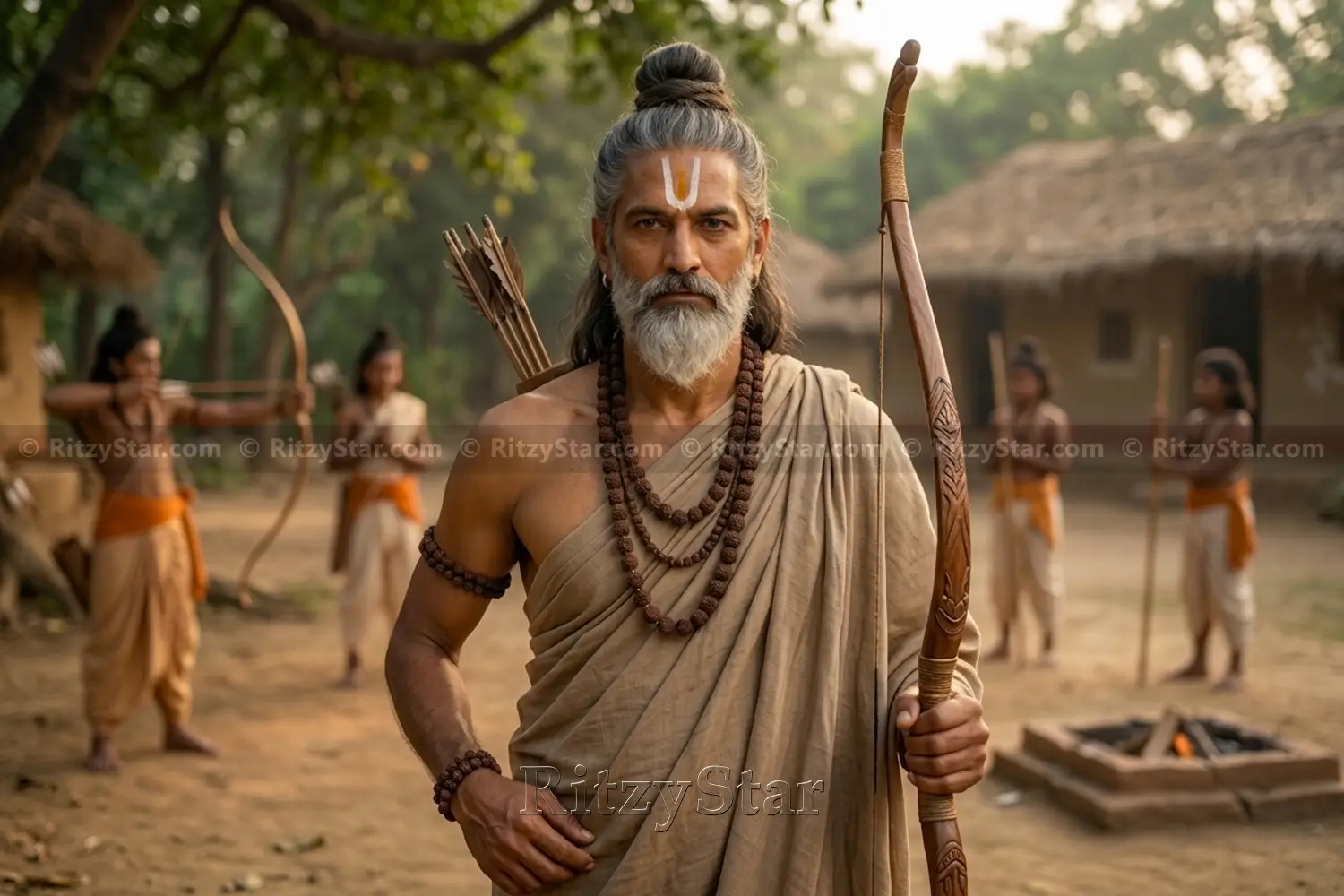
The most famous of Ghritachi’s unions is with the great sage Bharadvaja, one of the seven primordial sages (Saptarishis) and the progenitor of a powerful Brahmin lineage. This union produced one of the most celebrated warriors in all of Indian mythology—Dronacharya, the teacher of the Pandavas and Kauravas.
The Sage’s Austerity
Bharadvaja was performing intense penance on the banks of the Ganges. His spiritual power grew so great that the gods themselves became concerned. Indra, as was his custom, sent an apsara to break the sage’s concentration.
“भरद्वाजो महातेजा गङ्गातीरे तपश्चरन्।
तस्य तेजोभिभूतास्तु देवाः सर्वे सवासवाः॥”
— by Author
Meaning: The greatly radiant Bharadvaja was performing austerities on the banks of the Ganges. The gods, along with Indra, were overwhelmed by his power.
The Arrival of Ghritachi
Ghritachi appeared before Bharadvaja in her most enchanting form. She danced on the riverbank, her movements reflecting the flowing water, her anklets chiming with the song of the river. The sage, deep in meditation, was disturbed. He opened his eyes—and beheld her.
The moment was brief. A glance. A moment of desire. And then the sage, realizing his concentration had been broken, was overcome with shame and anger. He cursed Ghritachi—but not before she had conceived.
The Birth of Drona
According to the Mahabharata, Bharadvaja collected the seed that fell from him at the sight of Ghritachi into a vessel (drona) and from it was born a son—Drona, the great archer and teacher.
“भरद्वाजस्ततो गत्वा शरव्यां द्रोणमादधे।
तस्मिन्द्रोणे समुत्पन्ने द्रोणो नाम महारथः॥”
— by Author
Meaning: Bharadvaja then, having gone, placed the seed in a vessel; from that was born Drona, the great chariot-warrior.
But there is nuance here. Some texts suggest that Drona was born directly from Ghritachi’s womb and then abandoned—or that the union was more prolonged. The Mahabharata offers multiple versions. What is consistent is that Drona was born of the union between Bharadvaja and Ghritachi, and that his birth was extraordinary—born not from prolonged marriage but from a moment of cosmic interference.
Drona’s Legacy
Dronacharya became the greatest warrior of his age. He taught archery and martial arts to both the Pandavas and Kauravas. He was the guru who made Arjuna the greatest archer in the world. His son, Ashwatthama, became a powerful warrior in his own right—immortal, cursed, and central to the final tragedy of the Kurukshetra war.
“द्रोणो धनुर्धरः श्रेष्ठो भारद्वाजो महारथः।
तस्य पुत्रोऽश्वत्थामा च महाभारतविश्रुतः॥”
— by Author
Meaning: Drona, the greatest archer, the great chariot-warrior of Bharadvaja’s lineage; his son Ashwatthama, renowned in the Mahabharata.
Through Drona, Ghritachi’s blood flowed into the heart of the Kuru dynasty. Every arrow Arjuna shot, every lesson taught at Hastinapura, carried the echo of her dance on the banks of the Ganges.
The Union with Ruru – Birth of Shunahshepha
Another significant union in Ghritachi’s history is with the sage Ruru, a descendant of the great sage Bhrigu. This story, found in the Mahabharata, reveals a different facet of Ghritachi—one of love, grief, and divine intervention.
The Sage Ruru
Ruru was a young sage of the Bhrigu lineage, known for his devotion and his love for Pramadvara, the daughter of the apsara Menaka and the sage Vishwamitra. But tragedy struck when Pramadvara was bitten by a snake and died. Ruru, desperate to save her, offered half of his own life span to bring her back—a boon granted by a messenger from the gods.
But before this famous episode, Ruru had his own encounter with Ghritachi.
The Union
According to the Mahabharata, Ghritachi fell in love with Ruru—a rare occurrence, as apsaras typically act on Indra’s command, not their own desire. She assumed a beautiful form and approached the young sage. From their union was born a son.
“घृताच्यां रुरुतः पुत्रो जज्ञे विद्याधरः प्रभुः।
शुनःशेफ इति ख्यातः सर्वशास्त्रविशारदः॥”
— by Author
Meaning: From Ruru, through Ghritachi, was born a son, a lord among the Vidyadharas; known as Shunahshepha, he was skilled in all scriptures.
Shunahshepha – The Boy Who Was Sold
This son, Shunahshepha, has one of the most poignant stories in the Mahabharata. He was sold by his parents in a time of famine—or, in some versions, given away under duress. He was purchased by King Harishchandra to be sacrificed at Varuna’s altar, as the king had promised Varuna his son as payment for the boon of a child.
Shunahshepha, bound to the sacrificial post, prayed to the gods and was saved by the sage Vishwamitra, who adopted him and made him his eldest son. This Shunahshepha became a great sage in his own right, and his descendants formed a powerful Brahmin lineage.
“शुनःशेफं महाभागं विश्वामित्रोऽन्वपद्यत।
स वै राजर्षिरभवत् प्रजावान् दीर्घमायुषा॥”
— by Author
Meaning: The blessed Shunahshepha was adopted by Vishwamitra; he became a royal sage, prosperous and long-lived.
Thus, Ghritachi’s son became the ancestor of a great Brahmin lineage, connected both to the Bhrigu and Vishwamitra traditions—two of the most powerful spiritual lineages in India.
The Union with Kushika – The Forgotten Sage
Less celebrated but equally significant is Ghritachi’s union with Sage Kushika, the progenitor of the Kushika lineage—the lineage to which Vishwamitra belonged before his transformation from king to Brahmarishi.
The Kushika Lineage
Kushika was a sage of the Kshatriya (warrior) caste who performed such powerful austerities that he was granted a son who would become a great sage—that son was Vishwamitra, the king who became a Brahmarishi through the power of his penance.
“घृताच्यां कुशिकः पुत्रं गाधिनं समजीजनत्।
गाधिनस्तु विश्वामित्रो येन सर्वं जितं तपः॥”
— by Author
Meaning: Kushika, through Ghritachi, begot a son named Gadhi; Gadhi’s son was Vishwamitra, who conquered all through austerity.
According to some genealogical traditions, Kushika and Ghritachi were the parents of Gadhi, who was the father of Vishwamitra. This would make Ghritachi the grandmother of one of the greatest sages in Hindu tradition—the same Vishwamitra who appears in Madhavi’s story, the same who created a parallel universe in his rivalry with Vashistha.
The Significance
This connection places Ghritachi at the very origin of the Kushika dynasty—the lineage that produced Vishwamitra, the sage who challenged the supremacy of the Brahmin caste, who created a new heaven, who became one of the seven primordial sages despite being born a Kshatriya. Without Ghritachi, there would be no Vishwamitra, and without Vishwamitra, the Gayatri mantra might never have been revealed to humanity.
The Union with King Shantanu – The Mother of Vasishtha?
Some traditions associate Ghritachi with King Shantanu of Hastinapura—the same Shantanu who married Ganga and later Satyavati, the grandfather of the Kauravas and Pandavas. However, this association is complex and often conflated with other apsaras.
Alternative Reading
In some versions of the Mahabharata, it is not Ghritachi but another apsara who appears in Shantanu’s narrative. However, certain Puranic genealogies list Ghritachi as one of the celestial mothers whose children intermarried with royal lineages.
What is more certain is that Ghritachi’s descendants—through Drona, through Shunahshepha, through the Kushika lineage—intertwined with the Kuru dynasty. Drona was the guru of the Kurus. Shunahshepha’s descendants intermarried with royal houses. Vishwamitra’s descendants advised kings. Through these connections, Ghritachi’s influence permeated the political and spiritual fabric of ancient India.
👨👩👦 The Family of Ghritachi
| Sl.No | Name | Relationship | Children | Remarks |
|---|---|---|---|---|
| 1 | Sage Bharadvaja (One of the Saptarishis, great sage of the Rigveda) | Union (sent by Indra to break his austerity) | 1. Dronacharya – The greatest archer and martial teacher of his age; guru of the Pandavas and Kauravas; father of Ashwatthama. | Bharadvaja was performing intense penance on the banks of the Ganges when Ghritachi was sent to distract him. His concentration broken, he emitted seed which was collected in a vessel (drona), from which Drona was born. Drona later became the royal preceptor of Hastinapura. |
| 2 | Sage Ruru (Descendant of Bhrigu lineage) | Union (born of mutual desire, not Indra’s command) | 1. Shunahshepha – A great sage; adopted by Vishwamitra; ancestor of powerful Brahmin lineages; central figure in the story of King Harishchandra. | According to the Mahabharata, Ghritachi fell in love with Ruru—a rare instance of an apsara acting on personal desire rather than divine command. Their son Shunahshepha was sold by his parents during a famine, saved from sacrifice by Vishwamitra, and became a great sage. |
| 3 | Sage Kushika (Progenitor of the Kushika dynasty; ancestor of Vishwamitra) | Union (traditional genealogical accounts) | 1. Gadhi – King and sage; father of Vishwamitra; continued the Kushika lineage that produced one of the greatest sages in Hindu tradition. | Some Puranic genealogies identify Ghritachi as the mother of Gadhi, making her the grandmother of Vishwamitra. This places her at the origin of one of the most powerful spiritual lineages in India—the Kushika dynasty that produced the Brahmarishi Vishwamitra, composer of the Gayatri mantra. |
| 4 | Various Sages and Kings (through her role as celestial enchantress) | Multiple temporary unions | Various children whose names are not consistently recorded across texts | Like many apsaras, Ghritachi was sent on multiple missions to distract sages whose austerities threatened cosmic balance. Some of these unions resulted in children who became warriors, sages, or kings. The precise genealogy varies across Puranic and epic sources. |
Important Notes on Ghritachi’s Family:
- Drona – The Most Famous Son: Dronacharya is Ghritachi’s most celebrated offspring. His role in the Mahabharata as the teacher of both the Pandavas and Kauravas places him at the center of the epic’s drama. His son Ashwatthama, cursed to immortality, continues the lineage into the post-Mahabharata age.
- Shunahshepha – The Saved Sacrifice: Shunahshepha’s story is one of the most moving in the Mahabharata. Sold by his parents, bound to a sacrificial post, saved by Vishwamitra—his life embodies the mercy of the divine and the power of devotion. His descendants became important figures in Brahminical tradition.
- The Kushika Connection: The union with Kushika, if accepted as historical within the mythological framework, makes Ghritachi the ancestress of Vishwamitra—one of the most revered sages in Hindu tradition, the author of the Gayatri mantra, and the central figure in the story of Madhavi (as seen in the previous article).
- No Permanent Partners: Like most apsaras, Ghritachi had no permanent husband or consort. Her unions were temporary, often transactional (in the cosmic sense), and her children were typically raised by their fathers or others, not by her.
- Multiple Children Across Time: Ghritachi’s unions span generations in the mythological timeline. She appears across multiple epochs—from the age of the early sages (Bharadvaja, Kushika) to the later periods (Ruru, and possibly Shantanu). This is possible because apsaras are immortal and do not age.
- Distinction from Other Apsaras: Ghritachi should not be confused with other apsaras who had similar names or roles. Her identity as the mother of Drona is unique and well-established in the Mahabharata tradition.
🌊 The Dance of Destiny – Ghritachi’s Cosmic Role
Beyond her individual unions, Ghritachi represents something larger—a principle, a force, a necessity in the cosmic order. She is the instrument through which the universe maintains balance.
The Regulator of Austerity
When sages accumulate too much power, the gods tremble. A sage with enough penance could create new worlds, depose Indra, rewrite the laws of the universe. The apsaras are the counterbalance—the force that brings the transcendent back to the immanent, the ascetic back to the worldly.
“यदा यदा ऋषीणां च तपो वृद्धिं प्रपद्यते।
तदा तदाप्सरसः सृष्टा मोहनार्थं महात्मनाम्॥”
— by Author
Meaning: Whenever the penance of sages grows too great, the apsaras are created to bewilder those great souls.
Ghritachi was one of the foremost agents of this regulation. Her dance, her beauty, her very presence—these were weapons in a cosmic battle that most mortals never saw.
The Giver of Warriors
But there is another function. The children born from these unions—Drona, Shunahshepha, Gadhi—become essential to the mortal realm. They become warriors who protect dharma, sages who preserve knowledge, kings who rule with justice.
“ऋषीणां तपसा पुत्रा जायन्तेऽप्सरसः सुताः।
ते योधा भूमिपालाश्च धर्मस्य परिरक्षकाः॥”
— by Author
Meaning: From the penance of sages and the wombs of apsaras, sons are born. They become warriors and kings, protectors of dharma.
In this sense, Ghritachi is not merely a seductress but a mother of civilization. From her body come the teachers, the warriors, the kings who shape the world. Her dance may break a sage’s meditation, but her womb builds dynasties.
🕉️ The Deeper Meaning – Allegories and Interpretations
Like all great mythological figures, Ghritachi operates on multiple levels. Her story contains layers of meaning that reveal profound truths about existence, desire, and the nature of reality.
The Allegory of the Senses
In one interpretation, Ghritachi represents the senses—specifically, the sense of sight and touch. Her dance is the movement of the senses, her beauty is the allure of the material world, and her embrace is the entanglement of the soul in sensory experience.
The sages who fall to her represent the spiritual seeker whose meditation is interrupted by sensory input. The children born from these unions represent the karmic consequences—the actions and attachments that arise from sensory indulgence.
“घृताची नाम सा विद्या विषयाणां प्रवर्तिका।
तस्यां रताः सुरर्षीणां पुत्राः संसारबन्धनाः॥”
— by Author
Meaning: Ghritachi by name is the knowledge that activates the senses; attached to her, the children of the divine sages become bound to the world.
The goal of the spiritual path is not to destroy the senses but to transcend them—to see Ghritachi’s dance without being ensnared by it.
The Symbolism of Ghee
Ghritachi’s name—derived from ghrita (ghee)—is significant. Ghee is the essence of milk, the product of purification, the substance offered into the sacred fire. It is both nourishing and purifying.
“घृतं हविः स्मृतं यज्ञे पवित्रं च ओजसः प्रदम्।
घृताची तेन विज्ञेया सर्वेषां पोषणे रता॥”
— by Author
Meaning: Ghee is known as the oblation in sacrifice, pure and life-giving; Ghritachi is to be understood as one who delights in nourishing all.
In this reading, Ghritachi is not a seductress but a nourisher. Her unions are oblations offered to the cosmic fire. Her children are the results of those oblations—the warriors and sages who nourish the world.
The Feminist Reading – Agency and Its Limits
From a contemporary perspective, Ghritachi’s story raises complex questions about agency. She is often sent by Indra to break sages’ austerities—she acts not for herself but as an instrument of the king of gods. She is cursed by the sages she distracts, blamed for their failure of concentration.
“ऋषीणां शापभारेण घृताची सा पुनः पुनः।
देहं त्यक्त्वा पुनर्जाता दैवयोगेन कर्मणा॥”
— by Author
Meaning: Burdened by the curses of sages, Ghritachi, again and again, gives up her body and is reborn through the force of karma.
Yet within this constrained role, moments of agency emerge. Her union with Ruru is described as born of love—she chose him, desired him, came to him not because Indra commanded but because her own heart moved. In that moment, we see the apsara not as tool but as woman.
“रुरोश्च घृताची प्रीता न चैन्द्रादेशकारणात्।
स्वयं वरं वव्रे सा तं योगाच्च प्रियमास्थिता॥”
— by Author
Meaning: Ghritachi was pleased with Ruru, not by Indra’s command; she chose him herself and approached her beloved through yoga.
This rare moment of choice reveals the complexity of the apsara’s existence—a being of the celestial realm who occasionally reaches across the cosmic divide to touch the mortal with genuine affection.
📜 Ghritachi in Literature and Tradition
Ghritachi appears across multiple texts and traditions, each emphasizing different aspects of her story.
In the Mahabharata
The Mahabharata contains the most detailed accounts of Ghritachi’s unions. Her story with Bharadvaja and the birth of Drona appears in the Adi Parva (Book of Beginnings). Her union with Ruru and the birth of Shunahshepha appears in the Anushasana Parva (Book of Instructions). These narratives embed her in the central epic of Indian civilization.
“महाभारते घृताच्यास्तु वर्णितं चरितं महत्।
यत्रास्याः सर्वमाख्यातं पुत्राणां च पराक्रमः॥”
— by Author
Meaning: In the Mahabharata, the great life story of Ghritachi is described; there, everything is told of her and the valor of her sons.
In the Puranas
Various Puranas—the Vishnu Purana, the Bhagavata Purana, the Brahmanda Purana—contain references to Ghritachi. They often place her in the court of Indra, describe her beauty, and recount her role in breaking the austerities of various sages.
In Classical Sanskrit Literature
Kalidasa, the great Sanskrit poet, references Ghritachi in his works. The apsaras—including Ghritachi—appear in his Vikramorvashiyam and Kumarasambhavam as embodiments of beauty, art, and the tension between the spiritual and the sensual.
In Regional Traditions
In South Indian temple traditions, Ghritachi is sometimes depicted in dance sculptures, her form carved into the gopurams (temple towers) as a reminder of the beauty that both attracts and liberates. In certain folk traditions, she is venerated as a mother goddess, particularly in regions associated with her sons’ lineages.
🎭 Ghritachi and Other Apsaras – A Comparative View
Ghritachi is one of several famous apsaras, each with her own distinct role and legacy.
| Apsara | Most Famous Union | Most Famous Child | Distinctive Trait |
|---|---|---|---|
| Ghritachi | Bharadvaja, Ruru, Kushika | Dronacharya, Shunahshepha, Gadhi | Mother of warriors and sages; her children shape dynasties |
| Menaka | Vishwamitra | Shakuntala (mother of Bharata) | Broke the penance of the greatest sage; grandmother of a dynasty |
| Urvashi | King Pururavas | Ayus (ancestor of the Lunar Dynasty) | Her love story with Pururavas is the first known romance in Sanskrit literature |
| Rambha | Viswavasu, various sages | Various celestial beings | Often cursed for her role; her beauty causes both desire and destruction |
| Tilottama | Created to destroy Sunda and Upasunda | None | Her beauty was so extraordinary that even Shiva and Brahma were affected |
What distinguishes Ghritachi from these other apsaras is the diversity of her legacy. She is not known for one great union or one famous child. Instead, she weaves through multiple narratives, touching multiple lineages, shaping multiple destinies. Her sons are warriors (Drona), sages (Shunahshepha), and kings (Gadhi). Her influence spans the martial, the spiritual, and the political.
“अप्सरासु च सर्वासु घृताची बहुपुत्रिका।
नानावंशप्रतिष्ठात्री नानाराज्यप्रवर्तिका॥”
— by Author
Meaning: Among all the apsaras, Ghritachi is the one with many sons; she established various dynasties and initiated various kingdoms.
🌺 The Curse and Its Resolution – The Cycle of Rebirth
Like many apsaras, Ghritachi was cursed multiple times by sages whose concentration she broke. These curses, while painful, served a purpose in the cosmic order.
The Curse of Bharadvaja
When Bharadvaja realized that his meditation had been broken, he cursed Ghritachi. The nature of the curse varies across texts. Some say he cursed her to be separated from her son—which is why Drona was raised by his father alone, never knowing his mother. Others say he cursed her to wander the earth in mortal form for a time, experiencing the pains of human existence.
“भरद्वाजस्य शापेन घृताची पुत्रविच्युता।
तपस्तप्त्वा सुचिरं कालं मुक्ता शापाद् दिवं गता॥”
— by Author
Meaning: By Bharadvaja’s curse, Ghritachi was separated from her son; performing austerities for a long time, she was freed from the curse and returned to heaven.
The Curse of Other Sages
Other sages whom Ghritachi was sent to distract also cursed her. Each curse added to her burden, and each curse required penance to be lifted. This cycle of curse and penance, of fall and redemption, is central to the apsara narrative—a reminder that even celestial beings are subject to the law of karma.
The Resolution through Penance
Ghritachi’s ultimate liberation came through her own austerities. Unlike the sages whose penance she broke, her own penance was aimed not at gaining power but at shedding the consequences of her cosmic role. Through this, she purified herself and returned to her celestial nature—undiminished, unchanging, eternal.
“तपसा सा घृताची तु पुनर्दिव्यमवाप्तवती।
अप्सरस्त्वं चिरायुष्यं देवैश्च सह मोदते॥”
— by Author
Meaning: Through her penance, Ghritachi regained her divine nature, her apsara-hood, and long life; she rejoices with the gods.
🌄 Ghritachi’s Legacy – The Mother of Warriors
Ghritachi’s most enduring legacy is her son Drona. Through him, she is connected to the greatest epic in Indian tradition.
Dronacharya – The Teacher of Kings
Drona was not merely a warrior; he was the man who shaped the warriors of his age. He taught the Pandavas and Kauravas the art of war. He made Arjuna the greatest archer in the world. He stood at the center of the Kurukshetra war, his loyalty divided between his students and his duty.
“द्रोणो हि भारद्वाजः स घृताच्याः प्रसादजः।
येन धन्विद्यया लोकास्त्रयस्ते तोषिताः सदा॥”
— by Author
Meaning: Drona, the son of Bharadvaja, born through Ghritachi’s grace; by whose archery the three worlds are ever pleased.
Drona’s story is tragic. He loved his students, especially Arjuna. But he also loved his friend Drupada, who later betrayed him. He fought for the Kauravas not out of conviction but out of obligation. His death on the battlefield—tricked into laying down his arms by a lie about his son—is one of the most poignant moments in the Mahabharata.
Ashwatthama – The Immortal Avenger
Through Drona, Ghritachi’s lineage continues to Ashwatthama, Drona’s son. Ashwatthama fought on the Kaurava side in the Kurukshetra war. After his father’s death, he committed atrocities—massacring the Pandava camp at night, killing their sleeping children. He was cursed by Krishna to roam the earth forever, afflicted with disease and suffering, never to die.
“अश्वत्थामा घृताच्याश्च पौत्रो द्रोणस्य चात्मजः।
स चापि शप्तो भगवान् कल्पान्तं भ्रमते महीम्॥”
— by Author
Meaning: Ashwatthama, Ghritachi’s grandson and Drona’s son, was cursed by the Lord and wanders the earth until the end of the age.
This curse makes Ashwatthama one of the seven immortals (Chiranjivi) in Hindu tradition—eternal, suffering, awaiting the end of the Kali Yuga.
The Unbroken Thread
From Ghritachi’s womb, a thread runs through the Mahabharata. Her dance on the Ganges bank led to Drona. Drona’s teachings led to Arjuna’s archery. Arjuna’s arrow led to the fall of Bhishma. The war that reshaped the world traces back, in part, to a moment of desire on a riverbank—a dance that broke a sage’s meditation and gave birth to a teacher who changed everything.
“घृताच्याः स्मरणं पुण्यं द्रोणस्यापि च जन्म यत्।
तस्य चार्जुनविद्या या कुरुक्षेत्रं च यत्र सा॥”
— by Author
Meaning: Holy is the remembrance of Ghritachi, by whose grace Drona was born; his teaching of Arjuna, and Kurukshetra where it led.
🌅 Conclusion – The Dancer Who Lives in Every Warrior’s Bow
The story of Ghritachi is not merely the story of an apsara. It is the story of how beauty and desire are woven into the fabric of destiny. It is the story of how a moment of distraction can become a dynasty. It is the story of how the divine and the mortal intersect, briefly, and leave behind legacies that span centuries.
“नृत्यं तस्यास्तु संसारः पदन्यासः क्रियाविधिः।
तस्याः पुत्रा महावीर्या धर्मस्य परिपालकाः॥”
— by Author
Meaning: Her dance is the world; her steps are the rituals of action; her mighty sons are the protectors of dharma.
Ghritachi’s dance never ends. It continues in the rhythm of creation and destruction, in the movement of the planets, in the beating of every heart. Her anklets chime in the laughter of children, in the whispers of lovers, in the arrows that fly toward their targets. She is the beauty that distracts and the beauty that inspires, the mother of warriors and the grandmother of immortals.
“या देवी सर्वभूतेषु घृताचीरूपेण संस्थिता।
नमस्तस्यै नमस्तस्यै नमस्तस्यै नमो नमः॥”
— by Author
Meaning: To that goddess who abides in all beings in the form of Ghritachi, salutations to her, salutations to her, salutations to her again and again.
When you see a dancer, remember Ghritachi. When you hear a story of a great warrior, remember the apsara whose womb gave him life. When you struggle with desire that interrupts your meditation, remember that the same force that distracts also creates—that from the dance of the senses, the greatest dynasties are born.
Ghritachi reminds us that there is no pure spirituality without the body, no transcendence without immanence, no liberation without the world that binds. Her dance is the dance of existence itself—beautiful, distracting, creative, eternal.
Discover more from RitzyStar
Subscribe to get the latest posts sent to your email.