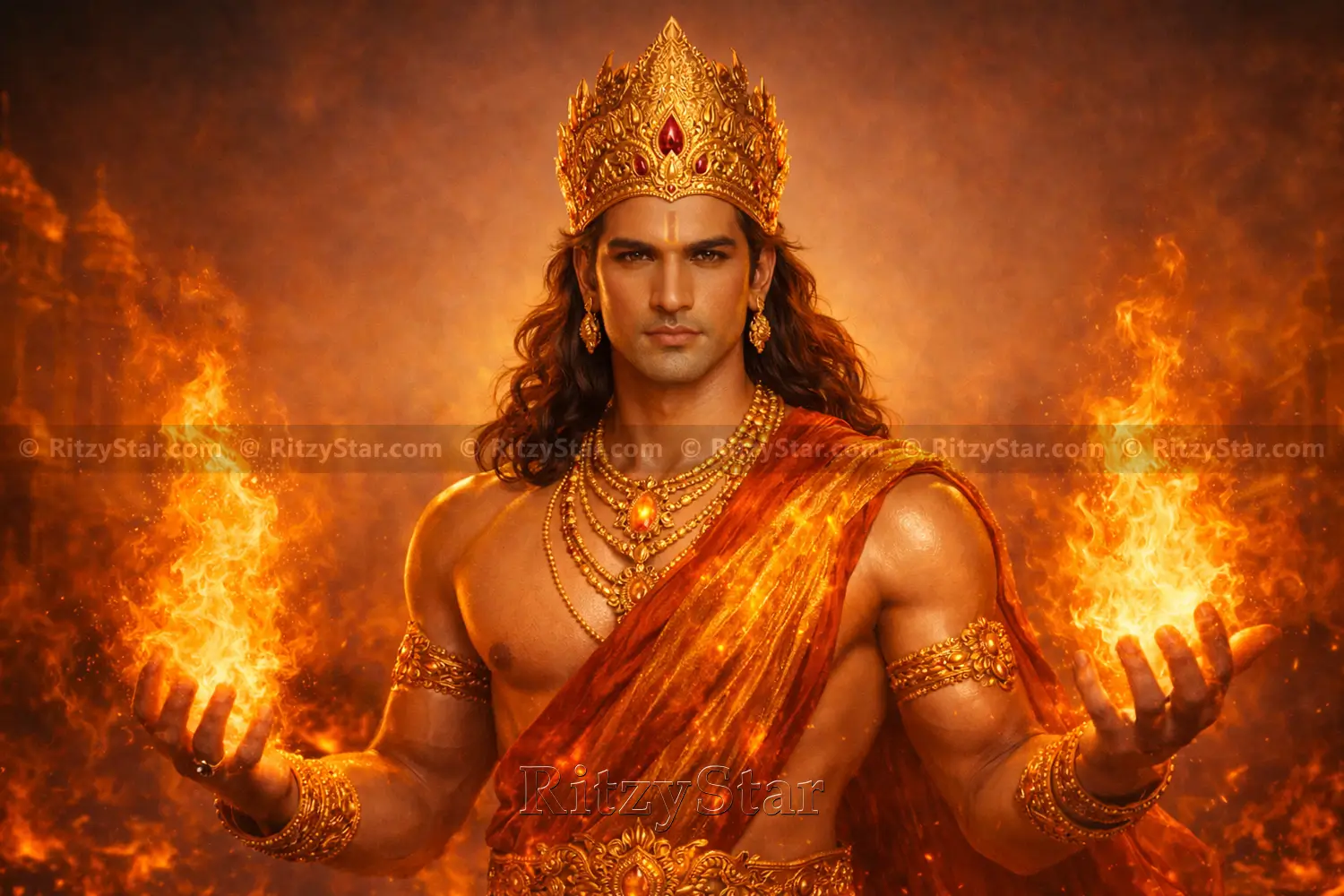
The Mouth of the Gods, The Witness of All Deeds, The Purifier
“अग्निर्मूर्धा दिवः ककुत्पतिः पृथिव्या अयम्।
अपां रेतांसि जिन्वति॥”
— Rigveda (1.164.1)
Meaning: Agni is the head of heaven, the summit of the sky, the lord of earth; he enlivens the waters and their seeds.
🔥 Introduction: The Fire That Consumes and Creates
He is the first invocation in the Rigveda. The first verse of humanity’s oldest living scripture begins with his name. He is the mouth of the gods, through whom all offerings ascend to the heavens. He is the witness of every sacred vow, the purifier of all impurity, the destroyer of darkness and ignorance. He is Agni—the Fire God.
But Agni is far more than a deity of flames and sacrifice. He is the intermediary between the human and the divine, the messenger who carries mortal prayers to immortal ears. He is present in every hearth, every temple lamp, every cremation pyre, every digestive fire within living beings. He is at once the destroyer who consumes and the purifier who transforms—the fire that burns away the impure and reveals the pure.
“अग्निं दूतं वृणीमहे होतारं विश्ववेदसम्।
अस्य यज्ञस्य सुक्रतुम्॥”
— Rigveda (1.12.1)
Meaning: We choose Agni as our messenger, the invoker who knows all, the wise priest of this sacrifice.
Unlike many gods whose domains are limited to specific realms—Indra to the heavens, Varuna to the waters, Surya to the sun—Agni pervades all existence. He is the cosmic fire that burns at the heart of stars, the volcanic fire that shapes the earth, the domestic fire that warms the home, the ceremonial fire that sanctifies ritual, the fire of digestion that sustains life, and the fire of aspiration that drives the soul toward liberation.
His story is woven into the very fabric of creation, from the primordial sacrifice that gave birth to the cosmos to the final fire that will consume the universe at the end of time. He is eternal, yet ever-born; ancient, yet eternally young.
🌟 Who Is Agni? The First Priest of the Cosmos
Agni is one of the most ancient and revered deities in the Hindu pantheon. In the Rigveda, he is second only to Indra in the number of hymns dedicated to him—over 200 hymns invoke his name and power. He is the Hotar—the invoker priest—who summons the gods to the sacrificial altar and conveys offerings from earth to heaven.
His Names and Epithets
Agni’s names are as numerous as his forms, each revealing a different aspect of his nature:
| Name | Meaning | Significance |
|---|---|---|
| Agni | Fire | From the root aj (to drive, to move); the one who moves swiftly |
| Vahni | Carrier | He carries offerings to the gods |
| Jatavedas | Knower of All Births | He knows all beings born and to be born |
| Anala | Unquenchable | He cannot be extinguished; the eternal flame |
| Pavaka | Purifier | He cleanses all that he touches |
| Hutasha | Consumer of Offerings | He devours what is offered in sacrifice |
| Vaishvanara | Belonging to All Men | The universal fire present in all humanity |
| Dhananjaya | Conqueror of Wealth | He conquers riches (through sacrifice) |
| Abhimani | Proud One | The fire that blazes with pride |
| Saptajihva | Seven-Tongued | He has seven tongues of flame |
| Suchi | Pure | He is inherently pure, the purifier |
His Physical Description
Agni is depicted in multiple forms, reflecting his multifaceted nature:
The Radiant Youth: Often portrayed with two heads—one representing his creative aspect, the other his destructive aspect. He has seven tongues (or seven flames) with which he laps up offerings. He rides a ram, symbolizing his role as the vehicle of sacrifice (rams were often sacrificed in Vedic rituals). He is red in complexion, with a glowing body, sharp teeth, and flaming hair.
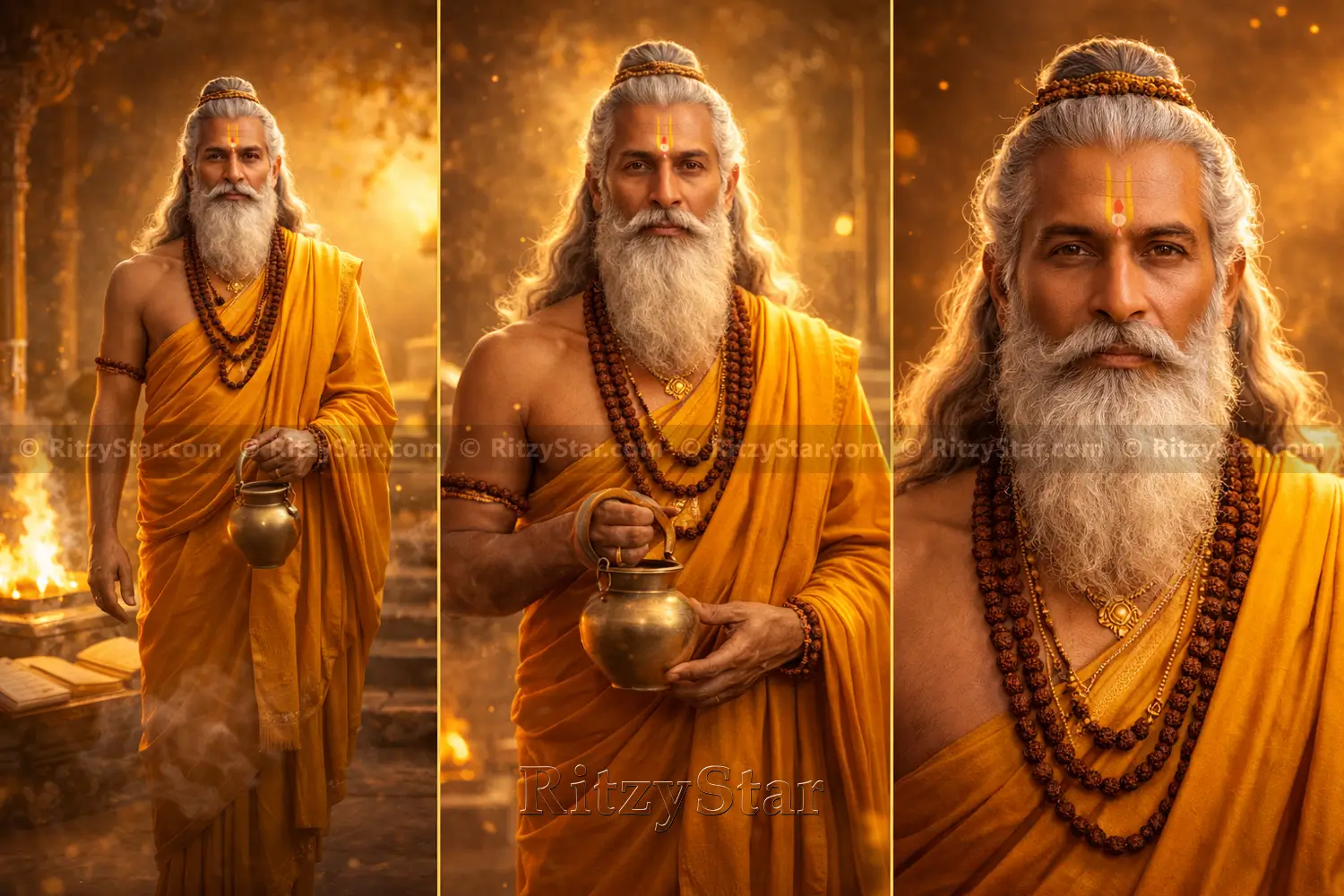
The Eternal Priest: Depicted with a sacred thread, a pot of clarified butter (ghee), and sacrificial implements. He is shown as the priest who presides over all rituals, his flames rising like arms reaching toward the heavens.
The Universal Fire: In his cosmic aspect, Agni is depicted as encompassing all forms of fire—from the gentle hearth to the blazing sun, from the lightning that splits the sky to the volcano that reshapes the earth.
“अग्निः पूर्वेभिरृषिभिरीड्यो नूतनैरुत।
स देवानेह वक्षति॥”
— Rigveda (1.1.2)
Meaning: Agni is invoked by ancient sages and by modern ones; he will bring the gods here.
🔥 The Origins of Agni – Born from the Cosmic Waters
Agni’s birth is a story of paradox: fire emerging from water, light arising from darkness. The Rigveda contains multiple accounts of his origin, each revealing a different facet of his nature.
The Primordial Birth
According to the most ancient accounts, Agni was born from the cosmic waters—the primordial ocean from which all existence emerged. He was hidden in the waters, in the secret place where fire and water coexist in potentiality. The gods discovered him there and brought him forth to serve as their messenger and priest.
“अपां गर्भं वसुधानिं सपर्यत मतिं कृण्वन्तो अग्निमीड्यम्।
संवत्सर्यं वयुनं जातवेदसमग्निं हिन्वन्तु निधयो अभीशवः॥”
— Rigveda (1.143.2)
Meaning: Serve the germ of waters, the bestower of wealth, Agni worthy of praise; let the offerings hasten Jatavedas, the eternal knower of births.
Another tradition speaks of Agni being born from the friction of two pieces of wood—the Arani—the upper and lower sticks used to kindle sacrificial fire. This birth is perpetual; every time fire is kindled, Agni is born anew. He is therefore the ever-new, ever-young god who is reborn in each act of creation.
The Son of Heaven and Earth
In some hymns, Agni is described as the son of Dyaus (Heaven) and Prithvi (Earth). He is the child of the cosmic parents, the fire that bridges the gap between them. When the sacrificial fire rises, it connects earth to heaven, and Agni, as the child of both realms, is the perfect intermediary.
“अग्निर्द्यावापृथिवी अजायत प्रथमो देवो यज्ञियैरभूत्।
स हि विश्वा भुवनानि प्रतीपः प्राणदपानद्वसुभिः समैरयत्॥”
— by Author
Meaning: Agni was born from Heaven and Earth; he became the first god worthy of sacrifice. He encompasses all beings, moving with life-breath and wealth.
The Ten Mothers
A fascinating Rigvedic verse (1.141.2) speaks of Agni being born from ten mothers—interpreted as the ten fingers that kindle the fire, or the ten directions, or the ten energies that bring him forth. This multiplicity of origins reflects Agni’s omnipresence—he is born wherever fire is kindled, by whomever kindles it.
“दश मातरो गर्भं धारयन्ते दश दक्षिणा दश योनिमस्मै।
दश प्राचीर्दशोदीचीरग्निं दशास्य प्राणः सह जातमाजौ॥”
— Rigveda (1.141.2)
Meaning: Ten mothers hold the embryo, ten offerings, ten birthplaces; ten eastern, ten northern—Agni, his breath born in battle.
👨👩👦 The Family of Agni – Wives and Sons
Agni’s relationships are complex, reflecting the multifaceted nature of fire itself. He has multiple consorts across different traditions, each representing a different aspect of his power.
| Sl.No | Name | Relationship | Children | Remarks |
|---|---|---|---|---|
| 1 | Svaha | Primary Consort (Goddess of Offerings) | 1. Agneya (Skanda/Kartikeya) – In some traditions, the fire-born form of the war god was born from Agni and Svaha’s union. | Svaha is the personification of the offering poured into the fire. Without her, sacrifices cannot reach the gods. She is considered Agni’s principal wife and the essential complement to his role as the conveyor of offerings. |
| 2 | Swaha (alternate spelling) | 2. Pavaka – A form of fire associated with purification; one of the three symbolic sons representing fire’s three aspects. | The chanting of “Svaha” during every Vedic sacrifice is an invocation to Agni’s consort, requesting her to carry the offering to the intended deity. Without Svaha, the offering is considered incomplete. | |
| 3 | Swadha | Consort (Goddess of Ancestral Offerings) | 1. Suchi – A form of fire associated with purity and the flames of the cremation ground; one of the three symbolic sons representing fire’s three aspects. | Swadha presides over offerings made to ancestors (pitris). She is invoked with the exclamation “Swadha” during ancestral rites. In this aspect, Agni serves as the conveyor of offerings to the departed ancestors. |
| 4 | Dakshina | Consort (Goddess of Sacrificial Fee) | 1. Pavaka (in some traditions) – The purifying fire associated with celestial realms. | Dakshina personifies the fee given to priests after a sacrifice. She is also considered a form of Agni’s energy, representing the generosity that completes the ritual. Her name means “south,” linking her to the southern fire used in ancestral rites. |
| 5 | Vishvarupa’s Sisters | Additional Consorts | 1. Pavamana – A form of fire associated with the purifying process of straining; the fire that refines and purifies. | According to the Mahabharata and Puranic traditions, Agni married the three daughters of Vishvarupa: Sarasvati, Viraja, and Mahaviraja (or some variations). These unions produced different aspects of fire. |
| 6 | 2. Pavaka (as distinct form) – The celestial fire. | |||
| 7 | 3. Pavamana – The purifying fire of the atmosphere. | |||
| 8 | 4. Suchi – The fire of the cremation ground and domestic hearth. |
The Three Sons – The Three Forms of Fire
In Puranic tradition, Agni’s three sons—Pavaka, Pavamana, and Suchi—represent the three manifestations of fire:
| Son | Domain | Function |
|---|---|---|
| Pavaka | Celestial Fire | The fire of lightning and the sun; the purifier of the heavens |
| Pavamana | Atmospheric Fire | The fire that purifies the air; the wind-driven flame |
| Suchi | Terrestrial Fire | The fire of the earth; the domestic hearth; the cremation fire |
These three sons, born from Agni’s various unions, are sometimes described as his children and sometimes as aspects of Agni himself. They represent the omnipresence of fire across all realms—heaven, earth, and the space between.
Svaha – The Essential Consort
Of all Agni’s consorts, Svaha is the most important. She is not merely his wife but his essential complement. Without her, Agni cannot fulfill his function as the conveyor of offerings. The very act of sacrifice depends upon her.
According to the Puranas, Svaha was the daughter of Daksha (or, in some accounts, of the sage Bhrigu). She was deeply in love with Agni, who at that time was absorbed in severe austerities and paid no attention to her. Distraught, she took the form of the six wives of the Krittikas (the Pleiades) and approached Agni, who, thinking she was the wives of the Krittikas, united with her. From this union was born Skanda (Kartikeya), the war god, in a remarkable birth.
“स्वाहा नाम विश्वविदा दुहिता दक्षस्य वै द्विज।
अग्नेः प्रिया सा सुश्रोणी पत्नी च परमेष्ठिनः॥”
— by Author
Meaning: Svaha, known to all, the daughter of Daksha, O Brahmin, was Agni’s beloved, the beautiful one, the wife of the supreme lord.
The exclamation “Svaha! ” uttered at the end of every Vedic mantra, is an invocation to her. It is she who carries the offering from the sacrificial fire to the intended deity. Without her, the offering would fall to the ground and be lost. With her, it becomes a divine offering, accepted by the gods.
🔥 The Twelve Forms – Agni’s Universal Manifestation
Agni is not one but many. The Taittiriya Aranyaka and other texts describe twelve forms of Agni, each corresponding to a different manifestation of fire in the cosmos and human experience:
| Form | Domain | Description |
|---|---|---|
| Garhapatya | Domestic Fire | The southern hearth fire, perpetually maintained in the household; source of all other sacred fires |
| Dakshinagni | Ancestral Fire | The southern fire used for ancestral rites; associated with the direction of Yama, lord of death |
| Ahavaniya | Offering Fire | The eastern fire used for offerings to gods; the most sacred of the three primary fires |
| Sabhyagni | Assembly Fire | The fire that warms and illuminates the assembly hall; fire of community |
| Avasadhyagni | Hospitality Fire | The fire used to welcome guests and prepare food for them |
| Vaishvanara | Universal Fire | The cosmic fire present in all beings; the digestive fire in all creatures |
| Kravyada | Cremation Fire | The fire that consumes the dead; the flesh-eating fire |
| Uttara | Northern Fire | The fire associated with the northern direction and spiritual pursuits |
| Bhuh | Earth Fire | The fire that manifests in the earth—volcanic, geothermal |
| Bhuvah | Atmospheric Fire | Lightning, the fire of the atmosphere |
| Suvah | Celestial Fire | The fire of the sun and stars |
| Agni | All-Encompassing Fire | The totality of all fires; the one that pervades all |
“द्वादशधा विहितं हव्यवाहं यं देवासो अग्निमध्रुक्षन्।
तं ते दद्मो अमृतस्य धारां स देवेष्वतिथिः सीद यज्ञे॥”
— by Author
Meaning: The twelve-formed bearer of offerings that the gods established—to you we give the stream of immortality; sit as a guest among the gods in this sacrifice.
🌍 Agni’s Great Deeds – Stories of the Fire God
The Burning of the Khandava Forest
Perhaps the most famous story of Agni in the Mahabharata is the burning of the Khandava Forest. Agni, having consumed countless offerings at the sacrifice of King Janamejaya, developed a severe digestive disorder (he had eaten too much fat!). To cure himself, he needed to consume the entire Khandava Forest, which was protected by the god Indra (who was a friend of the forest’s inhabitants, particularly the serpent Takshaka).
Whenever Agni attempted to burn the forest, Indra would extinguish him with rain. Frustrated, Agni sought the help of Arjuna and Krishna, who were visiting the banks of the Yamuna. Disguised as a Brahmin, Agni approached them and promised them celestial weapons in exchange for their help.
“खाण्डवं प्रति दहनं प्रार्थयामि नरर्षभौ।
युवां हि शक्तौ सहितौ रक्षितुं मामनिन्दितौ॥”
— Mahabharata (Adi Parva, 225.6)
Meaning: “I seek to burn the Khandava forest, O best of men. You two together are capable of protecting me, O blameless ones.”
Arjuna and Krishna agreed. They created a barrier of arrows and the Sudarshana Chakra respectively, preventing Indra’s rain from extinguishing the fire. For days, Agni consumed the forest, devouring its creatures, its trees, its very life. Only four beings escaped: the serpent Ashwasena (Takshaka’s son), the demon Maya, and two birds—Mandapala and his wife Lapita with their young.
From this burning, Agni was cured. And in gratitude, he gave Arjuna the Gandiva bow, the quiver of inexhaustible arrows, and a divine chariot. He also granted Krishna the Sudarshana Chakra, which he had used to block Indra’s rain. This event established Agni as a powerful ally of the Pandavas, a relationship that would prove crucial in the great war to come.
Agni and the Birth of Skanda
The birth of Skanda (Kartikeya), the war god and commander of the celestial armies, is intimately connected with Agni. According to the Puranas, the gods needed a powerful general to lead them against the demon Taraka. The only being capable of fathering such a warrior was Agni.
But Agni, at that time, was absorbed in severe asceticism and uninterested in worldly unions. The goddess Parvati, desiring to create a son, approached Agni, but he refused. Then Svaha, Agni’s devoted consort, took the form of the six wives of the Krittikas (Pleiades) and approached Agni, who, thinking she was them, united with her.
Svaha carried Agni’s seed to the Ganges, where it became the six-headed child Skanda. The six Krittikas raised him, giving him the name Kartikeya (“son of the Krittikas”). Skanda went on to kill Taraka and became the commander of the celestial armies.
“स्कन्दं जनयतां श्रेष्ठमग्नेस्तेजः समुत्थितम्।
षण्मुखं शरजन्मानं तारकस्य वधाय वै॥”
— by Author
Meaning: Skanda, the best of warriors, born from Agni’s seed, the six-faced one born among reeds, for the killing of Taraka.
Agni and the Sons of Pandu
Agni’s role in the birth of the Pandavas is often overlooked. According to the Mahabharata, Kunti, the mother of the Pandavas, possessed a boon from the sage Durvasa that allowed her to invoke any god and bear a son by him. She invoked:
- Dharma (Yama) to bear Yudhishthira
- Vayu (Wind) to bear Bhima
- Indra to bear Arjuna
But Nakula and Sahadeva were born to Madri through the Ashvini Kumaras.
Where is Agni in this? The connection is through Karna, the eldest Pandava who was abandoned. Kunti had invoked Surya (the Sun) before her marriage and bore Karna. But Surya is himself a manifestation of Agni—the celestial fire that illuminates the universe. Thus, Agni, in his form as Surya, was the father of Karna, the tragic hero of the Mahabharata.
Agni’s Seduction by the Apsaras
A lesser-known story speaks of Agni’s seduction by the celestial nymphs. According to the Mahabharata (Adi Parva), Agni once became enamored of the Apsaras (celestial dancers) and withdrew from his duties as the carrier of offerings. The gods were distressed, for without Agni, no sacrifices could reach them.
To restore cosmic order, the sage Vishvamitra cursed Agni to become omnivorous—to consume all things, pure and impure alike. This is why fire, originally pure and selective, now devours everything it touches—wood, flesh, bones, and waste.
“विश्वामित्रस्य शापेन सर्वभक्ष्योऽभवत् प्रभुः।
अग्निः पूर्वं न संकल्प्य हव्यकव्येषु वर्तते॥”
— by Author
Meaning: By Vishvamitra’s curse, the lord Agni became all-consuming; previously, he was selective in what he accepted in offerings.
This story explains why fire, which once only consumed pure offerings (ghee, wood, grains), now consumes everything—even the impure. It also highlights Agni’s essential nature: he is both pure and impure, selective and all-devouring, creative and destructive.
🕯️ Agni’s Role in Vedic Ritual – The Mouth of the Gods
Agni’s primary role in Vedic religion is as the Hotar—the invoker priest—who summons the gods and conveys offerings to them. Every Vedic sacrifice (yajna) is centered around Agni. Without him, no offering can reach the gods; with him, even the smallest offering becomes a divine gift.
The Three Sacred Fires
In traditional Vedic households, three fires are perpetually maintained:
1. Garhapatya (Southern Fire)
The household fire, perpetually maintained in the home. It is the source from which the other two fires are kindled. It represents the fire of the householder, the foundation of domestic life.
2. Dakshinagni (Southern Fire)
The fire used for ancestral rites and offerings to the Pitris (ancestors). It is placed in the southern direction, the direction of Yama, the lord of death. It represents the fire of continuity between generations.
3. Ahavaniya (Eastern Fire)
The fire used for offerings to the gods. It is placed in the eastern direction, the direction of dawn and new beginnings. It represents the fire of aspiration, the flame that rises toward the divine.
“त्रयस्त्रिंशद्देवता यस्याग्निर्मुखं प्रधानम्।
होता यज्ञस्य यज्ञानामग्निरेव यथाक्रमम्॥”
— by Author
Meaning: The thirty-three deities—Agni is their mouth, the chief. He is the invoker of sacrifice, the orderly conductor of all rites.
The Seven Tongues of Agni
Agni is described as having seven tongues, each with a specific function in the sacrifice:
| Tongue | Name | Function |
|---|---|---|
| 1 | Kali | The black tongue; consumes offerings with fierce flame |
| 2 | Karali | The terrible tongue; devours oblations |
| 3 | Manojava | Swift as thought; carries offerings instantly |
| 4 | Sulohita | The red-hot tongue; purifies with intense heat |
| 5 | Sudhamravarna | The smoke-colored tongue; rises as fragrant smoke |
| 6 | Sphulingini | The spark-spitting tongue; scatters blessings |
| 7 | Vishvaruchi | The all-radiant tongue; illuminates the sacrifice |
“सप्त जिह्वा अग्नेर्दीप्ताः प्रज्वलन्ति हव्यवाहनाः।
काली कराली च मनोजवा च सुलोहिता या च सुधूम्रवर्णा।
स्फुलिङ्गिनी विश्वरुचीति सप्त प्रज्वलन्ति मुखे तवाग्ने॥”
— Mundaka Upanishad (1.2.4)
Meaning: Seven tongues of Agni blaze forth, carriers of offerings: Kali, Karali, Manojava, Sulohita, Sudhamravarna, Sphulingini, and Vishvaruchi—these seven blaze in your mouth, O Agni.
The Five Fires of Self-Cultivation
In later Upanishadic and Tantric traditions, Agni becomes internalized. The Panchagni Vidya (Five Fires Knowledge) in the Chandogya Upanishad describes five fires that must be tended within:
- Heaven as the first fire
- Rain as the second fire
- Earth as the third fire
- Man as the fourth fire
- Woman as the fifth fire
These internal fires represent the processes of digestion, reproduction, and spiritual transformation. Agni, the external fire of sacrifice, becomes the internal fire of self-realization.
🔥 Agni in the Puranas – The Ten Forms of Fire
The Puranas elaborate on Agni’s nature, describing his ten forms (or ten fires) that correspond to different functions:
| Form | Function |
|---|---|
| Havyavahana | Conveys offerings to gods (celestial fire) |
| Kavyavahana | Conveys offerings to ancestors (southern fire) |
| Dakshina | Fire of the sacrificial fee (generosity) |
| Saharaksha | Fire of protection (guardian flame) |
| Asaharaksha | Fire of inexhaustible protection |
| Aindragni | Fire of Indra (lightning) |
| Vayavagni | Fire of the wind (atmospheric) |
| Yamyagni | Fire of Yama (cremation) |
| Shivagni | Fire of Shiva (destruction and transformation) |
| Brahmagni | Fire of Brahma (creation) |
“दशधा जायतेऽग्निश्च वह्निर्वह्निसमप्रभः।
हव्यवाहः कव्यवाहो दक्षिणः सहरक्षकः॥”
— by Author
Meaning: Agni is born in ten forms, the fire of fire-like radiance: Havyavaha, Kavyavaha, Dakshina, Saharaksha…
🌿 Agni and Shiva – The Fire of Destruction and Transformation
Agni shares a deep connection with Shiva, the god of destruction and transformation. In many traditions, Agni is considered a form of Shiva, particularly in his aspect as the Mahakala fire that consumes the universe at the end of time.
The Lingodbhava Story
According to the Linga Purana, Brahma and Vishnu once quarreled about who was supreme. Before them appeared a colossal pillar of fire—Agni in his cosmic form—that stretched from the depths of the netherworld to the highest heavens. Brahma took the form of a swan and flew upward to find its top; Vishnu took the form of a boar and dove downward to find its bottom. Neither succeeded. When they returned, the pillar split open, revealing Shiva within.
This story establishes Agni as the cosmic fire that contains and reveals Shiva—the ultimate reality that transcends both creation and preservation.
Rudra and Agni
The Rigveda often associates Rudra (the precursor of Shiva) with Agni. Rudra is described as the “red boar of the sky,” a fiery, powerful force. In the Shatarudriya section of the Yajurveda, one of the forms of Rudra is “the fire in the waters”—Agni hidden in the primordial ocean.
“अग्निं रुद्रं सं यत्ते सदः प्रियं मयोभुवः।
यच्च ते रुद्र शिवं तनूस्तन्नः शं यच्छ शर्म च॥”
— Yajurveda (3.61)
Meaning: Agni, Rudra—that assembly of yours is dear and delightful. O Rudra, that form of yours which is auspicious, bestow upon us peace and protection.
Agni as the Cremation Fire – Kravyada
Agni’s most fearsome aspect is as Kravyada, the flesh-eating fire of the cremation ground. This fire consumes the dead body, releasing the soul from its physical bonds. In this aspect, Agni is closely associated with Shiva, who dwells in cremation grounds and smears himself with ash from funeral pyres.
“क्रव्यादोऽग्निः प्रेतवहः श्मशाने ज्वलते सदा।
स एव भैरवो रुद्रः शिवः सर्वार्तिहारकः॥”
— by Author
Meaning: Kravyada, the flesh-eating fire, the carrier of the departed, always blazes in the cremation ground. He is the same as Bhairava, Rudra, Shiva—the remover of all sufferings.
🔥 Agni in Buddhism – The Fire Sermon
Agni’s significance extends beyond the Hindu tradition into Buddhism. The Adittapariyaya Sutta (Fire Sermon) is one of the Buddha’s most famous teachings. In it, the Buddha declares:
“Everything, O monks, is burning. And what is everything that is burning? The eye is burning, forms are burning, eye-consciousness is burning, eye-contact is burning… Burning with the fire of passion, burning with the fire of hatred, burning with the fire of delusion.”
The Buddha uses Agni—the fire of desire, aversion, and ignorance—as the central metaphor for the human condition. Liberation comes not from feeding the fire but from extinguishing it—Nirvana, the “blowing out” of the flames of craving.
“सब्बं भिक्खवे आदित्तं। केनच आदित्तं? सब्बं रागग्गिना आदित्तं, दोसग्गिना आदित्तं, मोहग्गिना आदित्तं।”
— Adittapariyaya Sutta
Meaning: Everything, O monks, is burning. With what is everything burning? Everything is burning with the fire of passion, with the fire of hatred, with the fire of delusion.
In Buddhist tantra, Agni appears as a wisdom deity, often depicted with flames emanating from his body, representing the transformative power of enlightened awareness.
🌄 The Symbolic Meaning – Agni as the Inner Fire
Agni is not merely an external deity to be worshipped with offerings. He is also the internal fire that burns within every living being—the fire of digestion (jatharagni), the fire of consciousness (chaitanyagni), the fire of aspiration (tapas).
The Five Internal Fires
The Ayurvedic tradition identifies five types of internal fire (Agni) that govern physiological and psychological processes:
| Agni | Location | Function |
|---|---|---|
| Jatharagni | Digestive tract | Digests food, transforms nutrients into energy |
| Bhutagni | Liver and tissues | Transforms food into the five elements |
| Dhatvagni | Each of the seven tissues | Nourishes and maintains each bodily tissue |
| Malagni | Waste products | Eliminates waste; ensures proper excretion |
| Jnanagni | Mind and consciousness | Digests experiences; transforms ignorance into wisdom |
The Fire of Yoga
In yogic tradition, Agni is the fire of tapas—austerity, discipline, the heat generated by sustained spiritual practice. This internal fire burns away impurities, both physical and mental. It is the fire that transforms the practitioner, purifying the body and igniting the flame of consciousness.
“तपसा दग्धकल्मषः समाधिं प्रतिपद्यते।
स तपो वह्निरूपेण देहे संचारते सदा॥”
— by Author
Meaning: By tapas, one burns away impurities and attains samadhi. That tapas, in the form of fire, constantly circulates in the body.
The Kundalini fire, said to lie coiled at the base of the spine, is a form of Agni. When awakened through yogic practice, this fire rises through the chakras, burning through knots of ignorance and culminating in the flame of enlightenment at the crown of the head.
🔥 Agni in Daily Life – The Ever-Present Witness
Agni is not distant or remote. He is present in every home, every hearth, every lamp, every flame. He is the witness of all human transactions—of marriages (where the sacred fire witnesses the vows), of births (where the fire receives the newborn), of deaths (where the fire consumes the body and frees the soul).
The Household Fire
In traditional Hindu households, the Garhapatya fire is maintained perpetually. It is the heart of the home, the source of warmth and sustenance. All offerings—of food, of ghee, of prayers—are made into this fire. It is the living presence of Agni in the home.
“गार्हपत्यो महानग्निर्गृहस्थस्य सदा हृदि।
तमन्वहं जुहुयादन्नैर्धर्मकामार्थसिद्धये॥”
— by Author
Meaning: The Garhapatya is the great fire, always in the heart of the householder. To it, daily, one should offer food for the attainment of dharma, desire, and wealth.
The Witness of Marriage
The Saptapadi (seven steps) ceremony in Hindu marriage is performed around the sacred fire. The fire is the witness—Agni Sakshi—to the vows exchanged. The couple circles the fire seven times, each step representing a promise, with Agni bearing witness to their commitment.
“अग्निरेव साक्षी मम वाक्यस्य युवयोः।
भवतां दारविवाहोऽयं सर्वलोकेषु गीयते॥”
— by Author
Meaning: Agni alone is the witness to my words for you both. This marriage of yours is celebrated in all worlds.
The Conveyor of Ancestral Offerings
In Shraddha ceremonies—offerings to departed ancestors—Agni serves as Kavyavahana, the carrier of offerings to the Pitris. The exclamation “Swadha! ” (Svaha’s counterpart for ancestral rites) invokes Agni’s consort for the ancestral offerings.
“पितृयज्ञे तु सोऽग्निः कव्यवाहः प्रकीर्तितः।
स्वधाशब्देन संयुक्तस्तर्पयेत्पितृदेवताः॥”
— by Author
Meaning: In the ancestral sacrifice, that Agni is called Kavyavahana. Connected with the word “Swadha,” he satisfies the ancestral deities.
🌅 Conclusion – The Eternal Witness
Agni is the most intimate of gods. He is present in every home, every kitchen, every temple lamp. He is the flame that lights the newborn’s path into the world and the flame that escorts the departed soul out of it. He witnesses every marriage, every offering, every prayer whispered into the rising smoke.
“अग्निः प्रथमा देवता यं देवाः समन्वते।
स नः प्रजां सुतेजसां स नो राज्यमिदं ददातु॥”
— by Author
Meaning: Agni is the foremost deity whom the gods follow. May he give us radiant offspring; may he give us this kingdom.
He is the fire that warms, the fire that cooks, the fire that destroys, the fire that purifies, the fire that transforms, the fire that liberates. He is the one constant in the cycle of creation and destruction—present at the beginning when the cosmos was born from fire, present at the end when the universe returns to fire.
“अयमग्निः सहस्रिणः सहस्रपोषी तकारः।
स नो ददातु निधीमान् भगः प्रसवीर्यम्॥”
— by Author
Meaning: This Agni bestows thousands, nourishes thousands. May he, the possessor of treasures, give us fortune and vitality.
Agni asks for nothing. He simply burns, ever-present, ever-watchful, ever-ready to receive and transform. He is the silent witness of all that is—the eternal flame that bridges heaven and earth, the sacred fire that connects the mortal to the divine, the inner light that illuminates the path from darkness to knowledge.
“ॐ अग्नये नमः।”
Salutations to Agni.
Discover more from RitzyStar
Subscribe to get the latest posts sent to your email.