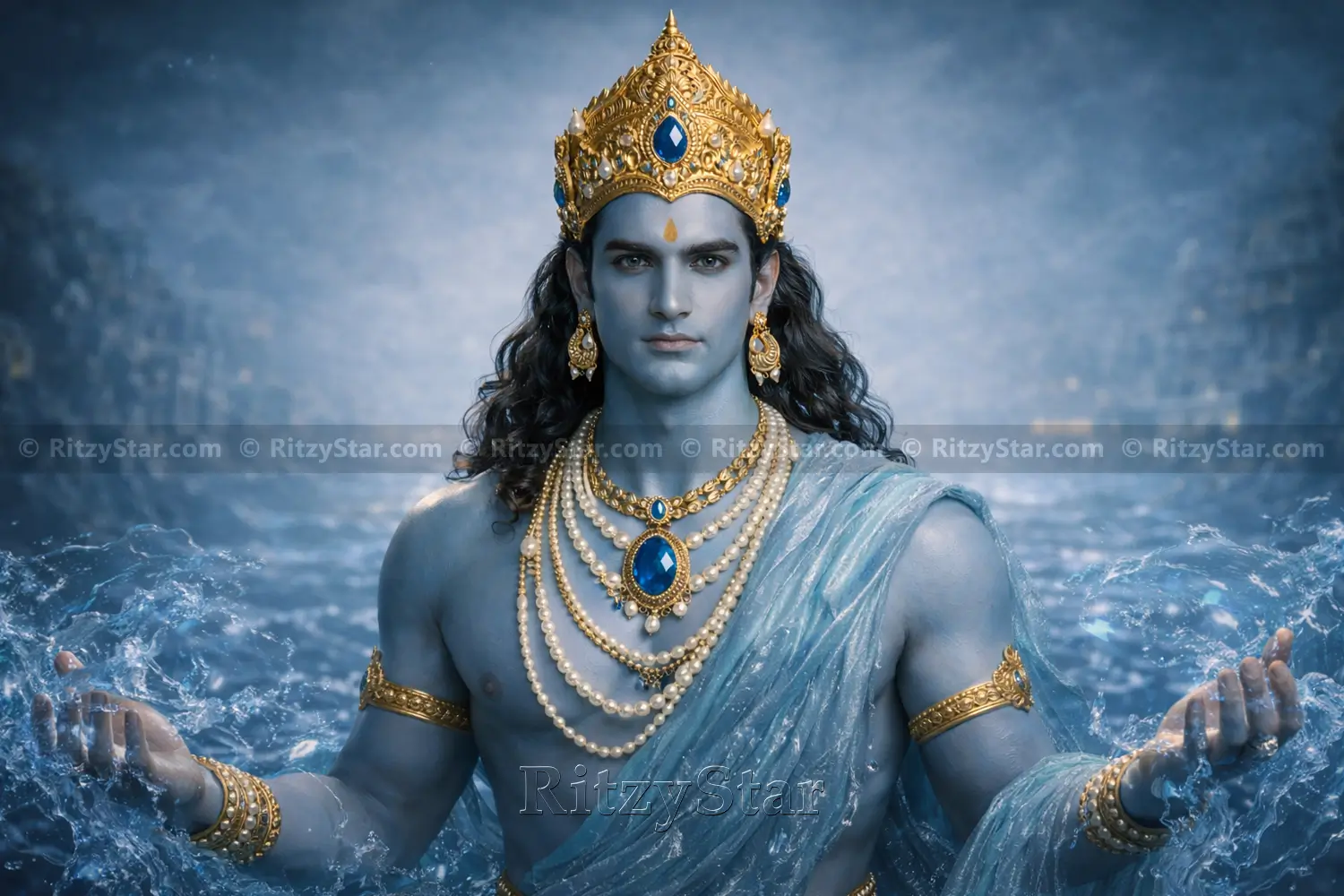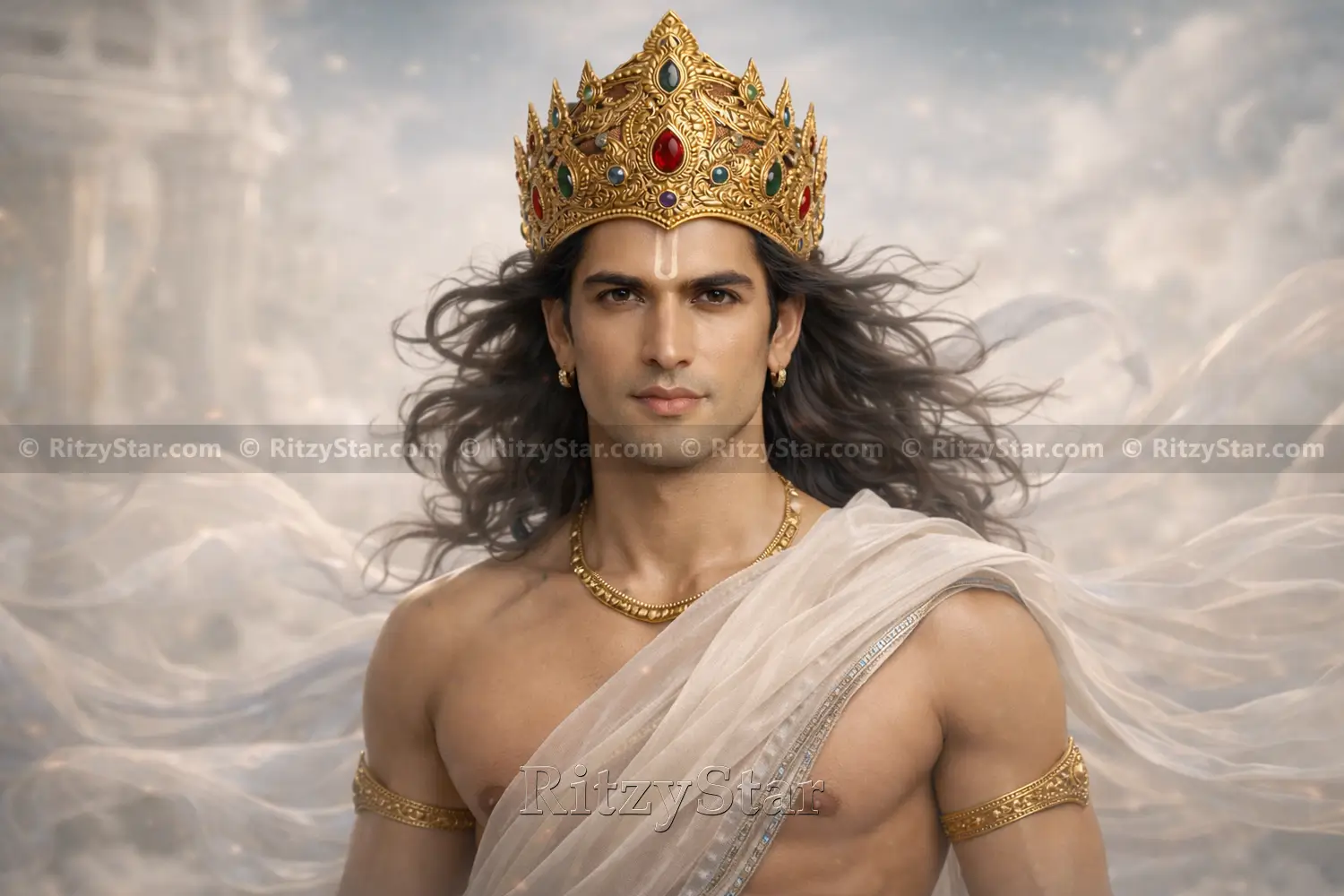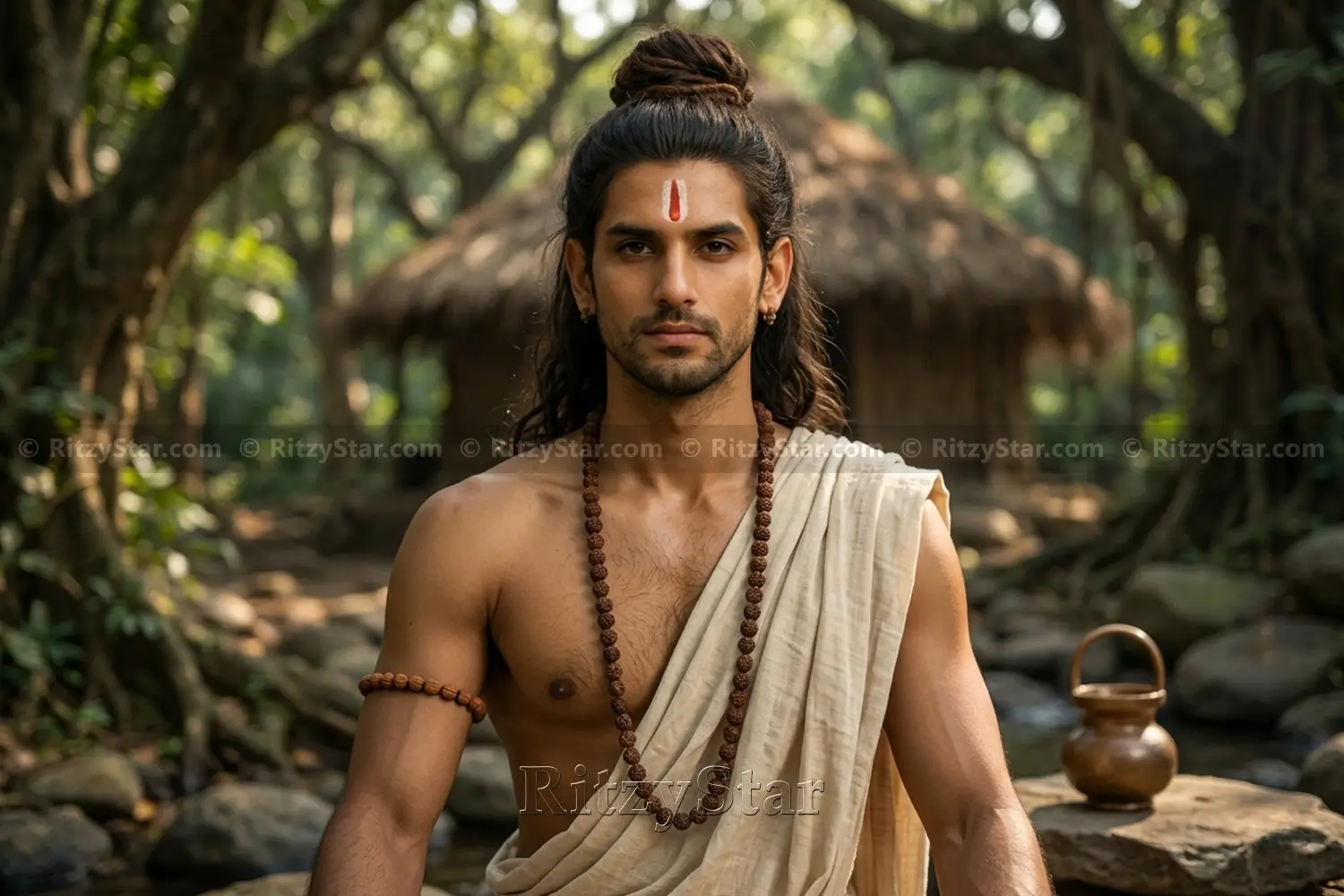
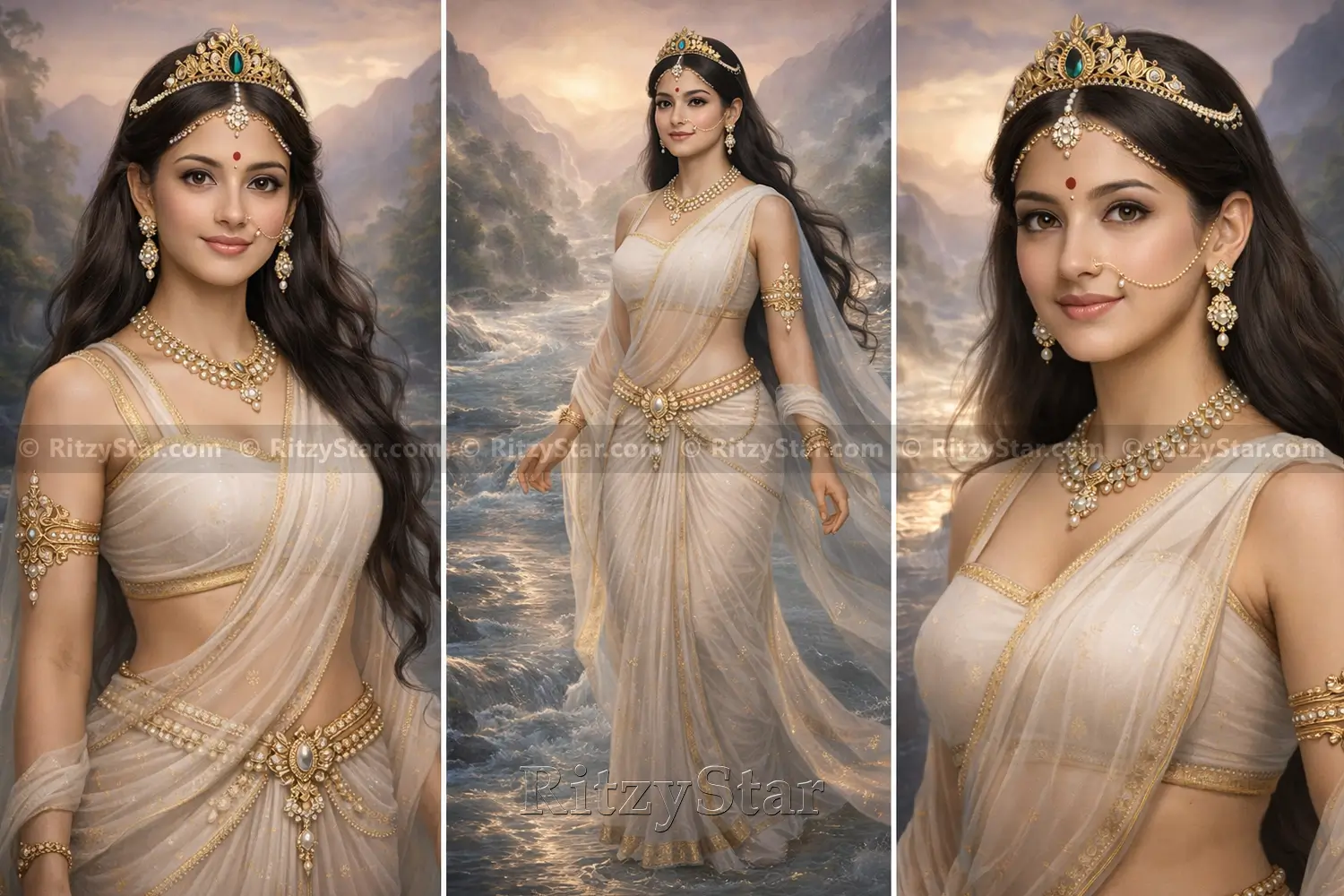
Mother of Bhishma, Bearer of Liberation, The Celestial River Who Flows Between Worlds
“गङ्गा सरित्सु प्रवरा देवानामपि देवता।
शिवेन मूर्ध्ना धृता या सा नः पुनातु पावनी॥”
— Ancient Verse
Meaning: Ganga, foremost among rivers, goddess even to the gods, who was borne upon Shiva’s head—may that purifier cleanse us.
🌊 Introduction: The Goddess Who Flows Through All Worlds
She begins in the heavens, a stream of light winding through the constellations. She descends through the realm of the gods, her waters carrying the blessings of Vishnu’s feet. She plummets toward earth with enough force to shatter the planet—until Shiva catches her in his matted hair, taming her arrogance, transforming her destructive power into life-giving flow. And then, astonishingly, this celestial goddess takes human form, marries a mortal king, and bears him eight sons—seven of whom she drowns with her own hands.
This is the story of Ganga.
Not merely a river, but a goddess. Not merely a mother, but a liberator. Not merely a wife, but a being whose actions defy mortal understanding. Ganga flows through Hindu mythology like her waters flow through the Indian subcontinent—majestic, life-giving, terrifying, and ultimately redemptive.
“त्रिपथगा त्रिलोकेषु पावनी पापनाशिनी।
गङ्गा देवनदी पुण्या नमस्तस्यै सदा नमः॥”
— by Author
Meaning: She who flows in three paths through the three worlds, the purifier, the destroyer of sins, the sacred celestial river Ganga—salutations to her, always salutations.
In the vast pantheon of Hindu goddesses, Ganga occupies a unique position. She is not distant like some celestial beings, nor abstract like philosophical concepts. She is tangible, touchable, present in the lives of millions who bathe in her waters, drink from her flow, and commit the ashes of their dead to her embrace. She is the goddess you can wade into, the divinity you can cup in your hands.
👑 Who Is Ganga? The Many Faces of the River Goddess
Ganga is first and foremost the personification of the Ganges River, the longest and most sacred river in the Indian subcontinent. But she is far more than a geographical feature personified. She is a goddess in her own right, with a complex mythology, multiple origin stories, and a personality that encompasses both celestial dignity and earthly passion.
“हिमवत्सुता गङ्गा पार्वती भगिनी शुभा।
विष्णुपादोद्भवा देवी शिवमूर्ध्नि व्यवस्थिता॥”
— by Author
Meaning: Daughter of Himalaya, sister of Parvati, born from Vishnu’s foot, established on Shiva’s head—the goddess Ganga.
Her Many Names
Like the river itself, which changes its name and character as it flows from mountain to plain to sea, the goddess Ganga is known by many names, each revealing a different aspect of her identity.
| Name | Meaning | Significance |
|---|---|---|
| Ganga | The Flowing One | Her primary name, from the Sanskrit root “gam” meaning “to go” or “to move” |
| Bhagirathi | Brought by Bhagiratha | Commemorates the sage whose austerities brought her to earth |
| Jahnavi | Daughter of Sage Jahnu | After the sage who drank her waters and released her from his ear |
| Mandakini | The Gentle-Flowing One | Her name in the heavens, where she flows as the Milky Way |
| Tripathaga | Three-Pathed One | She who flows in heaven, earth, and the netherworld |
| Vishnupadi | Born from Vishnu’s Foot | Acknowledges her origin from the god’s cosmic step |
| Shivapriya | Beloved of Shiva | Reflects her intimate connection with the destroyer god |
| Devadevi | Goddess of Gods | Honors her supreme status among celestial beings |
| Papanashini | Destroyer of Sins | Emphasizes her purifying power |
| Mokshadayini | Giver of Liberation | Her ultimate gift to those who surrender to her |
“नामान्यस्याः पृथक् पृथक् लोकेषु परिकीर्तिता।
प्रत्येकं तेषु नाम्नां हि गुणानन्त्यं प्रकाशितम्॥”
— by Author
Meaning: Her various names are celebrated across different worlds, each name revealing the infinity of her virtues.
✨ The Birth of Ganga – Three Origins, One Goddess
Unlike most Hindu deities whose origins are fixed in a single narrative, Ganga’s birth is described in multiple ways across different texts. These varying accounts do not contradict but rather complement each other, revealing different facets of her divine nature.
The First Origin: Daughter of the Himalayas
According to the Ramayana and several Puranas, Ganga is the eldest daughter of Himavan, the personification of the Himalayan mountains, and his wife Mainavati (also known as Menavati), the daughter of Mount Meru. Her younger sister is Parvati, who would grow up to marry Shiva.
“हिमवान् गिरिराजः स मेनायां तु सुतां शुभाम्।
गङ्गां नाम महाभागां जनयामास धार्मिकः॥”
— by Author
Meaning: The king of mountains, Himalaya, together with Mena, begot a blessed daughter named Ganga, the virtuous one.
In this telling, Ganga is born as a goddess, a celestial maiden, from the very heart of the mountains. She grows up in the palace of her father, surrounded by the peaks and glaciers that would later become the source of her earthly flow. When she attains youth, the gods take her to Svarga (heaven), where she transforms into a river and flows through the celestial realms.
This origin establishes Ganga’s connection to the earth—she is born of the mountains, sister to the goddess of fertility, rooted in the physical landscape of India even before her descent.
The Second Origin: Born from Vishnu’s Foot
The Bhagavata Purana presents a different, more cosmic origin. In this version, Ganga originates from the very body of Vishnu, the preserver god.
The story begins with Vishnu’s Vamana (dwarf) incarnation. The demon king Bali had gained control of the three worlds, and Vishnu approached him as a dwarf brahmin, begging for three steps of land. Bali, known for his generosity, agreed. Immediately, Vamana expanded to cosmic proportions. With his first step, he covered the earth. With his second, he covered the heavens. And with his third, he pushed Bali down to the netherworld.
“विष्णोः पदोदकं पुण्यं त्रैलोक्यस्य च पावनम्।
तदेव गङ्गा विख्याता त्रिपथा त्रिदिवे सदा॥”
— by Author
Meaning: The blessed water from Vishnu’s foot, purifier of the three worlds—that itself became renowned as Ganga, the three-pathed one, eternal in heaven.
As Vamana’s left foot rose to measure the highest regions, his big toe pierced the shell of the cosmic egg. Through this hole, the waters of the causal ocean—the primordial waters that exist outside the created universe—flowed into our cosmos. These waters first washed Vishnu’s lotus feet, acquiring a reddish-pink hue from the saffron on his toes, and then descended into the celestial realms.
Because she touched Vishnu’s feet before entering the universe, Ganga is known as Vishnupadi—”she who issues from Vishnu’s foot.” This origin gives her unparalleled purifying power, for she carries the very essence of the preserver god.
The Third Origin: Wife of Vishnu
The Devi Bhagavata Purana offers yet another origin, one that involves divine jealousy and cosmic curses. In this telling, Ganga was originally one of the three wives of Vishnu, together with Lakshmi (goddess of fortune) and Saraswati (goddess of wisdom).
“लक्ष्मीः सरस्वती गङ्गा विष्णोस्तिस्रः प्रियाः स्त्रियः।
तासां मध्ये कलिः प्रोक्तो गङ्गासरस्वतीस्त्रियोः॥”
— by Author
Meaning: Lakshmi, Saraswati, and Ganga were Vishnu’s three beloved wives. Between Ganga and Saraswati arose conflict.
The three goddesses lived together in Vaikuntha, Vishnu’s celestial abode. But harmony did not last. One day, Saraswati noticed Ganga casting playful glances at Vishnu. Jealousy consumed her, and she launched a furious verbal attack on Ganga, accusing her of trying to monopolize their husband’s affection.
Ganga appealed to Vishnu for help, but the god remained neutral, not wishing to take sides among his three equally beloved wives. Lakshmi attempted to calm Saraswati with gentle words, but this only redirected the jealous goddess’s anger toward her. Saraswati cursed Lakshmi to be born on earth as the Tulasi plant.
Enraged that Lakshmi had been cursed simply for defending her, Ganga cursed Saraswati in return: she would become a river on earth, flowing not with divine glory but with the weight of mortal sins. Saraswati responded with an identical curse: Ganga would also descend to earth, and there sinful humans would cleanse themselves in her waters—a blessing disguised as a curse.
“सरस्वती शापयुता गङ्गा शापयुता तथा।
लक्ष्मीश्च तुलसीरूपा धरण्यां समजायत॥”
— by Author
Meaning: Saraswati became cursed, Ganga also became cursed, and Lakshmi took the form of Tulasi—all three were born on earth.
To resolve the conflict, Vishnu declared that henceforth Lakshmi would be his only wife. He sent Saraswati to Brahma and Ganga to Shiva. Thus Ganga came to be associated with Shiva, setting the stage for the next chapter of her cosmic story.
🌌 The Descent of Ganga – When Heaven Came to Earth
The most famous episode in Ganga’s mythology is her descent from heaven to earth—an event that required the cooperation of gods, sages, and kings, and that transformed the Indian subcontinent forever.
The Curse of Kapila
The story begins with King Sagara, a powerful monarch of the Solar Dynasty. Sagara performed the Ashvamedha (horse sacrifice) to assert his sovereignty over the gods. Indra, king of heaven, grew jealous and stole the sacrificial horse, hiding it in the hermitage of the sage Kapila deep within the netherworld.
Sagara had 60,000 sons—fierce, proud, and impetuous. When the horse disappeared, he sent them to find it. The sons dug their way into the earth, tunneling down to the netherworld, where they finally discovered the horse calmly grazing near the meditating sage Kapila.
“षष्टिः पुत्रसहस्राणि सगरस्य महात्मनः।
कपिलं ददृशुः सर्वे हयं चैव समीपतः॥”
— by Author
Meaning: The sixty thousand sons of the great-souled Sagara saw Kapila and the horse nearby.
Assuming Kapila had stolen the horse, the sons rushed at him in fury, disrupting his meditation. The great sage opened his eyes—and with a single glance of his ascetic power, reduced all 60,000 princes to ashes.
The Quest for Liberation
Generations passed. Sagara’s grandson Amshuman and great-grandson Dilipa tried but failed to find a way to liberate the souls of the 60,000. Finally, Dilipa’s son Bhagiratha took up the mission with extraordinary determination.
“भगीरथो महातेजा गङ्गानयनतत्परः।
घोरं तपश्चकारोग्रं वर्षाणामयुतं नृप॥”
— by Author
Meaning: Bhagiratha of great splendor, intent on bringing Ganga, performed fierce austerities for ten thousand years.
Bhagiratha’s penance was unimaginable. He stood on one leg, arms raised, gazing at the sun, enduring heat, cold, rain, and wind. He lived on air alone, his body withering to skin and bone. For a thousand years he prayed to Brahma, begging the creator to allow Ganga to descend to earth so that her waters might purify his ancestors’ ashes.
Brahma, pleased with Bhagiratha’s devotion, appeared before him. But he revealed a problem: Ganga’s descent would be catastrophic.
The Problem of Ganga’s Pride
Ganga herself was not merely a passive river but a goddess with her own personality—and her own pride. When she learned of Bhagiratha’s request, she agreed to descend, but with arrogance. She intended to crash onto the earth with full force, demonstrating her power.
“गङ्गा च गर्विता देवी गर्वेण महता युता।
भगीरथेन नीतेति पातुं भूमिमचिन्तयत्॥”
— by Author
Meaning: Ganga, the goddess, filled with great pride, thought: “Bhagiratha is bringing me,” and planned to shatter the earth in her descent.
Brahma explained to Bhagiratha: if Ganga fell directly to earth with the full force of her celestial flow, the impact would shatter the planet. The earth could not bear her weight. Someone had to break her fall.
Shiva’s Intervention
Bhagiratha, undeterred, turned his prayers to Shiva, the great ascetic god who dwelt on Mount Kailasa. For another year he performed austerities, until Shiva finally appeared and agreed to help.
“शिवः प्रीतमना राजन् भगीरथमुवाच ह।
गङ्गां धारयिता मूर्ध्ना पतन्तीं वै स्वयं प्रभुः॥”
— by Author
Meaning: Shiva, pleased in his mind, spoke to King Bhagiratha: “I myself will bear Ganga on my head as she falls.”
When the moment came, Ganga descended from heaven with terrible force, confident in her power to overwhelm the world. But as she crashed down, she found herself caught not in a passive receptacle but in the matted locks of Shiva’s hair—a labyrinth of cosmic proportions.
“गङ्गा गर्वेण महता पपात शिरसि प्रभोः।
सा शिवस्य जटाजूटे लीनाभूद्विवशा तदा॥”
— by Author
Meaning: Ganga, with great pride, fell upon the lord’s head. She became lost, helpless, in the tangled mass of Shiva’s hair.
The goddess, so proud of her power, found herself utterly lost. She wandered through the infinite maze of Shiva’s locks for thousands of years, unable to find her way out. Her arrogance was humbled. Only when Shiva finally released her—a gentle trickle from his hair—did she emerge onto the earth, her pride tempered, her power transformed from destructive to life-giving.
Ganga Follows Bhagiratha
Emerging from Shiva’s locks, Ganga flowed onto the Himalayas and then followed Bhagiratha across northern India. She had agreed to be led by him, and she kept her word—but not without one more incident.
As Ganga followed Bhagiratha, her waters flooded the hermitage of the sage Jahnu, extinguishing his sacred fire. The sage, enraged, drank up every drop of the river, swallowing her entirely.
“जह्नुना पीयमाना सा गङ्गा चक्रे महामुनिम्।
भगीरथेन प्रार्थितः सोऽसृजच्छ्रवणान्मुनिः॥”
— by Author
Meaning: As Ganga was being drunk by Jahnu, the great sage was persuaded by Bhagiratha, and released her from his ear.
Bhagiratha once again had to plead—this time to Sage Jahnu, explaining his mission to liberate his ancestors. The sage, moved by Bhagiratha’s devotion, released Ganga from his ear. Because of this, Ganga is also known as Jahnavi—”daughter of Jahnu.”
Finally, Ganga reached the sea, flowed into the netherworld, and washed over the ashes of Sagara’s 60,000 sons. Their souls were purified at last and ascended to heaven.
“भगीरथप्रयत्नेन गङ्गा संप्राप्ता महीतले।
तस्य नाम्नापि विख्याता भागीरथीति सा स्मृता॥”
— by Author
Meaning: By Bhagiratha’s efforts, Ganga arrived on earth. After his name she is renowned as Bhagirathi.
💧 Ganga’s Sanctifying Power – The Goddess Who Purifies
Why did Bhagiratha need Ganga specifically to purify his ancestors? What makes her waters so special that a single touch can liberate souls from the most terrible of curses?
The Power of Vishnu’s Touch
Ganga’s purifying power derives from her origin. Whether as Vishnupadi (born from Vishnu’s foot) or as Bhagavadpadi (touched by the lord’s feet), she carries within her the very essence of the preserver god. In Hindu theology, the feet of a deity are considered the most sacred part of their form—they are what connects the divine to the earthly, what walks among mortals while the head remains in heaven. Water that has washed the feet of Vishnu is therefore supremely holy.
“विष्णुपादाब्जसम्भूता गङ्गा त्रिपथगामिनी।
स्पर्शाद्दर्शनतो ध्यानान्नराणां पापनाशिनी॥”
— by Author
Meaning: Ganga, born from Vishnu’s lotus feet, flowing in three paths, destroys the sins of men by touch, by sight, by meditation.
Purification Across Existences
The power of Ganga extends beyond a single lifetime. The Vishnu Purana declares that even those who live far from the river but call out her name are relieved of sins committed during their three previous existences. The Brahmandapurana states that bathing just once in Ganga purifies not only the bather but protects their entire tribe from hundreds of thousands of dangers.
“गङ्गां स्मरति यो नित्यं गङ्गां पश्यति यः प्रिये।
गङ्गां स्नाति च यो भक्त्या तस्य मोक्षः करे स्थितः॥”
— by Author
Meaning: One who remembers Ganga daily, one who beholds Ganga, one who bathes in Ganga with devotion—liberation rests in that person’s hand.
The Final Journey
Perhaps most importantly, Ganga is the goddess of final liberation. Hindus believe that immersing the ashes of their loved ones in the Ganges brings the soul closer to moksha—liberation from the cycle of birth and death. Even those who cannot afford a proper funeral pyre simply push the shrouded body into the river, trusting in Ganga’s power to purify and release.
“गङ्गायां यस्य देहस्य भस्मीभूतस्य निक्षिपेत्।
तस्य प्राणाः प्रयान्ति ध्रुवं ब्रह्मलोकं न संशयः॥”
— by Author
Meaning: One whose bodily ashes are cast into Ganga—that being’s soul certainly goes to the world of Brahma, without doubt.
In this aspect, Ganga becomes the ultimate mother—the one who receives her children at the end of life as she received them at birth, who cleanses not just the body but the soul, who guides the departed across the final threshold.
💕 Ganga as Wife and Mother – The Marriage to Shantanu
The Mahabharata presents a very different side of Ganga—not as cosmic river or celestial goddess, but as a woman who marries a mortal king and bears him children. This story intertwines with the curse of the Vasus and explains the birth of one of the epic’s greatest characters: Bhishma.
The Curse of the Vasus
The eight Vasus are celestial beings attendant upon Indra, deities of material elements and natural phenomena. One day, the Vasus and their wives were wandering through the forest when they came upon the hermitage of the sage Vashishtha.
There, they saw Nandini—the sage’s wish-fulfilling cow, whose milk could grant immortality and prosperity. The wife of one Vasu, Prabhasa (also called Dyaus in some versions), begged her husband to steal the cow for her earthly friend. Unable to refuse his beloved, Prabhasa convinced his seven brothers to help him.
They took the cow. But Vashishtha, through his spiritual power, immediately perceived the theft. He cursed the Vasus to be born on earth as mortals.
“वसवोऽष्टौ महात्मानः शप्ता वशिष्ठतेजसा।
मानुष्यं प्राप्नुवन्त्वेते इति क्रोधसमन्वितः॥”
— by Author
Meaning: The eight great-souled Vasus, cursed by Vashishtha’s power, shall attain humanity—thus he spoke, filled with rage.
The Vasus, terrified, begged for mercy. Vashishtha relented slightly: seven of them would be freed from the curse quickly, returning to heaven soon after birth. But Prabhasa, the instigator, would live a long life on earth, childless and bound by terrible vows.
Ganga Accepts the Mission
The Vasus approached Ganga, the river goddess, and begged for her help. They asked her to become their human mother—to take birth as a mortal woman, marry a king, and bear them as her sons. Ganga agreed, on one condition: she would kill each child at birth, releasing the seven Vasus immediately from their mortal bondage.
“गङ्गा तु वसुभिः प्रोक्ता मानुष्ये धारयस्व नः।
गङ्गा तथेति तानुक्त्वा मानुषं देहमास्थिता॥”
— by Author
Meaning: The Vasus said to Ganga, “Bear us in the mortal world.” Ganga, saying “So be it,” assumed a human body.
The Meeting with Shantanu
King Shantanu of the Kuru dynasty was hunting along the banks of the Ganges when he saw a woman of breathtaking beauty. She was Ganga in human form. He was instantly captivated.
“शान्तनुः प्रेक्ष्य तां देवीं गङ्गां मानुषरूपिणीम्।
विस्मितोऽभून्नरश्रेष्ठः कामबाणप्रपीडितः॥”
— by Author
Meaning: Shantanu, seeing that goddess Ganga in human form, was amazed, O best of men, and pierced by the arrows of desire.
Shantanu approached her and begged her to become his wife. Ganga agreed, but on four strange conditions:
- He could never question anything she did
- He could never speak harshly to her
- He could never obstruct her in any action
- If he ever broke these conditions, she would leave him forever
Shantanu, madly in love, agreed to everything.
The Drowning of Seven Sons
They married, and Ganga came to live in Shantanu’s palace. Their life together was happy—except for one thing. Each time Ganga gave birth to a son, she took the infant to the river and drowned him.
“प्रथमं तु सुतं जात्वा गङ्गा तोये प्रवेशयत्।
शान्तनुः पश्यति स्मैतन्न किंचिदप्यभाषत॥”
— by Author
Meaning: The first son born, Ganga immersed in water. Shantanu watched this but said nothing.
Shantanu was horrified but remembered his vow. He remained silent. The same thing happened with the second son, and the third, and the fourth, fifth, sixth, and seventh. Seven times he watched his wife drown their children. Seven times he bit his tongue and said nothing, bound by his promise.
But when the eighth son was born, Shantanu could bear it no longer.
“अष्टमे तु सुते जाते शान्तनुः करुणातुरः।
गङ्गां प्रति मुनिश्रेष्ठ मा गमः प्रतिषेधयत्॥”
— by Author
Meaning: When the eighth son was born, Shantanu, overwhelmed with compassion, forbade Ganga, saying “Do not do this.”
The Revelation
Ganga stopped. She looked at her husband with sorrowful eyes. Then she revealed the truth.
“गङ्गा तु शान्तनुं प्राह पुत्रस्नेहेन मोहितम्।
वसवोऽष्टौ महात्मानस्त्वया जाता नराधिप॥”
— by Author
Meaning: Ganga then said to Shantanu, deluded by affection for his son: “These are the eight great-souled Vasus born through you, O king.”
She explained the curse of Vashishtha, the Vasus’ plea, and her mission. The seven sons she had drowned were now freed from their curse and returned to heaven. But this eighth son—Prabhasa himself—was destined to live a long life on earth.
“अयं त्वष्टमको राजन् चिरं जीवितुमिच्छति।
मानुषे चैव लोकेऽस्मिन् यशसा च प्रकाशितः॥”
— by Author
Meaning: “But this eighth one, O king, desires to live long in this mortal world, shining with fame.”
The Name “Bhishma”
Ganga named the child Devavrata—”devoted to the gods.” She promised to raise him, train him, and return him to Shantanu when the time was right. Then she disappeared into the river with the infant, leaving Shantanu alone and grieving.
“गङ्गा पुत्रं समादाय जगामाथ यथागतम्।
शान्तनुः शोकसंतप्तो राज्ये स्थित्वा तथाकरोत्॥”
— by Author
Meaning: Ganga, taking her son, departed as she had come. Shantanu, tormented by grief, remained in his kingdom and performed his duties.
Years later, Shantanu was walking along the Ganges when he saw a young boy of extraordinary beauty and strength, damming the river with arrows. Ganga appeared and revealed that this was Devavrata, now fully grown and trained in all the arts of warfare and statecraft. She returned him to his father.
Devavrata would later take a terrible vow of lifelong celibacy to secure his father’s marriage to Satyavati—earning him the name Bhishma, “the terrible.” He became one of the greatest heroes of the Mahabharata, central to the epic’s tragedy, and remained true to his vow until his death on a bed of arrows.
👨👩👦 The Family of Ganga
| Sl.No | Name | Relationship | Children | Remarks |
|---|---|---|---|---|
| 1 | Shantanu (King of the Kuru Dynasty) | Husband (temporary human marriage) | 1. Eight Vasus (seven unnamed + Devavrata/Bhishma) – Seven sons were drowned at birth to release them from Sage Vashishtha’s curse, allowing them to return to heaven. | The marriage was conditional: Shantanu could never question Ganga’s actions. She drowned seven sons before Shantanu’s protest stopped her with the eighth. After revealing the truth, she returned to her divine form, taking the eighth son with her to raise him. |
| 2 | Shiva (The Destroyer God) | Divine Consort (in some traditions) | 1. Kartikeya (Skanda) – In some versions of the Skanda Purana, Ganga is considered one of the mothers of Kartikeya, though Parvati is his primary mother. | After Ganga was sent to Shiva following the conflict with Saraswati, she became intimately associated with him. In art, she is often depicted flowing from his matted hair, symbolizing their eternal connection. |
| 3 | Vishnu (The Preserver God) | Former Husband (in Devi Bhagavata tradition) | No children from this union | In the Devi Bhagavata Purana, Ganga was originally one of Vishnu’s three wives, along with Lakshmi and Saraswati. Conflict among them led to all three being cursed and separated from Vishnu. |
| 4 | Sage Jahnu | Foster Father (through incident) | No children | When Ganga flooded Sage Jahnu’s hermitage, he drank her entirely. At Bhagiratha’s plea, he released her from his ear, making her his “daughter” Jahnavi. |
Notes on Ganga’s Family:
- Dual Consorts – Ganga’s relationships reflect her dual nature. With Shiva, she is the cosmic river flowing through eternity. With Shantanu, she is the earthly mother, the mortal wife who nonetheless acts according to divine purpose.
- The Eight Vasus – The eight Vasus are:
- Prabhasa (Dyaus) – The instigator of the cow theft; became Bhishma
- Dhruva – The Pole Star
- Soma – The Moon
- Dhara – The Earth
- Anila – The Wind
- Anala – The Fire
- Pratyusha – The Dawn
- Prabhasa – The Light (this is the eighth, but in some lists, names vary)
- Kartikeya Connection – In some regional traditions, Ganga is considered one of the mothers of Kartikeya (Murugan), the god of war, though this is not universally accepted.
- No Other Children – Unlike some goddesses with many offspring, Ganga’s only undisputed children are the eight Vasus through Shantanu.
- The Seventh and Eighth – Tradition often specifies that seven Vasus were freed immediately, while the eighth (Bhishma) lived a long life on earth—childless, as he took a vow of celibacy.
🎨 Iconography – How Ganga Is Depicted
Ganga’s iconography reflects her dual nature as both celestial goddess and earthly river.
The Goddess Form
In sculpture and painting, Ganga is typically depicted as a beautiful woman, fair-complexioned, wearing a white crown and white garments—symbolizing the purity of her waters. She is often shown with four arms, holding:
- A kalasha (water pot) overflowing with holy water
- A lotus flower, symbolizing purity and creation
- A rosary (akshamala), representing her connection to time and cycles
- One hand in varada mudra (boon-giving gesture) or abhaya mudra (protection gesture)
“चतुर्भुजा श्वेतवर्णा मकरस्था वरप्रदा।
गङ्गा देवी सदा पायात्कलशाब्जधरा शुभा॥”
— by Author
Meaning: May Ganga Devi, four-armed, white-complexioned, seated on a makara, boon-giver, holding kalasha and lotus, ever protect us.
The Mount: Makara
Ganga’s vahana (divine mount) is the makara—a mythical creature typically depicted with the head of a crocodile and the tail of a dolphin. The makara represents the life-giving and sometimes dangerous nature of water. It is also the symbol of the zodiac sign Capricorn, connecting Ganga to cosmic cycles.
In Temple Architecture
Ganga frequently appears at temple entrances, particularly in North Indian temples, paired with her sister river goddess Yamuna. Ganga stands on her makara at one side of the doorway, while Yamuna stands on her tortoise at the other. Their presence purifies all who enter, symbolically bathing devotees before they approach the deity.
The Descent in Art
One of the most famous representations of Ganga is the massive relief at Mamallapuram (Mahabalipuram) near Chennai, dating to the 7th century CE. Known as “Arjuna’s Penance” or “Bhagiratha’s Penance,” the 24-meter by 6-meter granite panel shows Ganga descending from the heavens surrounded by gods, humans, and animals. A natural cistern above the relief could be filled so that water actually trickled down during festivals—making the descent of Ganga a living, flowing reality.
Gangadhara and Gangavisarjana
Shiva as Gangadhara (“bearer of Ganga”) is a common iconographic form, showing Shiva with Ganga flowing from his matted hair. In these images, Shiva stands with one leg straight, one slightly bent. One of his right hands holds up a lock of hair from which Ganga emerges, often shown as a small figure or simply as flowing water. His left arm holds an antelope. Sometimes he is shown embracing Parvati, consoling her that his affection for Ganga will not diminish his love for her.
The form called Gangavisarjanamurti shows the moment Shiva releases Ganga from his hair to flow onto the earth—the cosmic river becoming earthly, the divine becoming accessible.
🌏 Ganga Beyond Hinduism – The Universal Mother
While Ganga is primarily a Hindu goddess, her influence extends beyond the boundaries of any single religion.
In Buddhism
In Tibetan Buddhism, Ganga is recognized as a goddess associated with purification. The concept of purifying water appears throughout Buddhist ritual, and sacred rivers hold significant meaning in Buddhist cosmology.
In Southeast Asia
Throughout Southeast Asia, Hindu and Buddhist cultures have incorporated Ganga into local water rituals. In Bali, the Ganges is considered the source of all holy water used in temple ceremonies. In Cambodia, ancient inscriptions at Angkor Wat reference the descent of Ganga.
As a Universal Symbol
Beyond specific religious contexts, Ganga has become a universal symbol of:
- Purity – The cleansing power of water
- Motherhood – The nourishing, life-giving aspect of nature
- Liberation – The possibility of release from suffering
- Continuity – The eternal flow of time and life
- Compassion – The divine willingness to descend to earth for the sake of mortals
🌅 The Deeper Meaning – What Ganga Represents
Like all great myths, the story of Ganga operates on multiple levels. It is at once a cosmological narrative, a moral lesson, and a spiritual allegory.
The Descent as Spiritual Journey
Ganga’s descent from heaven to earth mirrors the soul’s journey from pure consciousness to embodied existence. Just as Ganga required Shiva’s mediation to survive the fall, the soul requires divine grace to navigate the challenges of earthly life. Just as Ganga purified the ashes of the dead, the divine consciousness ultimately liberates the soul from the cycle of birth and death.
“गङ्गावतरणं यद्वत् ब्रह्मणः सगुणागमः।
तद्वदेव मनुष्याणां देहे चैतन्यसंग्रहः॥”
— by Author
Meaning: As Ganga’s descent represents the coming of the Divine with attributes, so too does the gathering of consciousness in the human body.
The Drowning as Liberation
Ganga’s drowning of her seven sons seems horrific from a human perspective. But from a divine perspective, it was an act of liberation. The seven Vasus were suffering under a curse; Ganga freed them instantly, returning them to their celestial home.
This teaches a profound lesson: what appears as death from the earthly perspective may be liberation from the divine perspective. The soul does not die; it merely transitions. Ganga, as the mother who both gives life and facilitates this transition, embodies the full cycle of existence.
“गङ्गाम्भसि निमग्नानां सप्तानां मुक्तिरीदृशी।
मृत्युर्येषां स मोक्षोऽभूद् धन्यास्ते वसवः पुरा॥”
— by Author
Meaning: Such was the liberation of the seven immersed in Ganga’s waters. Death became liberation for them—blessed were those Vasus of old.
The Power of Devotion
Bhagiratha’s story illustrates the power of devotion (bhakti). Through his unwavering determination, he accomplished what seemed impossible: bringing heaven to earth. His penance moved Brahma, moved Shiva, and humbled even the proud Ganga. Bhagiratha’s devotion became the channel through which cosmic grace flowed into the world.
“भगीरथ इवात्युग्रं तपः कृत्वा सुदुश्चरम्।
गङ्गां संप्राप्य यद्वत्स्यात् सिद्धिर्भक्त्या तथैव च॥”
— by Author
Meaning: As Bhagiratha, performing extremely fierce and difficult penance, attained Ganga—so too is success attained through devotion.
The Humbling of Pride
Ganga’s pride was humbled in Shiva’s hair. The goddess who thought she could overwhelm the earth found herself utterly lost in the labyrinth of the god’s matted locks. This teaches that true power comes not from domination but from service. When Ganga emerged from Shiva’s hair, she flowed gently, bringing life instead of destruction.
🕉️ Ganga in Daily Worship
For millions of Hindus, Ganga is not a distant mythological figure but a living presence encountered daily.
The Morning Ritual
Devout Hindus begin their day by remembering Ganga. Many keep a small pot of Ganges water in their homes, using it for purification before worship. The mere utterance of her name—”Ganga, Ganga, Ganga”—is considered enough to invoke her purifying presence.
The Evening Aarti
Every evening along the Ganges, particularly in Varanasi and Haridwar, priests perform the Ganga Aarti—a ritual of offering fire to the goddess. Lamps are waved, conches are blown, bells are rung, and hymns are sung. Thousands gather on the ghats to participate, their faces illuminated by the flickering flames, their voices rising in devotion.
“गङ्गे च यमुने चैव गोदावरि सरस्वति।
नर्मदे सिन्धु कावेरि जलेऽस्मिन् सन्निधिं कुरु॥”
— by Author
Meaning: O Ganga, O Yamuna, O Godavari, O Saraswati, O Narmada, O Sindhu, O Kaveri—make your presence in this water.
The Pilgrimage
For many Hindus, a pilgrimage to the Ganges is a lifelong dream. Bathing in her waters, especially on auspicious days, is believed to wash away sins and bring one closer to liberation. The elderly often move to Varanasi or Haridwar in their final years, spending their last days in the presence of the goddess who will receive them at death.
The Final Offering
Perhaps the most intimate relationship with Ganga occurs at death. When a Hindu dies, the body is cremated, and the ashes are consigned to the Ganges. The family members who perform this ritual entrust their loved one to the goddess’s care, confident that she will guide the soul across the final threshold.
📚 Major Festivals of Ganga
Ganga Dussehra
Celebrated in May-June (the tenth day of the bright fortnight of Jyaistha), Ganga Dussehra commemorates the day Ganga descended to earth. Pilgrims flock to the riverbanks, bathe in the sacred waters, and offer prayers. Taking a dip in the Ganges on this day is believed to cleanse ten sins—or to free ten generations from suffering.
Ganga Jayanti
Celebrated in September-October (the seventh day of the bright fortnight of Ashvin), Ganga Jayanti marks the goddess’s birth. Devotees fast, perform rituals, and offer lamps floated on the river. In Varanasi, thousands of tiny lamps float on the Ganges, their flickering lights transforming the river into a stream of stars—a reflection of her celestial origin.
Kumbh Mela
The largest gathering of humanity on earth, the Kumbh Mela rotates among four cities—Prayagraj, Haridwar, Ujjain, and Nashik—but the most sacred bathing occurs at the confluence of the Ganges and Yamuna at Prayagraj. Millions of pilgrims gather, believing that bathing during this auspicious period brings liberation.
Makar Sankranti
In January, when the sun enters Capricorn (Makara), Ganga is honored with special rituals. In Bengal, the occasion is celebrated as Ganga Sagar Mela at the mouth of the Ganges, where the river meets the sea.
🌊 Conclusion – The Eternal Flow
The story of Ganga is the story of India itself. From the glacial heights of the Himalayas to the vast delta of Bengal, her waters have shaped the land, nourished civilizations, and carried the prayers of countless generations.
“गङ्गा सागरगामिन्याः पुलिनेषु समुत्सुकः।
वसन् ग्रामेऽपि यो मर्त्यः स याति परमां गतिम्॥”
— by Author
Meaning: One who, even living in a village, longs for the banks of Ganga as she flows to the sea—that mortal attains the supreme state.
As a goddess, Ganga embodies the paradox of the divine: she is both immanent and transcendent, both accessible and mysterious. You can wade into her, feel her coolness on your skin, cup her water in your hands—and yet she flows from a source beyond the cosmos, carrying blessings from Vishnu’s feet, tamed by Shiva’s grace.
“आदौ ब्रह्माण्डजननी मध्ये शिवजटाश्रया।
अन्ते च सागरगामिन्यै गङ्गायै नमो नमः॥”
— by Author
Meaning: To Ganga—first the mother of the cosmos, then dwelling in Shiva’s hair, finally flowing to the sea—salutations, salutations.
As a mother, Ganga is both terrifying and loving. She drowns her children—but to free them from bondage. She leaves her husband—but to fulfill a divine purpose. She raises a son only to return him to a world of duty and suffering—but that son becomes the greatest hero of his age, the pillar of his dynasty, the embodiment of vow and sacrifice.
“गङ्गा स्नानेन यत्पुण्यं यज्ञैर्दानैस्तपोव्रतैः।
तत्फलं समवाप्नोति नरो नास्त्यत्र संशयः॥”
— by Author
Meaning: The merit obtained by bathing in Ganga—whatever is obtained through sacrifices, gifts, austerities, and vows—a person attains that fruit. Of this there is no doubt.
In the end, Ganga remains what she has always been: the river of heaven and earth, the flow of time and eternity, the mother who gives life and the goddess who grants liberation. She is Tripathaga—she who flows in three paths—and all paths lead eventually to her.
Discover more from RitzyStar
Subscribe to get the latest posts sent to your email.