God of Oceans, Guardian of Cosmic Order, The Omniscient Sovereign
“यो अस्याध्यक्षः परमे व्योमन् सहस्रधामा विदथस्य राजा।
वरुणो दाधार सुवर्यतः सः स वै पश्यन्नभि पश्यति सर्वम्॥”
— Rigveda 8.41.2
Meaning: He who is the overseer of this supreme heaven, the thousand-rayed king of all existence, Varuna upholds the celestial realm. He sees all, looking upon everything that is.
🌊 Introduction: The All-Seeing God of Infinite Waters
Long before Shiva danced the cosmos into destruction, before Vishnu dreamed the universe into being, before Indra wielded his thunderbolt against the serpent of chaos—there was Varuna.
He is the most ancient of gods, the sovereign who ruled when the world was young and the laws of existence were still being written. He is the binder, the one who ties the universe together with invisible cords of cosmic law. He is the watcher, whose eyes see every deed, every thought, every hidden sin. He is the forgiver, who holds out hope to those who repent. And he is the lord of the infinite waters—the oceans that encircle the earth, the rivers that give life, the rains that nourish creation.
“वरुणः सर्वभूतानां प्रत्यक्षः साक्षिवत् स्थितः।
ऋतस्य गोप्ता धर्मात्मा नित्यं पश्यति चेष्टितम्॥”
— by Author
Meaning: Varuna stands before all beings as a direct witness. The protector of cosmic order, the righteous one, he perpetually observes all actions.
From the highest heavens to the deepest oceans, from the moral law that binds society to the noose that punishes the wicked, Varuna’s dominion is vast beyond comprehension. He is the god who was there at the beginning, who saw the first light pierce the primordial darkness, who held the sky and earth apart so that life could flourish.
This is the story of Varuna—the cosmic binder, the omniscient sovereign, the ancient god whose waters still flow through every river, every ocean, every drop of rain that falls upon the earth.
📜 Who Is Varuna? The Primordial Sovereign of the Cosmos
In the vast pantheon of Hindu deities, Varuna occupies a unique and ancient position. He is one of the oldest gods mentioned in the Rigveda—the oldest sacred text of Hinduism—dating back to nearly 1500 BCE. He is an Aditya, a son of the goddess Aditi (the infinite mother), and a brother to other celestial sovereigns like Mitra, Aryaman, and Bhaga.
But Varuna is not merely another god in the celestial hierarchy. In the earliest Vedic hymns, he is described as the supreme sovereign—the king of all gods, the ruler of the entire cosmos. His power extended over heaven, earth, and the realms between. He was the upholder of Rita (cosmic order), the force that kept the stars in their courses, the seasons in their cycles, and the laws of morality intact.
“राजा वरुणः सर्वेषां देवानामधिपः प्रभुः।
द्यावापृथिव्योर्धर्ता स भुवनानामधीश्वरः॥”
— by Author
Meaning: King Varuna is the lord of all gods, the master of all. He upholds heaven and earth and is the sovereign of all worlds.
The King of the Asuras
One of the most fascinating aspects of Varuna’s identity is his classification as an Asura in the Rigveda. In the earliest Vedic understanding, the term Asura did not mean “demon” as it later came to signify. Rather, it meant “lord” or “possessor of spiritual power”—a title of immense respect.
Varuna, along with his twin Mitra, was invoked as both Asura and Deva. He was the king of the Asuras, the wise and powerful sovereign who ruled with absolute authority over the cosmos. It was only later, as the Puranic tradition evolved and the Devas became associated with goodness and Asuras with evil, that Varuna’s status shifted. He was “adopted” into the Deva fold, his Asura nature largely forgotten.
“मित्रावरुणौ भगवानासुरत्वेन विश्रितौ।
राजानौ सर्वदेवानां सत्यधर्मप्रवर्तकौ॥”
— by Author
Meaning: The divine Mitra and Varuna are renowned for their Asura-nature. They are the kings of all gods and the enforcers of truth and righteousness.
The Guardian of the Western Direction
As the Vedic period gave way to the Puranic age, Varuna’s role transformed. He was no longer the supreme sovereign—that position had been taken by the Trimurti (Brahma, Vishnu, Shiva). Instead, Varuna became one of the Dikpalas (guardians of the directions), specifically the guardian of the western quarter.
Yet this demotion from supreme god to directional guardian did not diminish his majesty. As the lord of the west, he commands the vast oceans that lie beyond the horizon. His gaze still sees all, his noose still binds the wicked, and his waters still purify the faithful.
🔱 The Symbolism of Varuna – The Binder, The Watcher, The Purifier
Varuna’s name itself reveals his essential nature. Derived from the Sanskrit root “vṛ” (to cover, to surround, to bind), Varuna is “the one who covers or binds”.
The Cosmic Binder
What does Varuna bind? Everything. He binds the sky to the earth, the stars to their courses, the seasons to their cycles. He binds the moral law into the fabric of existence. He binds the wicked with his divine noose. He binds the universe together in a web of cosmic order that he alone maintains.
“वरुणो वृणुते विश्वं बन्धनैः सत्यधर्मभिः।
ऋतस्य रश्मिभिः बद्धा सर्वे लोका अवस्थिताः॥”
— by Author
Meaning: Varuna binds the entire universe with the bonds of truth and righteousness. All worlds remain established, bound by the cords of cosmic order.
This binding nature has led scholars to draw connections between Varuna and the Greek god Ouranos (Uranus). Both names derive from the same Proto-Indo-European root meaning “to bind” or “to cover.” Both were sovereign sky-gods who bound the wicked and maintained cosmic order. Both were eventually supplanted by younger, more dynamic gods (Indra in the Vedic tradition, Zeus in the Greek).
The Omniscient Watcher
Varuna sees everything. This is perhaps the most persistent theme in his worship throughout the Vedas. He has a thousand eyes (or, in some descriptions, the sun is his eye). Nothing escapes his gaze—not the secret sin committed in darkness, not the hidden thought that never becomes action.
“यत्किं चेदं वरुण दैव्ये जनेऽभिद्रोहं मनुष्या चरामसि।
अचित्ती यत्तव धर्मा युयोपिम मा नस्तस्मादेनसो देव रीरिषः॥”
— Rigveda 7.86.3
Meaning: Whatever offense we humans have committed against the divine hosts, whatever law of yours we have broken through ignorance—O god, do not harm us for that sin.
The Rigveda is filled with such confessions—acknowledgments that Varuna sees all, followed by pleas for forgiveness. This intimate, personal relationship between devotee and deity is unique in early Vedic religion. Unlike Indra, who was invoked for material boons, Varuna was approached with contrition and humility.
The Purifier
As the lord of waters, Varuna is intimately connected with purification. Water cleanses the body; Varuna cleanses the soul. In Hindu ritual, water is used for ablutions before prayers, for sprinkling on sacred objects, for the final rites of the departed. All of this is done in Varuna’s name, invoking his purifying presence.
“अप्सु वरुणो राजा भेषजं सर्वरोगिणाम्।
अभिषेको विशुद्ध्यर्थं वरुणस्य प्रसादजम्॥”
— by Author
Meaning: Varuna is the king in the waters, the medicine for all diseases. The ritual bath, for the purpose of purification, is born of Varuna’s grace.
👁️ The Many Names of Varuna – A Reflection of His Multifaceted Being
Like the infinite waters he commands, Varuna’s identity flows through many names, each revealing a different aspect of his divine nature.
| Name | Meaning | Significance |
|---|---|---|
| Varuna | The Binder; He Who Covers | Derived from the root “vṛ,” referring to his role in binding the cosmos and the wicked with his noose |
| Jalapati | Lord of Waters | As the deity of oceans, rivers, and all water bodies, he commands the life-giving and purifying essence of existence |
| Pashin | The Noose-Bearer | Refers to the Pasha (noose) he carries to bind sinners and enforce cosmic law |
| Dikpala | Guardian of the Direction | Specifically the guardian of the western quarter, one of the eight directional protectors in Hindu cosmology |
| Aditya | Son of Aditi | Born of the infinite mother, he is one of the twelve solar deities |
| Mitra-Varuna | The Twin Sovereigns | Paired with Mitra, representing the dual aspects of divine authority—Mitra governs human contracts, Varuna governs cosmic and divine order |
| Samudrapati | Lord of the Ocean | A Puranic epithet emphasizing his dominion over the seas |
| Ritasya Gopa | Protector of Cosmic Order | He upholds Rita, the universal law that governs all existence |
| Sahasraksha | Thousand-Eyed | Referring to his omniscience—he sees everything that occurs in the cosmos |
| Pracheta | The Wise One; The Consciousness | In later texts, he is identified as one of the Prachetas (wise beings), the sons of Prachinabarhis |
| Bhagavan Jalashayin | The Lord Who Rests on Waters | Connecting him to the primordial waters from which creation emerged |
“सहस्रचक्षुर्वरुणः सहस्राक्षश्च भारत।
सहस्रपात् सहस्रार्चिः सहस्रं वर्षति द्युभिः॥”
— by Author
Meaning: Thousand-eyed is Varuna, thousand-sighted indeed. Thousand-footed, thousand-rayed, he showers rain through his heavenly powers.
🌌 The Origins of Varuna – Born of the Infinite Mother
The origins of Varuna lie in the cosmic dawn of creation. According to the Vedic texts, Varuna is one of the Adityas—the sons of Aditi (the infinite, boundless mother) and the sage Kashyapa.
The Primordial Waters
Before creation, there was only water—dark, infinite, undifferentiated. This was the cosmic ocean, the womb of all existence. Varuna, as the lord of waters, existed in this primordial state. He was there before the gods, before the worlds, before time itself.
“आपो हि ष्ठा मयोभुवस्ता न ऊर्जे दधातन।
महे रणाय चक्षसे॥ यो वः शिवतमो रसस्तस्य भाजयतेह नः।
उशतीरिव मातरः॥”
— Rigveda 10.9.1-2
Meaning: Waters, indeed, are the givers of delight—grant us energy for great vision and power. The most purifying essence among you, share with us here, like eager mothers.
When the churning of the cosmic ocean occurred, Varuna was already present—not emerging from it, but as its sovereign and lord.
The Twelve Adityas
Varuna is the eldest and most powerful of the twelve Adityas, who include:
| Aditya | Domain |
|---|---|
| Varuna | Cosmic order, waters, the west |
| Mitra | Contracts, friendship, the dawn |
| Aryaman | Nobility, hospitality, marriages |
| Bhaga | Fortune, prosperity, marital bliss |
| Ansha | Portion, inheritance |
| Dhatri | Establishment, cosmic support |
| Tvashtri | Craftsmanship, forms, creations |
| Pushan | Meetings, journeys, nourishment |
| Indra | Kingship, weather, war (late addition) |
| Vivasvan | The sun |
| Savitri | Solar energy, inspiration |
| Vishnu | Preservation, cosmic measure (late addition) |
Varuna’s mother, Aditi, is the boundless one—the infinite expanse from which all existence springs. She is often invoked alongside her son, particularly in prayers for protection and forgiveness.
🔱 The Celestial Household of Varuna
Varuna’s household reflects his status as a sovereign god. He resides in his celestial palace at the bottom of the cosmic ocean—a realm of unimaginable beauty and splendor.
The Abode – Jaloka or Vasudha-Nagara
Varuna’s dwelling is known as Jaloka (the water realm) or Vasudha-Nagara (the city of the earth’s foundation). Located at the bottom of the cosmic ocean, this underwater palace is made of crystal and pearls, illuminated by the light of the sun reflected through the waves. It is here that Varuna holds court, surrounded by aquatic beings, nagas (serpent deities), and the souls of those blessed to dwell in his presence.
The Mount – Makara
Varuna’s vahana (vehicle) is the Makara—a mythical sea creature that combines elements of a crocodile, a dolphin, and an elephant. The Makara represents the mysterious and powerful creatures of the deep, the unknown forces that dwell beneath the waves. With its curled trunk, scaly body, and sweeping tail, the Makara is both fearsome and majestic—a fitting mount for the lord of oceans.
“मकरस्थो वरुणो देवो नीलवासा महाबलः।
पाशहस्तो दिगन्त्राता पश्चिमस्याधिपः प्रभुः॥”
— by Author
Meaning: Seated on the Makara, the god Varuna, clad in blue, of great strength, noose in hand, protects the western direction as its sovereign lord.
👑 The Wives of Varuna – The Goddesses of the Waters
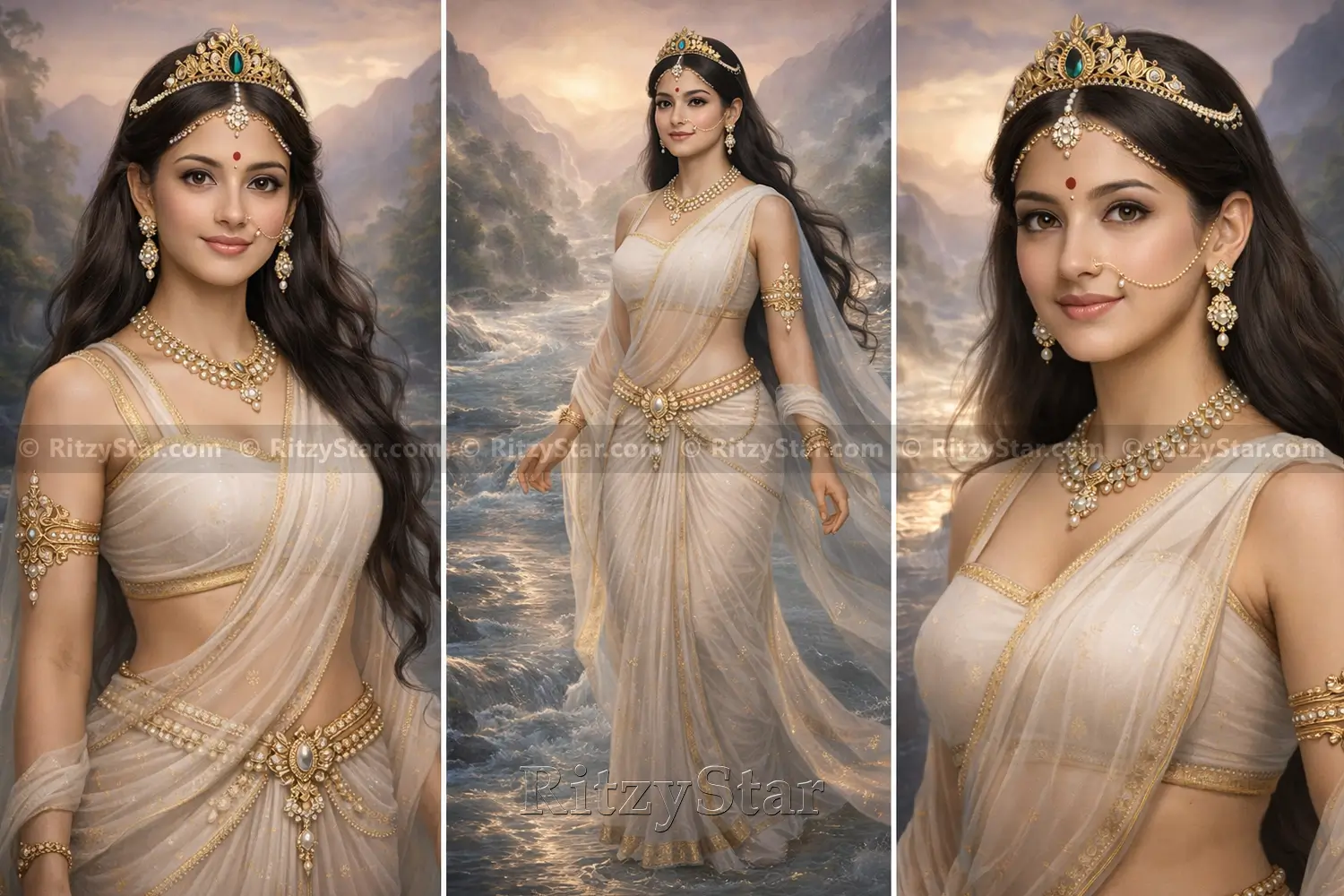
Unlike some deities who have a single consort, Varuna is associated with multiple goddesses, each representing a different aspect of water and divine feminine power.
The Family of Varuna
| Name | Relationship | Children | Remarks |
|---|---|---|---|
| Varunani (Varuni) | Chief Consort; also called Jaldevi | 1. Sushena – A divine physician mentioned in the Ramayana who aided Lakshmana in battle. 2. Vandi – The court poet of Varuna, known for his wisdom and eloquence. 3. Dakshasavarni Manu – One of the fourteen Manus, future ruler of a cosmic age. 4. Varuni (daughter) – The goddess of wine who emerged from the churning of the ocean | Varunani is the primary consort of Varuna and is often depicted seated beside him. She represents the nurturing, life-giving aspect of water. In some traditions, she emerged from the ocean alongside Varuna and chose him as her consort |
| Gauri | Secondary Consort | Mentioned in Puranic texts as another chief consort | Gauri (not to be confused with Parvati) is described as a goddess associated with the purifying aspects of water |
| Charshani | Secondary Consort | Mentioned in some genealogical lists | A lesser-known consort, associated with the “peoples” or “hosts” that follow Varuna |
| Jyeshtha | Secondary Consort | 1. Kali (demon) – A demonic son who creates chaos | Jyeshtha (the “eldest”) is associated with inauspicious qualities and poverty. Her connection to Varuna represents the darker, more dangerous aspects of water |
| Bhadra | Secondary Consort | Mentioned as a daughter of Chandra (the moon god) | Bhadra (the “auspicious one”) represents the gentle and favorable aspects of water |
Notes on Varuna’s Family:
- Multiple Consorts – Unlike the reference articles for Tara and Madhavi, Varuna has multiple wives/consorts. The table above lists only his direct consorts (partners), not his parents or siblings.
- The Three Varunis – The name “Varuni” refers to three distinct goddesses: Varuna’s wife, Varuna’s daughter (goddess of wine), and a Matrika (mother goddess) who emerged to drink the blood of the demon Andhaka.
- The Sage Vasishtha – According to some traditions, the great sage Vasishtha was born from Varuna’s seed, making Varuna his father. However, other traditions name Mitra-Varuna as his joint parents.
- Sushena the Physician – Sushena, son of Varuna, appears in the Ramayana as a skilled physician who tends to Lakshmana’s wounds and provides the Sanjivani herb.
📜 Varuna in the Vedas – The Sovereign of Cosmic Law
The Vedas, particularly the Rigveda, are the primary source for understanding Varuna in his original, preeminent form. Here, he is not merely a god of water but the sovereign of the entire cosmos.
The Upholder of Rita
The most fundamental concept associated with Varuna is Rita—the cosmic order that governs everything. Rita is not a law that Varuna enforces from outside; it is the very fabric of existence that he embodies and maintains. The sun rises because of Rita. The seasons change because of Rita. The stars move in their courses because of Rita. And Varuna is the guardian of this order.
“ऋतेन वरुणः सत्यं राजा धर्मं प्रवर्तयन्।
नक्षत्राणां पतिर्देवो नित्यं पश्यन्नभि पश्यति॥”
— by Author
Meaning: Through cosmic order, Varuna, the truthful king, sets righteousness in motion. As lord of the stars, the god perpetually observes all.
If Rita is violated—whether by a human sin, a celestial irregularity, or a disruption in natural cycles—Varuna’s noose is ready to bind the offender and restore balance.
The God of Confession and Forgiveness
One of the most remarkable aspects of Varuna worship in the Vedas is the intimate, confessional tone of the hymns addressed to him. Unlike the boisterous praises offered to Indra, the hymns to Varuna are often filled with remorse, humility, and pleas for forgiveness.
“यदप्सु ते वरुण सुम्नमस्ति यद्गावो यद्धविषा त्वा यजन्ते।
तद्वो वरुणः प्र मृनीतां मनीषा यूयं पात स्वस्तिभिः सदा नः॥”
— Rigveda 1.25.18-20
Meaning: Whatever sin we have committed against you, Varuna—whether against friend or comrade, whether in the village or the wilderness—forgive us that transgression.
The devotee acknowledges that Varuna sees all—not as a punitive tyrant but as a wise father who desires his children’s righteousness. And when the devotee repents, Varuna forgives.
Varuna and Mitra – The Twin Sovereigns
Varuna is frequently paired with Mitra, the god of contracts and human agreements. Together, they form the dyad Mitra-Varuna.
| Aspect | Mitra | Varuna |
|---|---|---|
| Domain | Human contracts, friendship | Cosmic law, divine order |
| Time | Day, the sun rising | Night, the moon and stars |
| Function | Binding agreements between humans | Binding the cosmos itself |
| Nature | More juridical, practical | More magical, speculative |
| Symbol | The morning sun | The encompassing sky |
“मित्रस्य च वरुणस्य च देवानां प्रथमं हविः।
प्रातर्यावभिर्यजामहे देवान् मित्रावरुणा नमोभिः॥”
— Rigveda 1.136.1
Meaning: Of Mitra and Varuna, the gods’ foremost offering, we worship at dawn these gods, Mitra-Varuna, with obeisances.
Together, Mitra-Varuna represent the totality of divine governance—the regulation of both human affairs (through contracts, oaths, and friendship) and cosmic affairs (through Rita, the universal law).
📿 Varuna in the Upanishads – The Teacher of Brahman
In the Upanishads, Varuna appears in a new role—not as a sovereign god to be worshipped with sacrifices, but as a spiritual teacher who reveals the nature of Brahman (ultimate reality).
The Bhargavi Varuni Vidya
The Taittiriya Upanishad contains a famous section called the Bhargavi Varuni Vidya (“the knowledge of Bhrigu from his father Varuna”).
The story unfolds as follows:
The sage Bhrigu approaches his father, Varuna, with a profound question: “Teach me Brahman, O Lord.”
Varuna, not answering directly, instructs Bhrigu to perform tapas (austerities) and seek the answer himself. Bhrigu meditates and returns with an initial answer: “Brahman is food (annam)—the physical, material world.”
Varuna tells him to meditate further. Bhrigu returns with a deeper answer: “Brahman is prana (life-force)—the vital energy that animates the physical.”
Again Varuna tells him to go deeper. Bhrigu returns: “Brahman is manas (mind)—the mental realm.”
Still not satisfied, Varuna sends him back. Bhrigu returns: “Brahman is vijnana (wisdom, consciousness).”
Finally, Varuna accepts Bhrigu’s answer when he reaches the deepest level: “Brahman is ananda (bliss, pure consciousness).”
Through this dialogue, Varuna reveals the method of spiritual inquiry—not accepting received wisdom but discovering truth through direct realization. He is the teacher who guides the student inward, peeling away layers of understanding until the ultimate truth is revealed.
⚔️ Varuna in the Epics – The Reluctant Lord of Oceans
By the time of the Ramayana and Mahabharata, Varuna’s role has shifted dramatically. He is no longer the supreme sovereign but a powerful deity who serves the greater cosmic order.
The Bridge to Lanka – Varuna and Rama
In the Ramayana, when Rama needs to cross the ocean to reach Lanka and rescue his abducted wife Sita, he turns to Varuna.
Rama performs intense tapasya to Varuna for three days and three nights, praying to the lord of oceans to provide a path. But Varuna does not respond.
On the fourth morning, Rama arises in fury. He strings his bow and prepares to dry up the entire ocean with his celestial weapons. As Rama’s arrows strike the ocean, setting it ablaze with supernatural fire, Varuna finally emerges from the depths. He bows to Rama and explains that he cannot make the ocean passable by his own will—it is by its nature fathomless. However, he promises not to hinder Rama’s army as they build a bridge of stones.
This episode is fascinating because it shows Varuna’s limitations—he cannot alter the fundamental nature of the ocean, even though he is its lord. The cosmic order he upholds binds even him.
Varuna and Arjuna – The Gift of the Gandiva
In the Mahabharata, Varuna plays a crucial role in Arjuna’s journey. When Arjuna is traveling through the forest, Varuna appears before him and presents him with two divine weapons:
- The Gandiva – The legendary bow that would become Arjuna’s primary weapon throughout the Kurukshetra war. It was said to be indestructible, capable of shooting an infinite number of arrows, and producing a terrifying twang that struck fear into enemies.
- The Varunastra – A celestial weapon that could summon the power of water to bind and incapacitate enemies.
Thus, Varuna becomes a benefactor to the Pandavas, equipping Arjuna with the tools he would need to fulfill his destiny.
🌊 Varuna in the Puranas – The Guardian of the West
In the Puranic literature, Varuna’s role is further transformed. He is now firmly established as the Dikpala (guardian) of the western direction, one of the eight Lokapalas who protect the cosmos.
The Iconography of Varuna
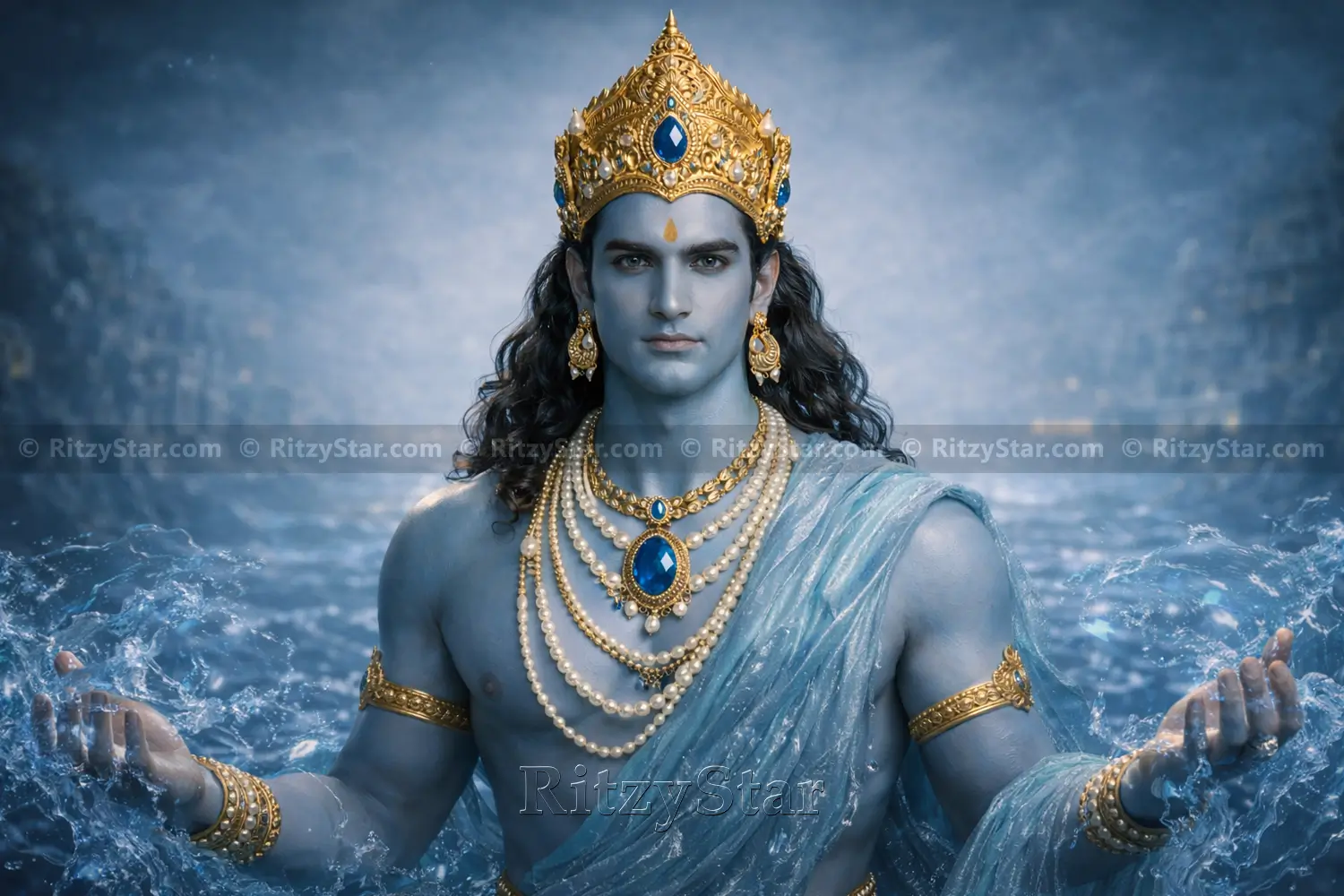
By the Puranic period, Varuna’s iconography is well-established. He is depicted as:
- Youthful and majestic – A handsome man in the prime of life, with a serene yet powerful countenance
- Dark blue complexion – Representing the depths of the ocean and the vastness of the sky
- Seated on Makara – His crocodile-like mount, symbolizing the creatures of the deep
- Holding a Pasha (noose) – His primary weapon, used to bind sinners and enforce cosmic law
- Holding a pitcher (Kalasha) – Filled with water or jewels, representing the treasures of the ocean
- Accompanied by attendants – Often depicted with river goddesses Ganga and Yamuna
- Wearing a crown and ornaments – Reflecting his royal status
“नीलवर्णो वरुणो देवः पाशहस्तो महाबलः।
मकरस्थो दिशः पाति पश्चिमां सर्वदा प्रभुः॥”
— by Author
Meaning: The blue-hued god Varuna, noose in hand, of great strength, seated on Makara, forever protects the western direction as lord.
Varuna and the Samudra Manthan
The Puranas recount the story of the Samudra Manthan (churning of the cosmic ocean). When the gods and demons churned the ocean to obtain the nectar of immortality, Varuna presided over the event as the lord of the waters.
From the ocean emerged many treasures: Lakshmi (goddess of fortune), Chandra (the moon god), Dhanvantari (the physician of the gods), Varuni (goddess of wine, who emerged as Varuna’s daughter), Airavata (the white elephant), Uchchaihshravas (the seven-headed white horse), Kaustubha (the most valuable jewel), and Parijata (the celestial wish-fulfilling tree).
Throughout this churning, Varuna remained the silent sovereign, ensuring that the cosmic process unfolded according to Rita.
🌏 Varuna in Other Traditions – Beyond Hinduism
Varuna’s influence extends far beyond the boundaries of Hinduism. He appears in Buddhist, Jain, and Sindhi traditions.
Varuna in Buddhism
In Buddhist mythology, Varuna is recognized as a king of the devas and a companion of the god Sakka (Indra). In Theravada Buddhism, Varuna is listed among the guardian deities who protect the Buddhist teachings. He is often depicted as a warrior-king, holding a noose and riding a makara. In Japanese Buddhism, as Suiten, Varuna is one of the twelve heavenly generals who protect the world, often depicted with a snake or dragon.
Varuna in Jainism
In Jain cosmology, Varuna is recognized as a celestial being (deva) who resides in the upper realms. He is associated with the western direction and with the element of water.
Varuna in Sindhi Tradition – Jhulelal
Among Sindhi Hindus, Varuna is worshipped as Jhulelal—a form of the god who saved them from persecution. According to legend, when a tyrannical ruler threatened to forcibly convert the Sindhi people, they prayed to Varuna for help. Varuna incarnated as a divine child named Uderolal, who grew up to be a warrior and sage, confronting the ruler and establishing religious freedom.
To this day, Sindhi Hindus celebrate Cheti Chand (the festival of Jhulelal) to honor Varuna’s incarnation. They also observe Chaliho Sahib, a forty-day festival of fasting and prayer to express gratitude to Jhulelal for their protection.
🏛️ Festivals and Worship of Varuna
Though Varuna is no longer the supreme deity he once was, his worship continues in various forms across India.
Cheti Chand – The Sindhi New Year
Cheti Chand is the most important festival for Sindhi Hindus. Celebrated on the second day of the Chaitra month (March-April), it marks both the spring harvest and the birth of Jhulelal, Varuna’s incarnation. Devotees gather near rivers, lakes, or the sea, offer prayers and floating lamps (diyas) on the water, fast and perform charitable acts, and process with the idol of Jhulelal through the streets.
Chaliho Sahib – The Forty Days
Chaliho Sahib is a forty-day festival observed by Sindhi Hindus to honor Jhulelal/Varuna. It occurs between July and August. During these forty days, devotees abstain from meat, alcohol, and certain other indulgences, wear simple, usually white, clothing, pray daily to Jhulelal, and gather at temples dedicated to Varuna for communal prayers.
Varuna in Vedic Rituals
In traditional Vedic rituals, Varuna is invoked for rain, for purification (water used in rituals is consecrated to Varuna), for forgiveness (hymns confessing sins and seeking absolution), and for protection—especially for sailors, fishermen, and those who travel by water.
🔮 The Deeper Meaning – Varuna as the Cosmic Conscience
What does Varuna represent in the deepest sense? He is not merely a god of water or sky. He is the cosmic conscience—the internal witness that sees every action, every thought, every hidden intention.
The All-Seeing Witness
When the Rigvedic poet confesses his sins to Varuna, he is engaging in an act of profound psychological and spiritual honesty. Varuna is the external projection of the internal conscience—the voice that says, “I know what you did.”
This internalization of Varuna as conscience is perhaps his greatest legacy. He is not a distant tyrant but an intimate presence—the one who knows us better than we know ourselves, who judges us not with cruelty but with the expectation that we can do better.
The Binder and the Liberator
Varuna binds the cosmos with Rita—but he also liberates. When the devotee repents, Varuna loosens the noose. When the sinner reforms, Varuna forgives. His binding is not punitive but corrective—designed to restore balance, not to destroy.
“उदुत्तमं वरुण पाशमस्मदवाधमं वि मध्यमं श्रथाय।
अथा वयमादित्य व्रते तवानागसो दितये देव भवाम॥”
— Rigveda 1.24.15
Meaning: Release from us, Varuna, the noose above, the noose below, and the noose in between. Then, O Aditya, may we become sinless in your law, O god, for the sake of your grace.
This is the paradox of Varuna: the binder who liberates, the punisher who forgives, the sovereign who serves.
🌅 Conclusion – The Eternal Sovereign
Varuna is not the most popular god in modern Hinduism. Few temples are dedicated to him exclusively. His festivals are regional, not pan-Indian. He has been overshadowed by the Trimurti, by the avatars of Vishnu, by the fierce goddesses of the Tantric tradition.
But Varuna never left.
“वरुणो वरुणो नाम देवानामपि दुर्लभः।
जलरूपः स नित्यं हि सर्वेषां हृदये स्थितः॥”
— by Author
Meaning: Varuna, named Varuna, is rare even among the gods. He is the form of water, eternally situated in the hearts of all beings.
He is in every river that flows to the sea. He is in every rain that falls from the sky. He is in every drop of water that purifies the body and, symbolically, the soul. He is in the conscience that whispers when we are about to do wrong. He is in the forgiveness we seek when we have done wrong.
Varuna is the ancient sovereign who has seen empires rise and fall, gods come and go, worlds created and destroyed. He was there at the beginning, and he will be there at the end—the binder who holds the cosmos together, the watcher who sees all, the purifier who cleanses all, the forgiver who redeems all.
“प्रपद्ये वरुणं देवं जलरूपं सनातनम्।
सर्वपापहरं शुद्धं सर्वदुःखनिवारणम्॥”
— by Author
Meaning: I take refuge in the god Varuna, the eternal form of water. He removes all sins, is pure, and dispels all sorrows.
In the end, Varuna remains what he has always been—the cosmic binder, the lord of waters, the omniscient sovereign, the teacher of truth. His story, like the waters he commands, flows through all of existence, touching everything, purifying everything, binding everything together in the great web of cosmic law.
Discover more from RitzyStar
Subscribe to get the latest posts sent to your email.