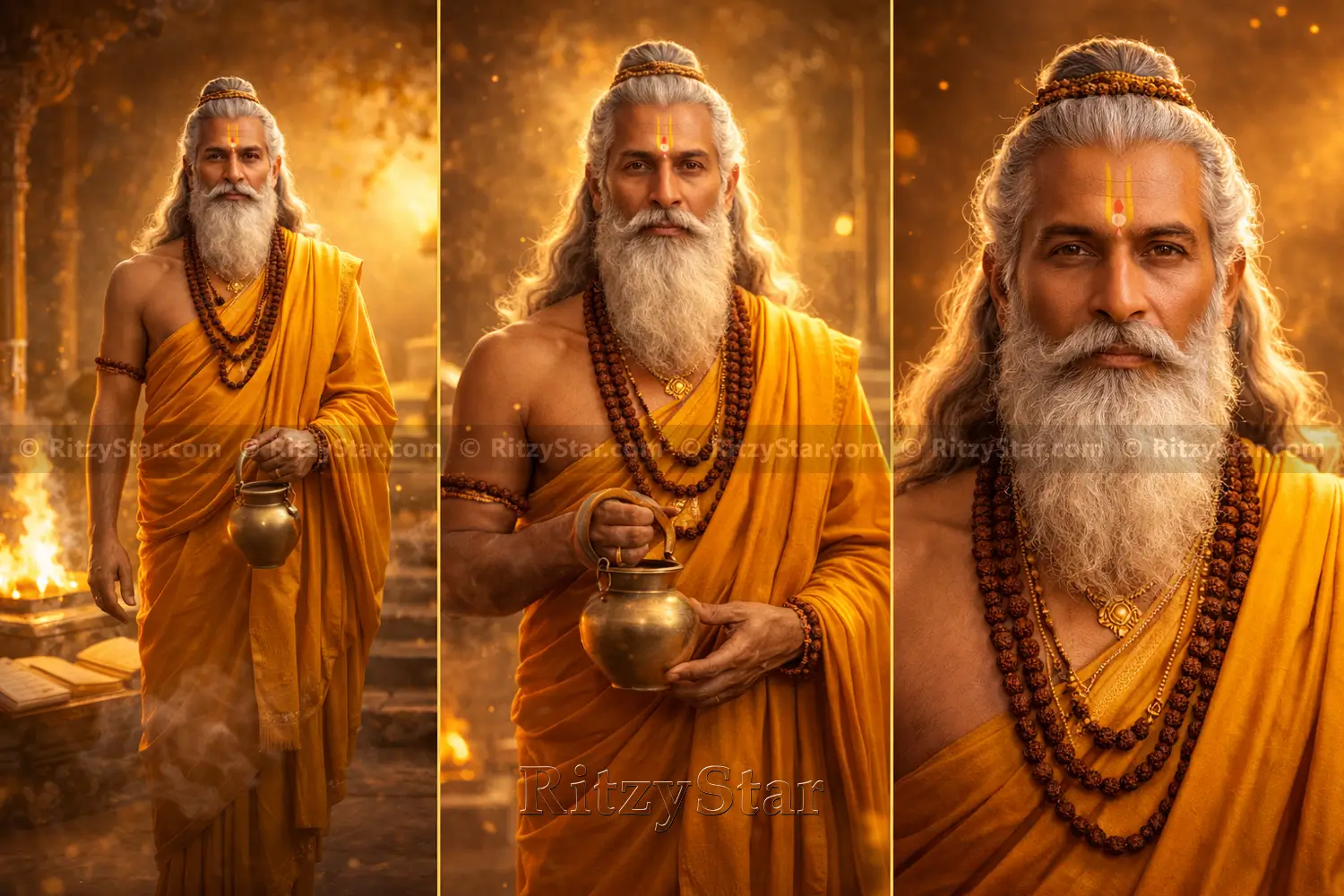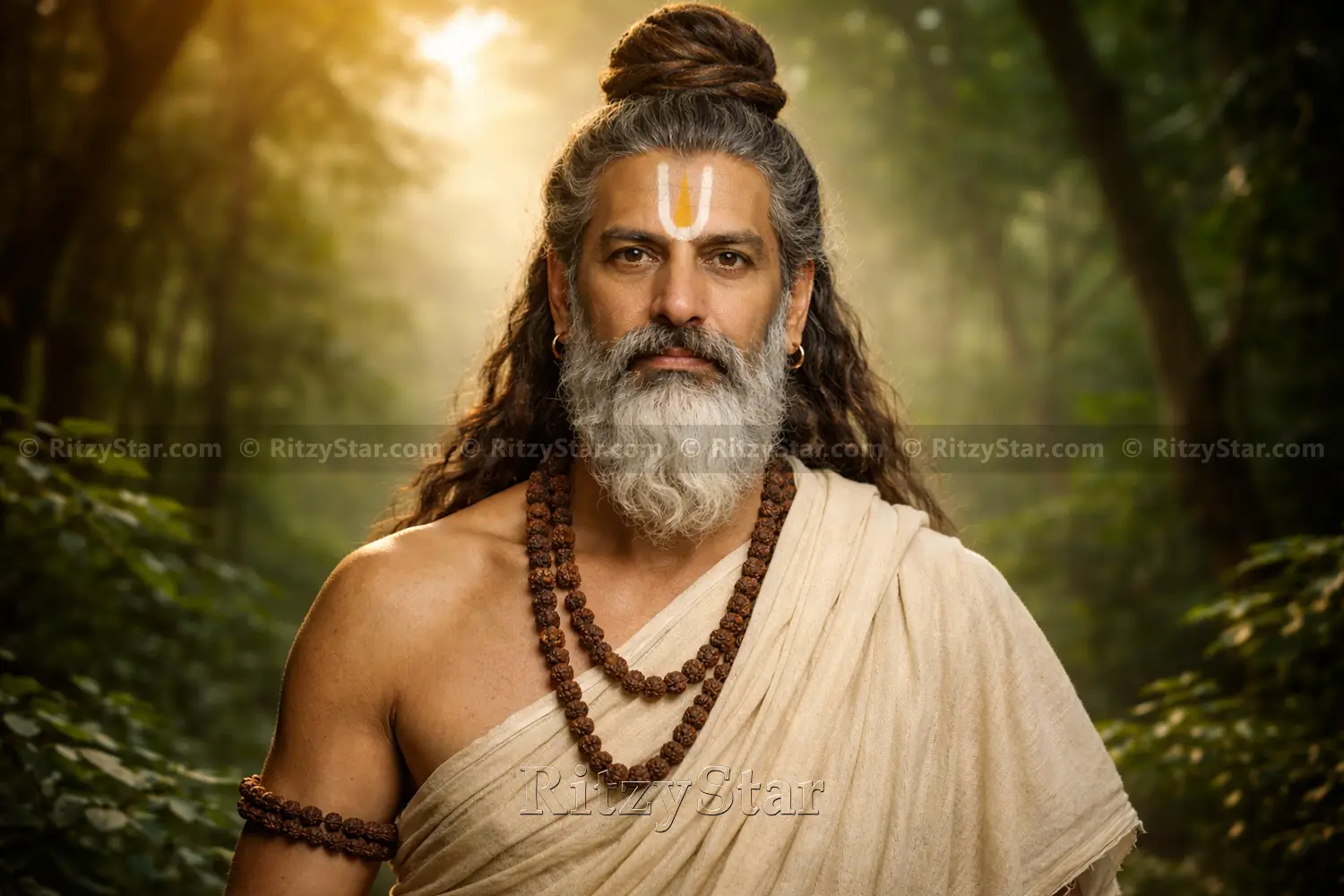

The Vedic Rishi Who Bridged North and South, Master of Yoga, Medicine, and the Stars
“अगस्त्यो योगविद्यानां निधिः सिद्धान्तशासिनाम्।
दक्षिणस्य दिशो नाथः सप्तर्षीणां च भूषणम्॥”
— Ancient Verse
Meaning: Agastya, the treasure of yogic sciences, the teacher of philosophical systems, the lord of the southern direction, and the ornament of the Saptarishis.
🌊 Introduction – The Sage Who Walked Between Worlds
There is a sage whose name appears in the Rigveda, whose presence is felt in the temples of Tamil Nadu, whose teachings form the foundation of Siddha medicine, and whose yogic powers allowed him to drink the ocean itself. He is Agastya—one of the most extraordinary and multifaceted figures in all of Indian tradition.
Agastya is not merely a rishi. He is a bridge—between North and South, between Vedic orthodoxy and Tamil mysticism, between the heavens and the earth. He is counted among the Saptarishis, the seven great sages who guide cosmic evolution. He is the first rishi to cross the Vindhya mountains and carry Vedic knowledge to the southern lands. He is the father of Tamil literature, the founder of Siddha medicine, the master of astrology, the alchemist who turned base metals to gold, and the diminutive sage of immense power who humbled mountains and drank oceans.
“अगस्त्यो नाम तेजस्वी वामनो ब्रह्मणः सुतः।
यस्य प्रभावाद् विन्ध्योऽपि न ववृधे महागिरिः॥”
— by Author
Meaning: Agastya, the radiant one, the dwarf son of Brahma’s mind, by whose power even the great Vindhya mountain did not grow.
His story spans the Vedas, the Ramayana, the Mahabharata, the Puranas, and the entire corpus of Tamil literature. He is mentioned in over thirty major texts across two millennia. His name is invoked in rituals for fertility, for success, for protection against poison, and for spiritual liberation. And yet, despite his prominence, there is no single “story” of Agastya—there are many, each revealing a different facet of this extraordinary being.
🪷 Who Was Agastya? The Dwarf Born of Divine Purpose
Agastya was not born of a womb. His origin is one of the most remarkable in Hindu mythology, reflecting his unique role as a being created for a specific cosmic purpose.
The Story of His Birth
According to the Valmiki Ramayana (Aranya Kanda) and various Puranas, the gods once gathered on Mount Meru for a celestial assembly. The demons (asuras), led by the powerful Vritra, attacked and began to devour the gods. In desperation, the devas fled and sought refuge with the creator god Brahma.
Brahma, seeing the terror of the gods, performed a powerful meditation. From his divine gaze, a radiant being emerged—not fully formed, but as a seed of light. This seed fell into a water pot (kumbha) that Brahma had prepared. From this pot, two beings were born: Agastya and his twin brother, Vashishtha.
“कुम्भयोः सम्भवं प्राप्तौ वशिष्ठागस्त्यौ महर्षी।
मित्रावरुणयोश्चांशौ ब्रह्मणो मानसौ सुतौ॥”
— by Author
Meaning: Born from water pots, the great sages Vashishtha and Agastya were parts of Mitra and Varuna, the mind-born sons of Brahma.
Thus, Agastya is called Kumbhasambhava (pot-born) and Kumbhayoni (pot-wombed). In some traditions, he is considered the son of the gods Mitra and Varuna, born from their seed when they were aroused by the celestial nymph Urvashi. In this version, the seed was collected in a pot and from it emerged Agastya and Vashishtha.
The Dwarf with Immense Power
Agastya is often depicted as a dwarf—short in stature but immense in power. His diminutive form is not a sign of weakness but a testament to his yogic mastery. He carries within him the condensed power of a thousand suns.
“वामनो ब्रह्मणः पुत्रो महर्षिर्घोरतपसः।
यस्य संदर्शनादेव विन्ध्यो नाभ्यवर्तत॥”
— by Author
Meaning: The dwarf, son of Brahma, the great sage of fierce austerities, by whose very presence the Vindhya mountains stood still.
His height is often described as reaching only to the waist of an ordinary man. But when he walks, the earth trembles. When he speaks, the heavens listen. He is proof that power is not measured in physical stature but in spiritual attainment.
His Twin: Vashishtha
Agastya’s twin, Vashishtha, is equally revered—the chief priest of the Solar Dynasty, the guru of Lord Rama. The two brothers represent two streams of Vedic tradition: Vashishtha associated with the North, Agastya with the South. Together, they embody the completeness of Vedic knowledge.
💍 Lopamudra – The Wife Who Matched His Greatness
If Agastya is extraordinary, his wife Lopamudra is no less so. Their union is one of the most celebrated in Vedic literature—a partnership of equals, a marriage of intellectual and spiritual giants.
The Creation of Lopamudra
Like her husband, Lopamudra has a remarkable origin. According to the Mahabharata (Vanaparva) and the Puranas, Agastya, after years of intense austerity, felt the need for a householder’s life. But he could not find a wife worthy of him—no mortal woman could match his spiritual stature.
Using his yogic powers, Agastya created a woman from the most beautiful parts of various creatures and beings. He took:
- The grace of the deer
- The beauty of the celestial nymphs
- The intelligence of the goddess Saraswati
- The patience of the earth
- The radiance of the sun
From these, he fashioned Lopamudra—a woman of incomparable beauty and intelligence. He then arranged for her to be born as the daughter of the King of Vidarbha, where he later found and married her.
“लोपामुद्रां सृजद् योगादगस्त्यः प्रथमं स्वयम्।
सौन्दर्येणाप्रतिद्वन्द्वां विद्यया च सरस्वतीम्॥”
— by Author
Meaning: Agastya first created Lopamudra through his yogic power—without equal in beauty, and like Saraswati in wisdom.
The Rigvedic Hymns – A Husband-Wife Dialogue
The most remarkable aspect of the Agastya-Lopamudra relationship is their presence in the Rigveda itself. Two hymns (I.179 and I.170) are attributed to them, and they contain a fascinating dialogue between husband and wife—one of the few places in the Rigveda where a woman’s voice is heard directly.
In these hymns, Lopamudra expresses her desires and her frustrations. She has lived a life of extreme austerity with Agastya, and she longs for companionship, for children, for the joys of a householder’s life. She does not demand—she reasons. She does not rebel—she questions.
“न ता विवक्षुर्वि वदन्ति सन्तो व्रतेन पत्नी वि चरन्ति गातुम्।
प्रजया पत्नी सुकृतेन गातुं युक्ता ग्रावाणा तपसा विश्वरूपा॥”
— Rigveda I.179.2
Meaning: The righteous do not speak of that which cannot be expressed. Through the vow, the wife seeks her path. Through children, through righteous deeds, she seeks her way—united with her husband, she attains all forms through austerity.
Agastya, in turn, responds with love and understanding. He has not neglected her; he has been immersed in spiritual pursuits. But he hears her, honors her, and their union is consummated—producing a son who would carry forward their legacy.
The Birth of Dridhasyu
From the union of Agastya and Lopamudra was born a son named Dridhasyu (also called Dridhachyu or Idhmavaha in some texts). He was a sage of great power, inheriting his father’s yogic abilities and his mother’s wisdom.
“दृढस्युर्नाम तेजस्वी अगस्त्यात् समजायत।
यो वंशं धारयामास दक्षिणस्यां दिशि स्थितः॥”
— by Author
Meaning: The radiant Dridhasyu was born from Agastya, who carried forward the lineage in the southern direction.
Dridhasyu became a teacher of the Vedas, continuing his father’s work of spreading Vedic knowledge in the South. His descendants, the Agastyas, are mentioned as one of the gotras (lineages) of Brahmins in South India.
🌍 The Crossing of the Vindhyas – When a Sage Humbled a Mountain
One of the most famous stories of Agastya concerns his journey south and his encounter with the Vindhya mountain range—a story that reveals his immense yogic power and his role as the bridge between North and South.
The Growing Mountain
The Vindhya mountains, which separate northern and southern India, were once growing. According to the Puranas, Vindhya was jealous of Mount Meru, the cosmic axis, which the sun and moon circumambulated. Vindhya demanded that the sun also honor him by circling his peaks. When the sun refused, Vindhya began to grow—higher and higher, threatening to block the sun’s path and disrupt the cosmic order.
“विन्ध्योऽहं वर्धिष्येऽहं मेरुं चातिक्रमिष्यामि।
इत्युक्त्वा ववृधे शैलो देवदैत्यभयंकरः॥”
— by Author
Meaning: “I will grow,” said Vindhya, “I will surpass Meru.” Saying this, the mountain grew, causing fear among gods and demons alike.
The gods were terrified. If Vindhya continued growing, he would block the sun, disrupt the seasons, and throw the universe into chaos. They approached Agastya for help.
The Sage’s Command
Agastya journeyed south with his wife. When he reached the Vindhya range, the growing mountain loomed before him, blocking his path. The sage, though dwarf-sized, stood before the immense peak and spoke:
“यावदहं दक्षिणतः प्रतिनिवृत्तः स्यां तावत् त्वं वर्धस्व।
अतः परं ममागमनं प्रतीक्षस्व यावदागच्छामि॥”
— by Author
Meaning: “Until I return from the south, do not grow. Wait for my coming before you grow further.”
The mountain, recognizing the sage’s power, agreed. It halted its growth and bowed low, allowing Agastya to pass.
The Sage Who Never Returned
But Agastya never returned north. He settled in the south, establishing his hermitage, spreading Vedic knowledge, and becoming the spiritual father of the southern lands. And Vindhya, bound by his word to the sage, never grew again. To this day, the Vindhya mountains remain lower than the Himalayas, their growth arrested by the power of Agastya’s command.
“सोऽगस्त्यो दक्षिणं देशं गत्वा तत्रैव संस्थितः।
विन्ध्योऽपि प्रतिजां रक्षन्न ववृधे महागिरिः॥”
— by Author
Meaning: Agastya, having gone to the southern land, remained there. Vindhya, keeping his promise, did not grow.
This story is more than mythology. It symbolizes Agastya’s role in the cultural geography of India—the sage who carried Vedic civilization across the Vindhyas, who established dharma in the South, and who created the cultural unity that bridges the two halves of the subcontinent.
🌊 The Drinking of the Ocean – When a Sage Saved the Gods
Perhaps the most spectacular story of Agastya’s power is the tale of how he drank the entire ocean. This episode, found in the Ramayana, Mahabharata, and Puranas, demonstrates his status as a being of cosmic significance.
The Disappearance of the Ocean
According to the story, a powerful demon named Kalakeya (or sometimes Vritra) had obtained a boon from Brahma that he could only be killed by a mortal. Emboldened, the demon and his armies hid themselves in the ocean, emerging to attack sages and disrupt their sacrifices. They would strike and then retreat to the depths, safe from the gods who could not enter the waters.
“रसातलगताः सर्वे कालकेयाः सहस्रशः।
तपांसि विघ्नयन्ति स्म यज्ञांश्च मुनिसत्तमान्॥”
— by Author
Meaning: Thousands of Kalakeya demons, having gone to the ocean depths, disrupted the austerities and sacrifices of the great sages.
The gods, unable to reach the demons, sought a solution. They approached Agastya, whose yogic powers were unmatched. The sage agreed to help.
The Sage Drinks the Ocean
Agastya went to the seashore. Standing before the vast expanse of water, he began to drink. Using his yogic power, he consumed the entire ocean—every drop, every wave, every depth. The ocean floor lay exposed, dry and empty.
“समुद्रं पिबतेऽगस्त्यो देवानां कार्यसिद्धये।
सर्वतीर्थमयं तोयं जगामोदरमध्यतः॥”
— by Author
Meaning: Agastya drank the ocean for the sake of the gods’ mission. All the waters of all the sacred rivers went into his stomach.
With the ocean gone, the demons were exposed. The gods descended and destroyed them. After the battle, the gods begged Agastya to release the waters. But the sage simply said:
“यथा प्राप्तं समुद्रेण तोयं तत् पुनराप्नुयात्।
न शक्नोमि विस्रष्टुं जीर्णं तत् मे उदरस्थितम्॥”
— by Author
Meaning: “Let the ocean obtain its waters as it may. I cannot release what has been digested in my stomach.”
The ocean, humbled, asked the gods to help. The gods then caused the Ganga and other rivers to flow into the empty basin, filling it gradually. To this day, the ocean is said to be slightly less salty than before—because Agastya digested its original waters.
The Deeper Meaning
Like the story of the Vindhyas, this tale is layered with meaning. On one level, it is a myth explaining the ocean’s saltiness (or relative lack thereof). On another, it symbolizes Agastya’s ability to “drink up” or absorb all dualities—to transcend the ocean of samsara itself. The sage who can drink the ocean can certainly cross it, and this is why Agastya is often invoked for safe sea voyages and for overcoming obstacles.
📜 Agastya in Vedic Literature – The Rigvedic Hymnist
Agastya’s presence in the Rigveda establishes his antiquity and importance. He is credited with several hymns, and his dialogue with his wife Lopamudra is unique in the Vedic corpus.
The Rigvedic Hymns of Agastya
Agastya is the seer (rishi) of approximately twenty-five hymns in the Rigveda (Mandala I). These hymns cover a wide range of topics:
- Praise of the Ashvins (the divine physicians)
- Hymns to Indra
- Hymns to the Maruts
- Philosophical speculations on the nature of existence
- The famous dialogue with Lopamudra
“अगस्त्यो मैत्रावरुणिर्ऋषिः सूक्तानां द्रष्टा।
यस्य वाक्यैर्वेदविद्या सर्वा संप्रतिष्ठिता॥”
— by Author
Meaning: Agastya, the son of Mitra and Varuna, was the seer of hymns; by his words all Vedic knowledge is established.
The Lopamudra Hymn
Rigveda I.179 is attributed jointly to Agastya and Lopamudra. It is a rare glimpse into the personal life of a Vedic rishi and reveals the humanity behind the sage.
In this hymn, Lopamudra speaks of her longing. She has spent many years in ascetic discipline with her husband, but now she desires the fullness of life—children, companionship, the joys of the householder.
“बहूनि साकं नु तपांस्यूषुः प्रजां दातुं भगवन्तं चिकित्सन्।
तपसा हि देवा अन्वविन्दन् तपसा वेदा अन्वविन्दन्॥”
— Rigveda I.179.1
Meaning: “Many austerities have I performed together (with you). Seeking to give me children, the revered one understood. For through austerity the gods found (their powers), through austerity the Vedas were found.”
Agastya’s response is one of understanding and love. He does not rebuke her; he honors her desires. Their union is not merely physical but spiritual—a merging of two souls equally dedicated to dharma.
“तपसा राष्ट्रं तपसा प्रजां पश्यन्ति तपसा दिव आपः।
तपसा हि देवा अन्वविन्दन् तपसा वेदा अन्वविन्दन्॥”
— Rigveda I.179.4
Meaning: “Through austerity they see the kingdom, through austerity offspring, through austerity the waters of heaven. For through austerity the gods found, through austerity the Vedas were found.”
This hymn is a profound meditation on the relationship between tapas (austerity) and worldly fulfillment. It teaches that the two are not opposed—that true austerity leads to the capacity for worldly engagement, and that worldly engagement, when done with awareness, is itself a form of austerity.
🧘 Agastya in the Ramayana – The Sage Who Gave Rama the Divine Bow
Agastya appears at crucial moments in the Ramayana, particularly in the Aranya Kanda (Forest Section), where Rama, Sita, and Lakshmana encounter him during their forest exile.
The Meeting in the Forest
As Rama wanders the Dandaka forest, he is directed to Agastya’s hermitage by other sages. When Rama arrives, Agastya welcomes him with great honor, recognizing him as the avatar of Vishnu. He offers Rama hospitality and imparts spiritual teachings.
“अगस्त्यं तु समासाद्य रामः सत्यपराक्रमः।
पूजितस्तेन धर्मात्मा न्यवसत्तत्र राघवः॥”
— Valmiki Ramayana, Aranya Kanda
Meaning: Having approached Agastya, Rama of true valor, the righteous one, was honored by him and resided there.
The Gift of the Divine Weapons
Agastya, recognizing that Rama will soon face Ravana, gives him the celestial weapons created by Vishvakarma for the gods. These include:
- The divine bow of Vishnu
- The inexhaustible quiver
- The sword of Indra
- Various divine missiles (astras)
“धनुष्प्रवरमादाय विष्णुना विहितं पुरा।
सशरं चापमादाय ततो रामोऽभ्यपूजयत्॥”
— Valmiki Ramayana, Aranya Kanda
Meaning: Taking the excellent bow created by Vishnu in ancient times, along with arrows and the bow, Rama honored (Agastya).
This gift is crucial for Rama’s later victory over Ravana. It connects Agastya to the central narrative of the Ramayana and establishes him as a supporter of divine dharma.
The Instruction on Hanuman
In some versions, Agastya also instructs Rama on the power of Hanuman, the monkey god who would become his greatest devotee and ally. Agastya’s spiritual insight allows him to recognize Hanuman’s divine nature before it is fully revealed.
📖 Agastya in the Mahabharata – The Sage Who Appears at Crucial Moments
Agastya appears in several episodes of the Mahabharata, often as a voice of wisdom and as a figure whose power shapes events.
The Story of Lopamudra (Detailed)
The Mahabharata (Vanaparva) contains the most complete version of the Agastya-Lopamudra story. It elaborates on Lopamudra’s creation, her marriage, and the dialogue between them.
In this version, Agastya, after creating Lopamudra and arranging her birth as a princess, goes to the king of Vidarbha and asks for her hand. The king is reluctant—Agastya is a poor ascetic, while Lopamudra has been raised in royal luxury. But Lopamudra herself accepts the sage, recognizing his greatness.
“वृणेऽहमगस्त्यमृषिं पतिं प्रभुम्।
त्यक्त्वा राज्यं सुखं चैव सर्वमित्यब्रवीत्तदा॥”
— Mahabharata, Vanaparva
Meaning: “I choose the sage Agastya as my lord and husband,” she said, “renouncing kingdom and all pleasures.”
The story then describes their life together—Lopamudra’s austerity, her patience, and eventually her request for children, which leads to the birth of Dridhasyu.
The Killing of Vatapi
One of the most famous stories of Agastya—found in the Mahabharata, the Ramayana, and various Puranas—is his slaying of the demon Vatapi.
The Story of Vatapi and Ilvala
Ilvala and Vatapi were demon brothers. Ilvala had a boon that he could resurrect his brother after death. Their method of killing was cunning: Ilvala would invite Brahmins and sages to a feast, where he would serve mutton made from Vatapi (who could transform into a ram). After the guest ate, Ilvala would call out, “Vatapi, come out!” and the demon would tear his way out of the victim’s stomach, killing him.
“इल्वलो वातापिमांसं विप्रेभ्यो ददौ सदा।
वातापे क्रियतामिति पश्चात् स प्राणयत् पुनः॥”
— by Author
Meaning: Ilvala always served Vatapi’s meat to Brahmins. Then he would call, “Vatapi, come forth!” and revive him, killing the Brahmin.
Many sages were killed this way. When Agastya arrived, Ilvala served him the same dish. But Agastya, knowing the demon’s trick, digested Vatapi completely. When Ilvala called out, there was no response. Agastya simply said:
“वातापे जीर्यतां पूर्वं येनाहं त्वां प्रवेशितः।
अजीर्णं नास्ति मे किंचित् सर्वं जीर्णं मया विभो॥”
— by Author
Meaning: “Let Vatapi be digested first, since you have entered me. I have no indigestion—everything has been digested by me, O lord.”
Ilvala, in rage, attacked Agastya, but the sage burned him to ashes with a glance. This story further establishes Agastya’s power of digestion—both literal and metaphorical. He is the one who can “digest” all impurities, all obstacles, all demons.
🧬 Agastya in the Puranas – The Cosmic Sage
The Puranas expand Agastya’s role from a Vedic rishi to a cosmic figure. He appears in stories of creation, of lineage, and of spiritual transmission.
The Progenitor of Southern Brahmins
Agastya is considered the progenitor of many Brahmin lineages in South India. The Agastya gotra is one of the most prominent among Tamil Brahmins (Iyers) and among Brahmins of Kerala (Nambudiris). Thousands of families trace their lineage to him.
“अगस्त्यगोत्राः पञ्चाला द्रविडाश्च तथापरे।
दक्षिणापथवासिनः सर्वे तस्य वंशजाः॥”
— by Author
Meaning: The Panchalas, the Dravidas, and others—all dwellers of the southern regions are his descendants.
The Author of the Agastya Samhita
Agastya is credited with authoring several important texts:
- Agastya Samhita – A text on cosmology, astrology, and temple construction
- Agastya Gita – A philosophical text within the Skanda Purana
- Agastya Nadi – A system of astrological predictions
- Agastya Jataka – A text on astrology
These works, while of later origin, are attributed to Agastya, indicating his enduring authority across various disciplines.
🧪 Agastya in Siddha Medicine – The Father of Southern Healing
Perhaps nowhere is Agastya more revered than in the Siddha tradition of Tamil Nadu. Here, he is not merely a sage but the founder of the entire system—the Adi Siddha, the first and greatest of the Siddhas.
The Siddha Tradition
The Siddha system of medicine is one of the oldest medical systems in the world, predating Ayurveda in some accounts. It emphasizes:
- Alchemy (transmutation of metals)
- Yoga and meditation
- Herbal medicine
- Astrology
- Spiritual healing
The Siddhas are said to be 18 in number, with Agastya as their preceptor. The other Siddhas—such as Tirumular, Bogar, and Patanjali—are considered his disciples or successors.
“அகத்தியர் ஆதி சித்தர் சித்த மருத்துவத் தந்தை।
அவர் அருளிய மருந்தே அமரரையும் காப்பது॥”
— Tamil Siddha Verse
Meaning: Agastya is the first Siddha, the father of Siddha medicine. The medicine he revealed protects even the immortals.
Agastiya’s Contributions to Medicine
Agastya is credited with:
- Discovering mercury-based medicines (Rasa Vaidya)
- Authoring texts on the preparation of metallic medicines
- Establishing the principles of pulse diagnosis (Nadi Pariksha)
- Classifying diseases and their treatments
- Creating herbal formulations that are still used today
The Agastya Kuzhambu, Agastya Hair Oil, and Agastya Churnam are still sold in Tamil Nadu as traditional remedies, bearing the sage’s name.
The Siddha as Alchemist
In Siddha tradition, Agastya is the master alchemist. He is said to have known the secret of transforming base metals into gold—not as a form of greed, but as a demonstration of his mastery over matter. The Rasa Vaidya (mercury medicine) system he founded treats mercury as a divine substance, capable of healing when properly processed.
“रसो हि भगवान् शंभुः शिवः साक्षान्न संशयः।
अगस्त्येन प्रकटितो जगतां हितकाम्यया॥”
— by Author
Meaning: Mercury is Lord Shambhu, Shiva himself—there is no doubt. Revealed by Agastya for the welfare of the worlds.
🌟 Agastya in Tamil Literature – The Sage Who Gave Language to the South
Agastya’s role in Tamil tradition is so profound that he is considered the father of Tamil language and literature.
The Legend of the Tamil Sangam
According to Tamil tradition, Agastya was present at the first Tamil Sangam (academy of poets), held at Madurai. He is said to have written the Agattiyam, the first Tamil grammar, which became the foundation of all Tamil literature.
“அகத்தியன் தமிழ் நூல் அகத்தியம் என்பது।
அதன் அடிப்படையில் எழுந்தது சங்கத் தமிழ்॥”
— Tamil Tradition
Meaning: Agastya’s Tamil work is called Agattiyam. Upon its foundation arose the Sangam Tamil literature.
Though the original Agattiyam is lost (surviving only in fragments quoted in later works), its influence is acknowledged by all Tamil scholars. The sage’s connection to Tamil is so strong that he is often called Tamil Agastya or Agastiyar in Tamil texts.
The Spread of Vedic Culture
Agastya’s journey south is understood in Tamil tradition as the moment when Vedic culture first reached the Tamil lands. He is credited with:
- Establishing the first Vedic schools in the South
- Teaching the Vedas to the Tamil people
- Composing hymns in Tamil that parallel the Vedic hymns
- Integrating local traditions with Vedic practices
“வடமொழி தென்மொழி ஒன்றாக்கி வைத்தவர் அகத்தியர்।
வேதம் தமிழுக்கு அருளிய முனிவர் அவர்॥”
— Tamil Verse
Meaning: Agastya is the one who united the northern and southern languages. He is the sage who gave the Vedas to Tamil.
🔮 Agastya in Astrology and Nadi Shastra
Agastya’s role in astrology is equally significant. The Nadi Shastra (predictive astrology) tradition attributes its origins to him.
The Agastya Nadi
The Agastya Nadi is a collection of palm-leaf manuscripts containing astrological predictions. According to tradition, Agastya wrote these predictions thousands of years ago, detailing the lives of individuals who would seek his guidance in the present era.
“अगस्त्यनाडी सर्वेषां ज्योतिषां प्रधानम्।
भविष्यद्वाणी साक्षाद् यत्र विद्यते॥”
— by Author
Meaning: The Agastya Nadi is the foremost among all astrological texts. Therein exists direct speech of the future.
Seekers still visit Nadi astrologers in Tamil Nadu, who locate the palm leaf containing the seeker’s past, present, and future, attributed to Agastya’s foresight.
The Agastya Jataka
The Agastya Jataka is another astrological text attributed to him, dealing with horoscope interpretation. His principles of chart reading are still studied by traditional astrologers in South India.
🌌 Agastya as a Celestial Body – The Star Canopus
Agastya’s presence extends to the heavens themselves. The star Canopus (Alpha Carinae) is known in Indian astronomy as Agastya Nakshatra.
The Brightest Star in the South
Canopus is the second-brightest star in the night sky (after Sirius) and the brightest in the southern celestial hemisphere. In Indian tradition, it is seen as the sage Agastya, stationed in the south, guiding all who look to him.
“अगस्त्यो दक्षिणे भागे यः स्थितो ज्योतिषां वरः।
नाविकानां स मार्गज्ञः पन्थानं दर्शयेत् सदा॥”
— by Author
Meaning: Agastya, stationed in the southern region, is the foremost of stars. He knows the paths of sailors and always shows the way.
The Star That Guides Sailors
Because Canopus is visible in the southern sky, it served as a guide for sailors navigating the Indian Ocean. Agastya, the star, was invoked for safe voyages—just as Agastya, the sage, was invoked for protection at sea.
“अगस्त्यं प्रणमेद् यस्तु सागरस्य प्रवासने।
स यात्रां निर्वहत्येव न च भ्रश्यति मार्गतः॥”
— by Author
Meaning: He who bows to Agastya when setting out on a sea voyage completes his journey and does not lose his way.
🧘 Agastya in Yoga – The Sage of Spiritual Discipline
Agastya is also revered as a master of yoga. The Agastya Asanas (yogic postures) are named after him, and he is considered a source of yogic knowledge.
The Agastya Asanas
Several yoga postures are attributed to Agastya:
- Agastya Pranamasana – A bowing posture
- Agastya Vrikshasana – A tree posture variation
- Agastya Dhyanasana – A meditation posture
These asanas are said to embody the sage’s qualities: stability, patience, and spiritual focus.
The Agastya Gita
Within the Skanda Purana, the Agastya Gita is a philosophical dialogue between Agastya and the god Skanda. It covers topics such as:
- The nature of the Self
- The path of devotion (bhakti)
- The principles of non-dualism (Advaita)
- The practice of yoga
“आत्मनो विद्धि तत्त्वं त्वं योगमार्गेण भार्गव।
अगस्त्यगीता विख्याता मोक्षशास्त्रेषु सत्तमा॥”
— by Author
Meaning: “Know the truth of the Self through the path of yoga, O Bhargava.” Thus the Agastya Gita is renowned as the best among scriptures on liberation.
🌸 The Family of Agastya – Direct Relationships
| Sl.No | Name | Relationship | Children | Remarks |
|---|---|---|---|---|
| 1 | Lopamudra (also called Kaushitaki, Varaprada) | Wife (created by Agastya, born as princess of Vidarbha) | 1. Dridhasyu (also called Dridhachyu, Idhmavaha) – A great sage who carried forward his father’s lineage in the southern regions. Known for his wisdom and yogic powers. | Lopamudra is one of the most celebrated women in Vedic literature. She is co-author of Rigveda hymns I.179 and is praised for her wisdom, patience, and spiritual attainment. Her dialogue with Agastya in the Rigveda is unique as a husband-wife philosophical exchange. |
Notes on the Family Table:
- No Other Wives – Unlike many sages who had multiple wives, Agastya is consistently depicted with only one wife, Lopamudra, in all major texts.
- One Son – The couple had only one son, Dridhasyu, who continued the Agastya lineage. Some later texts mention other descendants, but Dridhasyu is the only direct child.
- Lopamudra’s Origins – She was created by Agastya using his yogic power and then born as the daughter of the King of Vidarbha. This makes her unique among mythological women—neither fully divine nor fully mortal, but a being created for a specific spiritual purpose.
- The Rigvedic Connection – Lopamudra’s presence in the Rigveda (along with Agastya) establishes her as one of the few women seers (rishikas) of the Vedic period.
- Descendants – The Agastya gotra (lineage) among South Indian Brahmins traces itself to Dridhasyu and through him to Agastya.
🌅 The Legacy of Agastya – The Sage Who Endures
Agastya’s legacy spans over three millennia and continues to shape Indian culture today.
In Temples
Agastya is worshipped in temples across South India:
- Agastya Temple, Kerala – Located in Pothigai hills, believed to be the site of his hermitage
- Agastya Temple, Tamil Nadu – Several temples dedicated to him, particularly in the Tirunelveli region
- Agastya in Shiva Temples – He is often depicted in panels of Shiva temples, especially in stories related to the Vindhyas
In Festivals
The Agastya Jayanti (birth anniversary) is celebrated by his followers, particularly in South India. It falls during the Tamil month of Karthikai (November-December).
In Literature
Agastya is mentioned in over 30 major Sanskrit texts and countless Tamil works. He is a central figure in:
- The Rigveda
- The Ramayana
- The Mahabharata
- The Puranas (especially Skanda, Agni, and Padma)
- Tamil Sangam literature
- Siddha medical texts
In Medicine
The Siddha system continues to be practiced in Tamil Nadu, with Agastya as its patron saint. Thousands of practitioners claim lineage from him, and his formulations are still prescribed.
In Astrology
The Nadi Shastra tradition remains active, with readers claiming to interpret Agastya’s ancient predictions. Thousands of seekers visit Tamil Nadu each year for Nadi readings.
In the Heavens
The star Canopus (Agastya Nakshatra) continues to shine in the southern sky, a reminder of the sage who humbled mountains, drank oceans, and bridged the cultures of North and South India.
🕉️ Conclusion – The Sage Who Contains the South
Agastya is more than a historical figure or a mythological character. He is a force—a presence that permeates the spiritual, cultural, and intellectual life of South India and beyond.
“अगस्त्यः सागरं पीत्वा विन्ध्यं च विनतं कृत्वा।
वेदान् दक्षिणतः स्थाप्य सिद्धिं प्राप परां प्रभुः॥”
— by Author
Meaning: Having drunk the ocean, humbled the Vindhya, and established the Vedas in the South, Agastya attained the highest perfection.
He represents the power of discipline, the union of knowledge and practice, the integration of diverse traditions. In his dwarf form, he teaches that true greatness is not measured by stature but by spiritual attainment. In his drinking of the ocean, he shows that the obstacles of the world can be absorbed and transcended. In his journey south, he embodies the spread of culture and the unity of the subcontinent.
The sage who walked between worlds—between North and South, between Vedic orthodoxy and Tamil mysticism, between the gods and mortals—continues to walk among us. In the temples where he is worshipped, in the medical texts that bear his name, in the star that shines in the southern sky, and in the hearts of those who seek wisdom, Agastya endures.
“यस्य स्मरणमात्रेण महापातकनाशनम्।
तमगस्त्यं महासिद्धं नमामि मुनिपुङ्गवम्॥”
— by Author
Meaning: By whose mere remembrance great sins are destroyed, that Agastya, the great Siddha, the foremost of sages—I bow to him.
Discover more from RitzyStar
Subscribe to get the latest posts sent to your email.