From Warrior to Sage, The Most Fierce Tapasvin in All of Creation
“क्षत्रियोऽहं महीपालो विश्वामित्रो महायशाः।
तपसा ब्राह्मणत्वं च प्राप्स्यामि नात्र संशयः॥”
— Ancient Verse
Meaning: I am a Kshatriya, a great king, the famed Vishvamitra. Through austerity, I shall attain Brahminhood—of this, there is no doubt.
🔥 Introduction: The Man Who Challenged the Gods
He was born a king, but he died a sage—not by inheritance, but by sheer, unrelenting will. He forced the gods to remake the cosmos to accommodate his ambition. He created a parallel heaven when Indra tried to stop him. He terrified the trinity of Brahma, Vishnu, and Shiva with his austerities. And when the greatest sage of his age, Vashishtha, stood in his way, Vishvamitra did not bow—he fought for a thousand years, then walked away to wage a war within himself that would last a lifetime.
This is the story of Vishvamitra—the only human in Hindu mythology who forged his own divinity, who refused to accept the limitations of birth, who proved that the power of the soul is greater than any privilege of blood.
“विश्वामित्रो महातेजा राजर्षिर्ब्रह्मर्षितां गतः।
तपसा दग्धपाप्मा च येन सृष्टा सरस्वती॥”
— by Author
Meaning: Vishvamitra of great splendor, the royal sage who attained Brahmin-hood, burned away all sin through austerity—by him was created the river Sarasvati.
From the king who lusted after a celestial cow to the sage who authored the Gayatri Mantra—the most sacred verse in Hindu tradition—Vishvamitra’s journey is the epic of a soul in transformation. It is a story not of effortless grace, but of struggle, failure, rage, redemption, and finally, transcendence.
👑 Who Was Vishvamitra? The King Who Refused to Be King
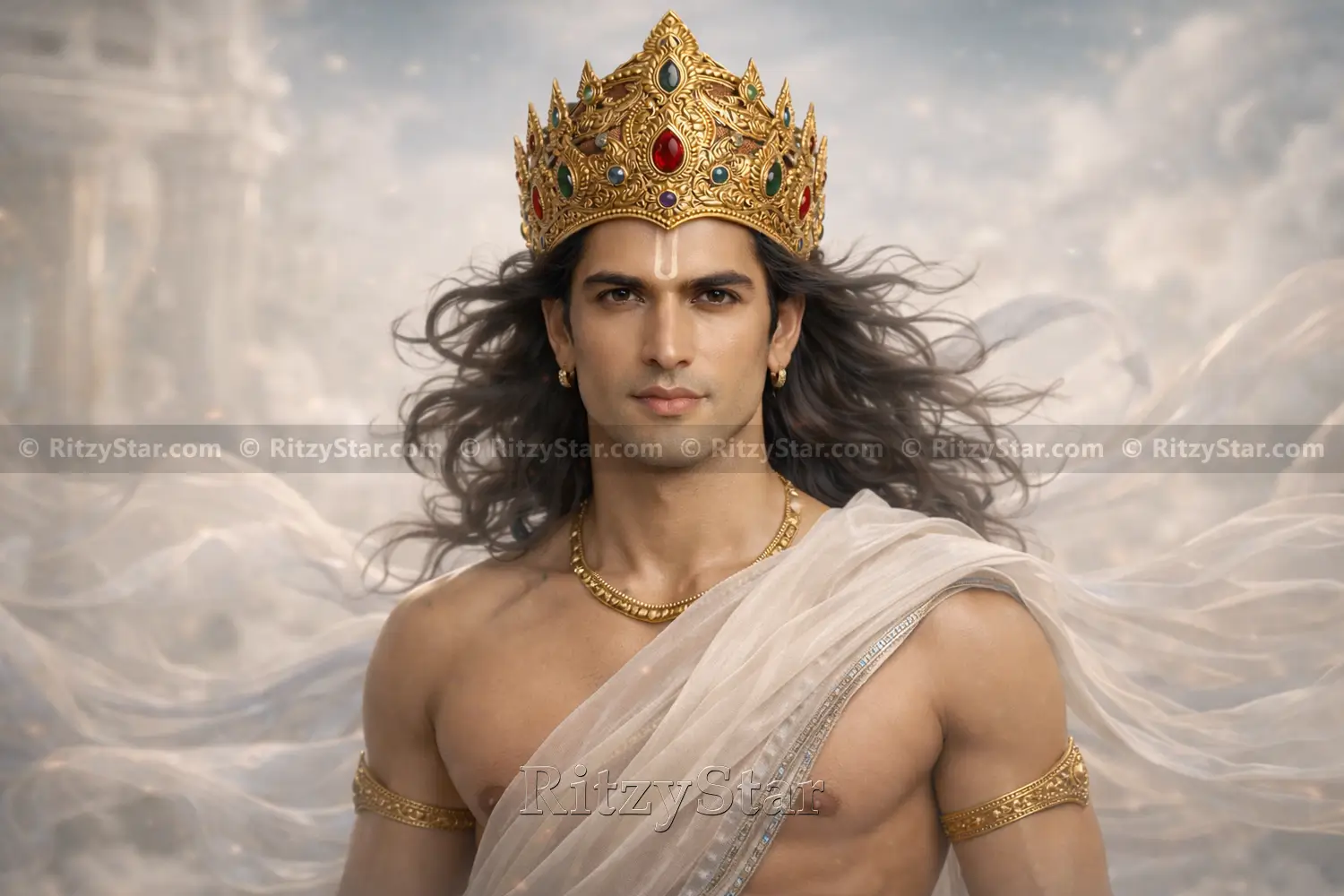
Vishvamitra was born as Kaushika—a Kshatriya king of the Lunar Dynasty (Chandravansha). His father was Gadhi, the king of Kanyakubja (modern-day Kannauj), and a descendant of the legendary King Kusha. In some genealogies, Gadhi is described as a powerful ruler who was also a scholar, and Kaushika inherited both his father’s throne and his ambition.
“गाधेः पुत्रो महावीर्यः कौशिको नाम पार्थिवः।
राजर्षिर्ब्रह्मविद्यायां निष्णातः सत्यवाक् शुचिः॥”
— by Author
Meaning: The son of Gadhi, of great valor, was the king named Kaushika. A royal sage, proficient in spiritual knowledge, truthful in speech, and pure.
As a young king, Kaushika ruled his prosperous kingdom with justice and strength. His armies were mighty, his treasury full, his people content. He had everything a king could desire—wealth, power, wives, children, and the respect of neighboring rulers.
But the gods had other plans. And a cow would change everything.
🐄 The Cow That Started It All – The Conflict with Vashishtha
The turning point of Vishvamitra’s life came not through philosophy or revelation, but through a cow—specifically, a celestial cow named Nandini, also known as Kamadhenu—the wish-fulfilling cow belonging to the great sage Vashishtha.
The Journey Through the Forest
King Kaushika, accompanied by his vast army, was traveling through the forests of his kingdom. The journey was long, the provisions began to run low, and the king’s entourage grew weary. They came upon the hermitage of Sage Vashishtha—a peaceful ashram nestled in the wilderness, where the great Brahmarishi lived with his disciples and his miraculous cow, Nandini.
“वशिष्ठस्याश्रमं प्राप्तः कौशिकः सह सैनिकैः।
आतिथ्यं याचयामास क्षुधार्तः परमेश्वरः॥”
— by Author
Meaning: Kaushika, together with his army, reached Vashishtha’s ashram. Weary with hunger, the great king requested hospitality.
Vashishtha, renowned for his hospitality, welcomed the king and his massive entourage. He then turned to Nandini, his celestial cow, and asked her to provide a feast worthy of the king and his army.
The Miraculous Feast
Nandini, being Kamadhenu herself, immediately produced an abundance of food, drink, and all manner of delicacies. The entire army—tens of thousands of soldiers, along with their horses, elephants, and attendants—ate to their heart’s content. And yet, the cow’s bounty never diminished.
“ततः सा कामधेनुश्च ससर्जान्नं सुशोभनम्।
भोजयामास राजानं ससैन्यं परमेश्वरम्॥”
— by Author
Meaning: Then that Kamadhenu produced excellent food and fed the king and his army, the great lord.
Kaushika was astonished. He had never seen anything like this—a single cow providing for an entire army. His amazement turned to desire. If this cow could serve his army in times of peace, imagine what she could do in times of war. With such a cow, he could feed his soldiers indefinitely, conquer any kingdom, and become the undisputed emperor of the world.
The Demand
Kaushika approached Vashishtha with a proposal—or rather, a demand befitting a king who was accustomed to getting what he wanted.
“इमां धेनुं महाभाग देहि मह्यं तपोधन।
अर्थिने क्षत्रियायाद्य राज्यविस्तारहेतवे॥”
— by Author
Meaning: “Give me this cow, O blessed one, give her to me, O treasure of austerities. To me, a Kshatriya who seeks it, for the expansion of my kingdom.”
He offered the sage wealth in exchange—gold, elephants, entire provinces. But Vashishtha, who regarded Nandini not as property but as a member of his spiritual family, refused. She was not for sale. She was not for barter. She was the heart of his ashram, the mother who sustained his disciples, the gift of the gods that could not be traded.
The Refusal and the King’s Rage
Kaushika, his pride wounded by the refusal, did what kings did when denied: he commanded his soldiers to take the cow by force.
“बलाद्धरध्वं गां तूर्णं यदि नो दीयते मुनिः।
क्षत्रियोऽहं न वै विप्रैः परिभूतो भवाम्यहम्॥”
— by Author
Meaning: “Seize the cow by force if the sage does not give her. I am a Kshatriya—I shall not be insulted by Brahmins.”
What followed was a lesson in the true nature of power.
The Army of Vashishtha
As Kaushika’s soldiers advanced on the cow, Nandini did not flee. Instead, she turned to Vashishtha with a look that asked permission to respond. When the sage nodded, she unleashed her power.
“वशिष्ठाज्ञया धेनुः सैन्यं तत्क्षत्रियस्य च।
ससर्ज योधान् दुर्धर्षान् दशसाहस्रिकान् रणे॥”
— by Author
Meaning: At Vashishtha’s command, the cow created, in battle, invincible warriors—tens of thousands of them.
From every pore of the celestial cow emerged armies—hundreds of thousands of warriors, fierce and indestructible, armed with divine weapons. They fell upon Kaushika’s forces and annihilated them in moments. The king’s hundred sons, who led the attack, were all killed. His army was destroyed. Only Kaushika himself survived, fleeing the battlefield in shame and terror.
“विनष्टसैन्यः स नृपः पुत्रशोकार्दितस्तदा।
एकाकी प्रययौ राजा चिन्तयन् क्षत्रियं बलम्॥”
— by Author
Meaning: With his army destroyed, the king, tormented by grief for his sons, fled alone, contemplating the power of the Kshatriya.
🕉️ The Great Transformation – From King to Ascetic
But Kaushika did not return to his palace to lick his wounds. He did not rebuild his army or seek revenge through conventional means. Something had broken in him—or rather, something had awoken.
The Realization
As he stood alone in the forest, the shattered remnants of his pride scattered around him, Kaushika understood something profound: the power of a Brahmin’s spiritual force—brahmatej—was greater than the power of a king’s armies. Weapons could be countered with weapons, but how did one counter a power that came from within, that was not dependent on soldiers or swords?
“नायुधैर्न बलै राज्ञो न मन्त्रैर्न च संपदा।
तपसैव तु यद्ब्राह्मं तद्वीर्यं सर्वदुर्जयम्॥”
— by Author
Meaning: “Not by weapons, not by armies, not by strategy, not by wealth—only by austerity is the Brahmin’s power achieved, which is invincible.”
And in that moment, Kaushika made a decision that would echo through eternity. He would abandon his kingdom. He would abandon his throne, his wealth, his identity as a king. He would become something far greater than he was born to be.
“त्यक्त्वा राज्यं सुखं सर्वं पुत्रदारधनादिकम्।
तपसे प्रययौ राजा दृढनिश्चयमास्थितः॥”
— by Author
Meaning: Renouncing his kingdom, all pleasures, sons, wife, and wealth, the king went forth to perform austerity, firm in his determination.
🔥 The Austerities – A Thousand Years of Fire
What followed was one of the most extraordinary tapasyas (austerities) ever recorded in Hindu mythology—a thousand-year-long battle between the will of one man and the combined forces of the cosmos.
The First Ascent – The Terror of Indra
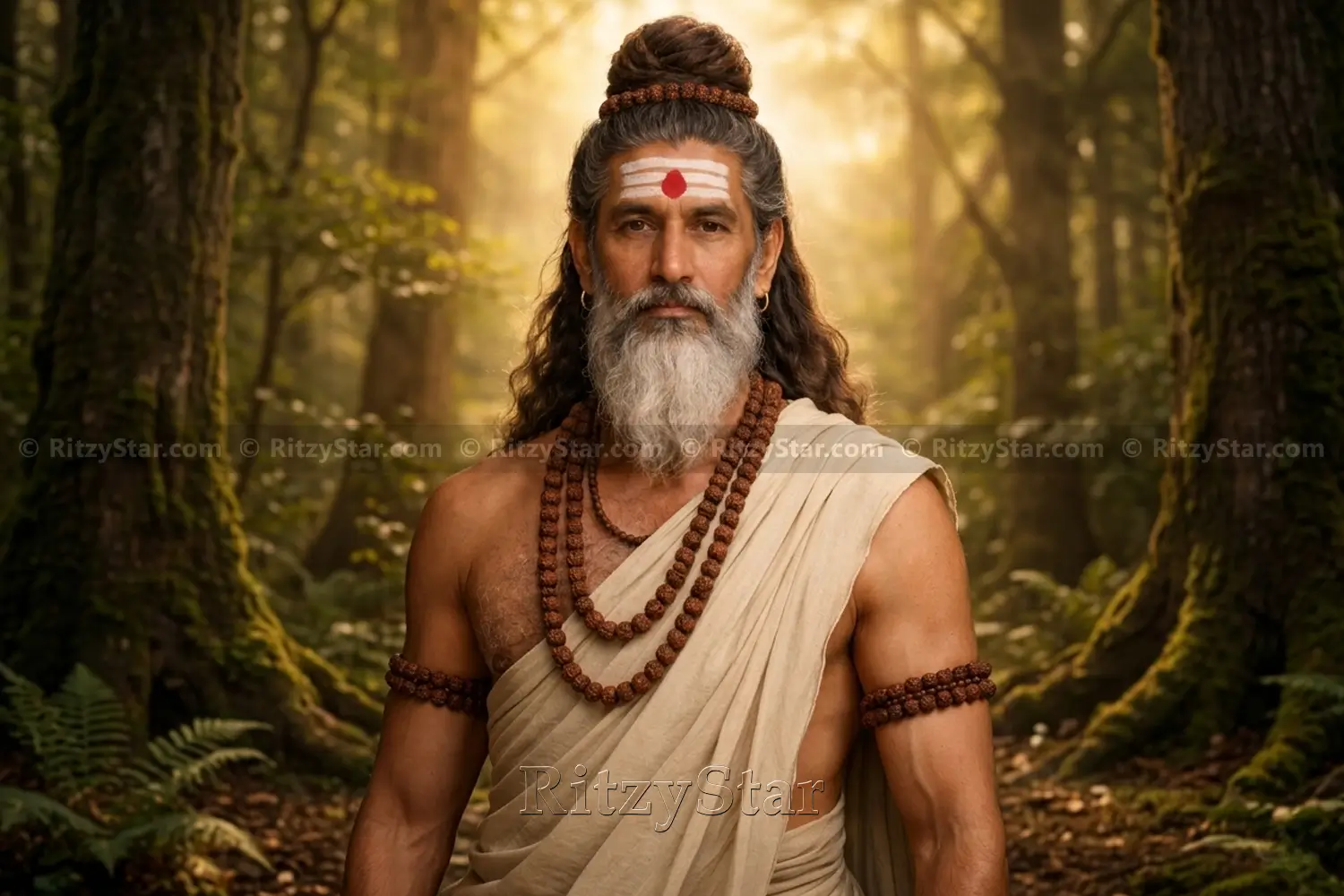
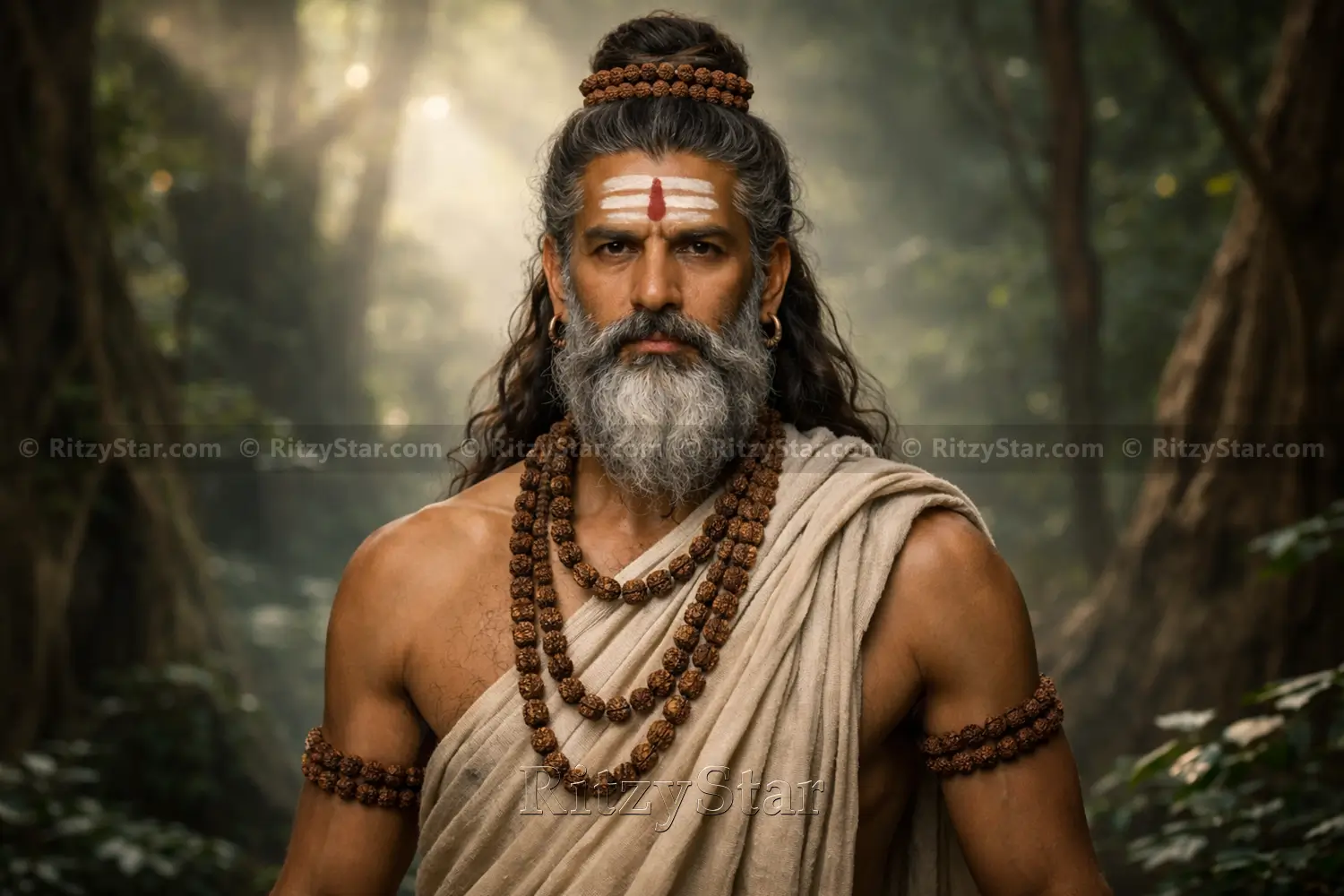
Kaushika—now calling himself Vishvamitra (Friend of the Universe)—began his austerities in the depths of the forest. He stood on one leg for months, arms raised to the sky, facing the burning sun. He survived on air alone, then on water, then on nothing. His body withered, his skin turned to leather, his hair grew into tangled mats. But his spirit burned brighter than ever.
“तपस्तेपे स घोरं तु विश्वामित्रो महातपाः।
दशवर्षसहस्राणि वायुभक्षो जितेन्द्रियः॥”
— by Author
Meaning: Vishvamitra, the great ascetic, performed fierce austerities for ten thousand years, sustaining himself on air, his senses conquered.
The gods grew alarmed. If Vishvamitra continued, his power would exceed that of Indra himself. So Indra, the king of gods, sent a celestial nymph—Menaka—to disrupt his meditation.
The Seduction of Menaka – The Fall and the Daughter
Menaka, the most beautiful of the apsaras, descended to the forest where Vishvamitra was meditating. Her beauty was designed to break the concentration of any ascetic. She danced, she sang, she moved with the grace of the wind through the trees.
For a thousand years, Vishvamitra had remained unmoved. But Menaka’s beauty was not ordinary—it was crafted by the gods themselves to be irresistible.
“मेनका नाम तेजस्वी विश्वामित्रं महामुनिम्।
रूपयौवनसम्पन्ना विचचार तपोवने॥”
— by Author
Meaning: Menaka, radiant and endowed with beauty and youth, moved through the ascetic forest, seeking Vishvamitra, the great sage.
The ascetic broke. His austerities shattered. Desire, dormant for so long, awakened in him. He and Menaka spent years together in the forest—years that Vishvamitra would later consider the greatest failure of his life.
From their union was born a daughter—Shakuntala, who would later become the mother of Emperor Bharata, the ancestor of the Kauravas and Pandavas. But at the moment of her birth, Vishvamitra was not present. Menaka, her task accomplished, returned to the heavens, leaving the newborn infant in the forest.
“शकुन्तला नाम सुता मेनकायां व्यजायत।
विश्वामित्रात् महाभागा या भारतकुलोद्भवा॥”
— by Author
Meaning: A daughter named Shakuntala was born to Menaka by Vishvamitra—the blessed one from whom the Bharata dynasty arose.
The Realization and Renewed Determination
When Vishvamitra awoke from his delusion and discovered what had happened, he was consumed by rage—not at Menaka, not at Indra, but at himself. He had allowed his senses to overcome his will. He had fallen from the path he had chosen.
But instead of despairing, Vishvamitra made a choice that defines his character: he returned to his austerities with even greater intensity.
“निर्वेदं परमं गत्वा विश्वामित्रो महामुनिः।
तपस्तेपे ततो भूयः सहस्रं परमं वर्षम्॥”
— by Author
Meaning: Having attained supreme dispassion, the great sage Vishvamitra again performed austerity for another thousand years.
🌊 The Creation of a Parallel Heaven – Challenging Indra
Vishvamitra’s austerities intensified. He now performed penances that terrified the gods themselves. His power grew to such proportions that the very fabric of the cosmos began to tremble.
The Threat to Indra
Indra, seeing that Vishvamitra’s power was now greater than ever, tried again to disrupt him. This time, he sent a beautiful apsara named Rambha. But Vishvamitra had learned from his failure with Menaka. When Rambha approached, he cursed her to become a rock for ten thousand years—and then returned to his meditation without breaking his focus.
“रम्भां शप्त्वा तदा क्रोधाद् विश्वामित्रो महातपाः।
पाषाणीभव दुष्टे त्वं दशवर्षसहस्रकम्॥”
— by Author
Meaning: Cursing Rambha in his wrath, the great ascetic Vishvamitra said: “Become a rock, O evil one, for ten thousand years.”
The Creation of Trishanku’s Heaven
Vishvamitra’s power had grown so immense that he could now perform acts normally reserved for the gods themselves. The story of Trishanku demonstrates the extent of his power.
King Trishanku desired to ascend to heaven in his mortal body. When the gods refused him, he approached Vishvamitra for help. The sage, in his compassion, agreed to conduct a great sacrifice that would elevate the king to the heavens.
“त्रिशङ्कोर्यज्ञमारब्धं विश्वामित्रेण धीमता।
देवास्तु तद्विघ्नं चक्रुर्न चासौ विमुखोऽभवत्॥”
— by Author
Meaning: The wise Vishvamitra began Trishanku’s sacrifice. The gods tried to obstruct it, but he did not turn back.
When Indra and the gods tried to prevent Trishanku’s ascent, Vishvamitra did something unprecedented. With the sheer force of his tapas, he created an entire parallel heaven—a new celestial realm—and began sending Trishanku there.
The gods, terrified that Vishvamitra would now create new gods to populate his new heaven, rushed to make peace. They agreed to allow Trishanku to reside in the heavens—suspended upside down, neither fully in heaven nor fully on earth, as a compromise. But Vishvamitra had proven his point: his power could rival that of the gods themselves.
“तपसा ब्रह्मणा चैव सृष्टं स्वर्गं त्रिशङ्कवे।
देवा विस्मितमायाताः सम्पूज्य ऋषिसत्तमम्॥”
— by Author
Meaning: By his austerity and Brahmic power, heaven was created for Trishanku. The gods, amazed, came to worship the best of sages.
📜 The Gayatri Mantra – Vishvamitra’s Greatest Gift
While Vishvamitra is known for his wars with Vashishtha and his battles with the gods, his greatest contribution to humanity is the revelation of the Gayatri Mantra—the most sacred verse in the Vedas, chanted by millions of Hindus every day.
The Mantra
“ॐ भूर्भुवः स्वः तत्सवितुर्वरेण्यं भर्गो देवस्य धीमहि धियो यो नः प्रचोदयात्॥”
Om Bhur Bhuva Swaha, Tat Savitur Varenyam, Bhargo Devasya Dhimahi, Dhiyo Yo Nah Prachodayat.
Meaning: We meditate upon the glorious splendor of the Creator. May he illuminate our minds.
This mantra, revealed to Vishvamitra during his deepest states of meditation, became the cornerstone of Hindu spiritual practice. It is said that the mantra contains within it the essence of the Vedas—the power to awaken the intellect, to purify the mind, to connect the seeker with the divine.
“विश्वामित्रेण या गायत्री दृष्टा परमतेजसा।
तया मुक्तिर्भवेद् राजन् सर्वक्लेशापहारिणी॥”
— by Author
Meaning: The Gayatri, seen by Vishvamitra of supreme brilliance, bestows liberation and removes all afflictions, O King.
⚔️ The Rivalry with Vashishtha – A Thousand Years of Conflict
The central drama of Vishvamitra’s life is his relationship with Vashishtha—the Brahmarishi who had defeated him with a cow, who embodied everything Vishvamitra sought to become, who represented the birthright he could never claim.
The Quest for Brahmarishi Status
After his first thousand years of austerity, Vishvamitra approached the gods, seeking recognition as a Brahmarishi (the highest class of sages, those who have attained Brahman-realization). The gods, impressed by his tapas, were willing to grant it—but Vashishtha, the embodiment of Brahminhood, was not.
“न त्वं ब्रह्मर्षितां प्राप्तो राजर्षिस्त्वं महायशः।
पुनस्तपस्तपस्वी त्वं यावद् ब्रह्मर्षितां व्रजेत्॥”
— by Author
Meaning: “You have not attained Brahmarishi status, O greatly famed one—you are a Rajarshi (royal sage). Continue your austerities until you attain Brahmarishi-hood.”
Vishvamitra was enraged. He had performed austerities that would have made any other being a god, yet this one sage stood in his way. And so began a thousand-year-long struggle—not of arms, but of wills.
The Second Round – Vashishtha’s Sons
In his rage, Vishvamitra unleashed his power against Vashishtha. Using his ascetic powers, he created a legion of warriors who attacked Vashishtha’s ashram. But Vashishtha, with nothing but his brahmadanda (a staff imbued with Brahmic power), destroyed them all—and then, with a single word, reduced Vishvamitra’s entire kingdom to ashes.
“वशिष्ठस्य ब्रह्मदण्डः सर्वसैन्यविनाशकः।
कौशिकस्य पुरं चापि भस्मसाच्चक्रिरे मुनेः॥”
— by Author
Meaning: Vashishtha’s Brahmadanda destroyed all armies, and the sage also reduced Kaushika’s city to ashes.
The Third Round – The Self-Doubt
Vishvamitra retreated to the forest, humiliated once again. He began to doubt himself. Perhaps he was not worthy. Perhaps a Kshatriya could never become a Brahmarishi. Perhaps birth mattered more than effort.
But then he remembered: Vashishtha himself was not born a Brahmin. Vashishtha was born from the mind of Brahma—he was a manasaputra, a mind-born son of the creator. He had no birth at all, in the ordinary sense. If Vashishtha could be a Brahmarishi without being born a Brahmin, then why couldn’t Vishvamitra, who had the will to become one?
“न जातिर्ब्राह्मणस्येह न संस्कारो न चान्वयः।
तपसैव हि यो धर्मी स विप्र इति निश्चयः॥”
— by Author
Meaning: “Neither birth, nor ritual, nor lineage makes a Brahmin. Only austerity and righteousness—that is the true mark of a Brahmin.”
And with this realization, Vishvamitra resumed his austerities with greater intensity than ever before.
🕊️ The Final Transformation – The Acknowledgment
After thousands of years of austerity, after failures and renewals, after wars with gods and conflicts with sages, Vishvamitra reached a state of perfect equanimity.
The Test of Equanimity
When he had achieved this state, the gods sent a final test. Vashishtha himself came to Vishvamitra’s hermitage. But this time, Vishvamitra did not rage. He did not prepare for battle. He rose, greeted the sage with respect, and offered him the hospitality that Vashishtha had once offered him, so long ago.
“वशिष्ठं पूजयामास विश्वामित्रस्तपोधनः।
न क्रोधो न च संरम्भो न मानो हृदि वर्तते॥”
— by Author
Meaning: Vishvamitra, the treasure of austerity, worshipped Vashishtha. Neither anger, nor agitation, nor pride remained in his heart.
Vashishtha, seeing the transformation, embraced his former rival. He acknowledged that Vishvamitra had achieved what no Kshatriya had ever achieved before—he had become a Brahmarishi, equal to the greatest sages who had ever lived.
“ब्रह्मर्षिस्त्वं महातेजा विश्वामित्र न संशयः।
तपसा दग्धपाप्मा त्वं सर्वैः सम्पूजितो मुनिः॥”
— by Author
Meaning: “You are a Brahmarishi, O great-splendored Vishvamitra—there is no doubt. You have burned away all sin through austerity, and you are worshipped by all sages.”
👨👩👦 The Family of Vishvamitra
| Sl.No | Name | Relationship | Children | Remarks |
|---|---|---|---|---|
| 1 | Menaka (Celestial Apsara) | Union (sent by Indra to disrupt his penance) | 1. Shakuntala – Born in the forest after Menaka left; raised by Sage Kanva; later married King Dushyanta; mother of Emperor Bharata, after whom India (Bharatavarsha) is named. | This union occurred during Vishvamitra’s early austerities when he was still a Rajarshi. Menaka’s seduction caused him to temporarily abandon his penance. After Shakuntala’s birth, Menaka returned to heaven, and Vishvamitra resumed his austerities with renewed determination. |
| 2 | Madhavi (Princess, daughter of King Yayati) | Union (to complete Sage Galava’s guru-dakshina) | 1. Sushruta (Ashtaka) – A king-sage who combined royal blood with Brahmanical spiritual power. His descendants included both warriors and sages; founder of the Ashtaka dynasty in some traditions. | This union occurred much later in Vishvamitra’s life. Madhavi was given to him by his disciple Galava, who had been using her to obtain horses from kings. Vishvamitra accepted her to produce a son, thereby freeing Galava from his obligation without requiring the remaining horses. |
| 3 | Other Wives (Names vary by text) | Various | Numerous sons – According to the Puranas, Vishvamitra had over 100 sons from various wives. Most notable among them: Shunahshepa (adopted, saved from sacrifice), and other sons who became the progenitors of many gotras. | The Vishvamitra gotra (lineage) is one of the largest Brahmin gotras in India today. Many Brahmin families trace their ancestry to Vishvamitra’s sons, who spread across the subcontinent. |
Notes on the Family Table:
- Menaka – The celestial nymph sent by Indra to break Vishvamitra’s meditation. Their union was brief but produced Shakuntala, whose lineage became central to Indian history. This relationship was not a marriage in the conventional sense.
- Madhavi – The princess of the Lunar Dynasty who was given to Vishvamitra by his disciple Galava. Their union produced Sushruta (Ashtaka). This arrangement was transactional—Madhavi was given to Vishvamitra to produce a son, after which she returned to Galava.
- Other Wives – Various texts mention that Vishvamitra had multiple wives during his years as a king before renouncing the world. After becoming an ascetic, he had no further unions except those described above.
- No Traditional Marriage – Unlike many sages who had formal wives (patnis), Vishvamitra’s significant unions were primarily with celestial nymphs or through transactional arrangements. His primary identity was as an ascetic, not a householder.
🌊 The Creation of the Sarasvati River – A Sage’s Compassion
One of the most extraordinary episodes in Vishvamitra’s life occurred during a terrible drought that devastated the land. Sages, animals, and ordinary people were dying of thirst. In his compassion, Vishvamitra decided to do something that only a being of immense spiritual power could attempt—he created a river.
The River from Austerity
Through his tapas, Vishvamitra called upon the celestial river Sarasvati—the goddess of knowledge and flow—to manifest on earth. But the river was reluctant. So Vishvamitra, with the power of his will, compelled her to appear.
“विश्वामित्रेण संप्राप्ता सरस्वती महानदी।
तपसा च प्रसादेन देवानामपि दुर्लभा॥”
— by Author
Meaning: By Vishvamitra’s power, the great river Sarasvati was brought forth—a feat difficult even for the gods, achieved through his austerity and grace.
The river flowed, quenching the thirst of countless beings. To this day, the Sarasvati River is venerated in Hindu tradition, and its mythical existence is attributed to Vishvamitra’s compassion.
📖 The Gayatri Mantra – A Deeper Understanding
The Gayatri Mantra, revealed by Vishvamitra, is considered the essence of the Vedas. Its significance cannot be overstated.
The Structure of the Mantra
- Om – The primordial sound, the source of all creation
- Bhur Bhuvah Svah – The three worlds: earth, atmosphere, heaven (or the three planes of existence)
- Tat Savitur Varenyam – That adorable effulgence of the Creator
- Bhargo Devasya Dhimahi – We meditate upon that divine light
- Dhiyo Yo Nah Prachodayat – May he illuminate our intellects
The Significance
The mantra is not merely a prayer—it is a vibration that aligns the seeker with the cosmic order. It is said to purify the mind, awaken the intellect, and lead the practitioner toward liberation. For millennia, it has been recited at dawn, noon, and dusk by millions of practitioners.
“गायत्री वेदमाता च विश्वामित्रेण दर्शिता।
त्रिकालं यो जपेन्नित्यं स मुच्येत् सर्वकिल्बिषैः॥”
— by Author
Meaning: The Gayatri, mother of the Vedas, was revealed by Vishvamitra. Whoever chants it daily at the three junctures is freed from all impurities.
🕉️ Vishvamitra in the Ramayana – The Royal Preceptor
Vishvamitra appears prominently in the Ramayana, where he plays a crucial role in the early life of Rama. By this time, he is already a revered Brahmarishi, recognized by all as one of the greatest sages who ever lived.
The Journey to Mithila
In the Ramayana, Vishvamitra approaches King Dasharatha of Ayodhya and requests that Rama and Lakshmana accompany him to protect his sacrifice from demons. Dasharatha is reluctant to send his young sons, but Vishvamitra’s status is such that the king cannot refuse.
“रामलक्ष्मणौ राजेन्द्र देहि मह्यं महाबलौ।
रक्षार्थं यज्ञवाटस्य राक्षसा विघ्नकारिणः॥”
— Ramayana
Meaning: “Give me Rama and Lakshmana, O great king, the mighty ones, for the protection of my sacrificial ground—the demons are causing obstacles.”
The Teaching of Divine Weapons
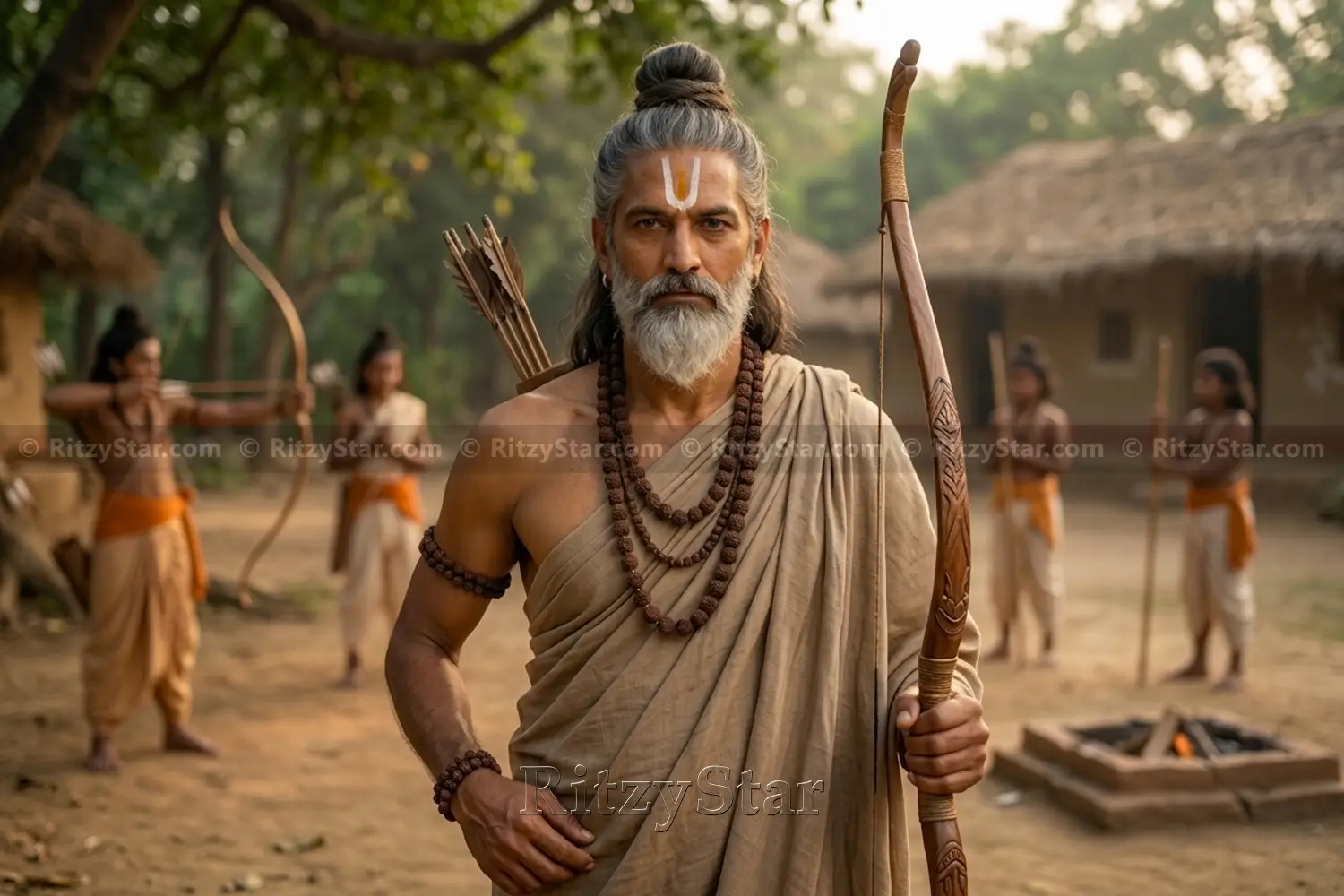
During their journey, Vishvamitra teaches Rama the use of divine weapons—the Astra Shastra—including the ultimate weapon, the Brahmastra. He guides Rama through the forest, protects him from demons, and ultimately leads him to Mithila, where Rama meets Sita and breaks Shiva’s bow.
“विश्वामित्रप्रसादेन रामो लब्ध्वा महायुधान्।
ताटकां निजघानाजौ सुबाहुं च नराधिप॥”
— Ramayana
Meaning: By Vishvamitra’s grace, Rama obtained great weapons. He killed Tataka in battle, O King, and also Subahu.
Vishvamitra’s role in the Ramayana shows him as a teacher, a protector, and a catalyst for the events that would lead to the defeat of Ravana. He represents the bridge between the old world of Vedic sages and the new world of epic heroes.
🌟 Vishvamitra’s Legacy – The Sage Who Redefined Divinity
Vishvamitra’s legacy is profound and multifaceted. He is:
The Author of the Gayatri Mantra
The Gayatri Mantra, revealed by Vishvamitra, remains the most sacred verse in Hinduism. It is chanted daily by millions, and it is considered the essence of the Vedas.
The Symbol of Self-Transformation
Vishvamitra’s story is the ultimate testament to the power of will. He was not born a Brahmin. He had no special privilege of birth. What he achieved, he achieved through sheer, relentless effort—over thousands of years, through failure after failure, through rage and despair and renewal.
“न जातिर्न कुलं राजन् तप एव विशिष्यते।
विश्वामित्रो यथा प्राप्तो ब्रह्मर्षित्वं परन्तप॥”
— by Author
Meaning: Neither birth nor lineage, O King, but austerity alone is supreme. Thus did Vishvamitra, O scorcher of enemies, attain Brahmarishi-hood.
The Bridge Between Worlds
Vishvamitra embodied both Kshatriya power and Brahmin wisdom. He showed that the two were not mutually exclusive—that a warrior could become a sage, that strength could be transformed into wisdom.
The Preceptor of the Ramayana
As Rama’s teacher, Vishvamitra shaped the hero who would become the ideal of kingship. Without his guidance, Rama might never have learned the divine weapons, never have reached Mithila, never have met Sita.
The Ancestor of Countless Lineages
The Vishvamitra gotra is one of the largest Brahmin gotras in India today. Countless families trace their ancestry to his sons, making him a living presence in the spiritual geography of modern India.
📖 The Deeper Meaning – What Vishvamitra’s Story Teaches Us
Like all great myths, Vishvamitra’s story operates on multiple levels—historical, moral, spiritual.
The Power of Will
Vishvamitra’s story teaches that will is stronger than birth. He was born a Kshatriya, but he refused to accept the limitations of his birth. Through effort alone, he achieved what was thought impossible.
“इच्छाशक्तिर्महाशक्तिः तपसा यत्समर्जिता।
विश्वामित्रो यया प्राप्तो ब्रह्मर्षित्वं सुदुर्लभम्॥”
— by Author
Meaning: The power of will is a great power, acquired through austerity. By it, Vishvamitra attained Brahmarishi-hood, which is so difficult to achieve.
The Necessity of Failure
Vishvamitra failed—spectacularly. He lost his army, his sons, his pride. He was seduced by Menaka and fell from his penance. He raged, he cursed, he destroyed. But each failure taught him something. Each failure made him stronger. His story is not of effortless perfection, but of persistence through failure.
The Reconciliation of Opposites
Vishvamitra’s ultimate reconciliation with Vashishtha represents the reconciliation of Kshatriya and Brahmin, of power and wisdom, of action and contemplation. In the end, the two great rivals embrace, acknowledging that each needs the other.
The True Meaning of Brahminhood
Through Vishvamitra, Hindu tradition articulates a radical idea: Brahminhood is not a matter of birth, but of attainment. Any person, regardless of origin, can achieve the highest spiritual status through discipline and dedication.
🌅 Conclusion – The Man Who Became a Universe
Vishvamitra—the “Friend of the Universe”—lived up to his name. He befriended the cosmos through the sheer force of his will. He forced the gods to bend, created new heavens, and revealed the mantra that would guide humanity for millennia.
“विश्वामित्रो महातेजा राजर्षिर्ब्रह्मर्षितां गतः।
तपसा दग्धपाप्मा च सर्वलोकनमस्कृतः॥”
— by Author
Meaning: Vishvamitra of great splendor, the royal sage who attained Brahmin-hood, burned away all sin through austerity, and is revered by all worlds.
His story is the story of human potential—of what we can become when we refuse to accept the limitations imposed by birth, by circumstance, by the judgments of others. He shows us that the path to greatness is not smooth, that failure is part of the journey, that rage and humility are both teachers.
“या देवी सर्वभूतेषु विश्वामित्रात्मिका स्थिता।
नमस्तस्यै नमस्तस्यै नमस्तस्यै नमो नमः॥”
— by Author
Meaning: To that divinity who abides in all beings as the spirit of Vishvamitra, salutations to her, salutations to her, salutations to her again and again.
From a king who wanted a cow to a sage who gave humanity the Gayatri Mantra—this is the arc of Vishvamitra’s life. It is a journey of a thousand years, of failure and renewal, of rage and peace, of death and rebirth. It is, in the end, the journey of every soul that seeks to transcend its origins and become something greater.
Discover more from RitzyStar
Subscribe to get the latest posts sent to your email.