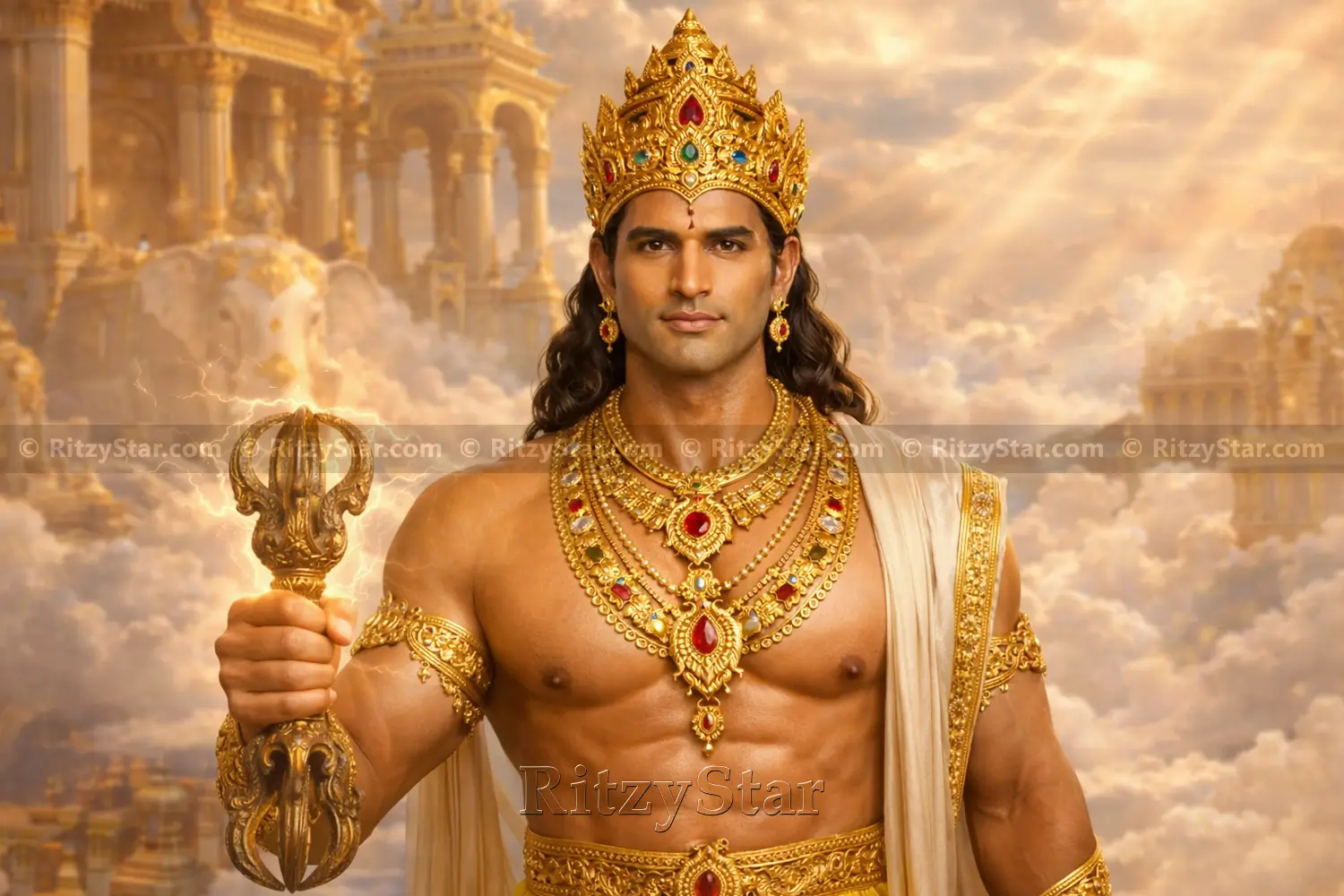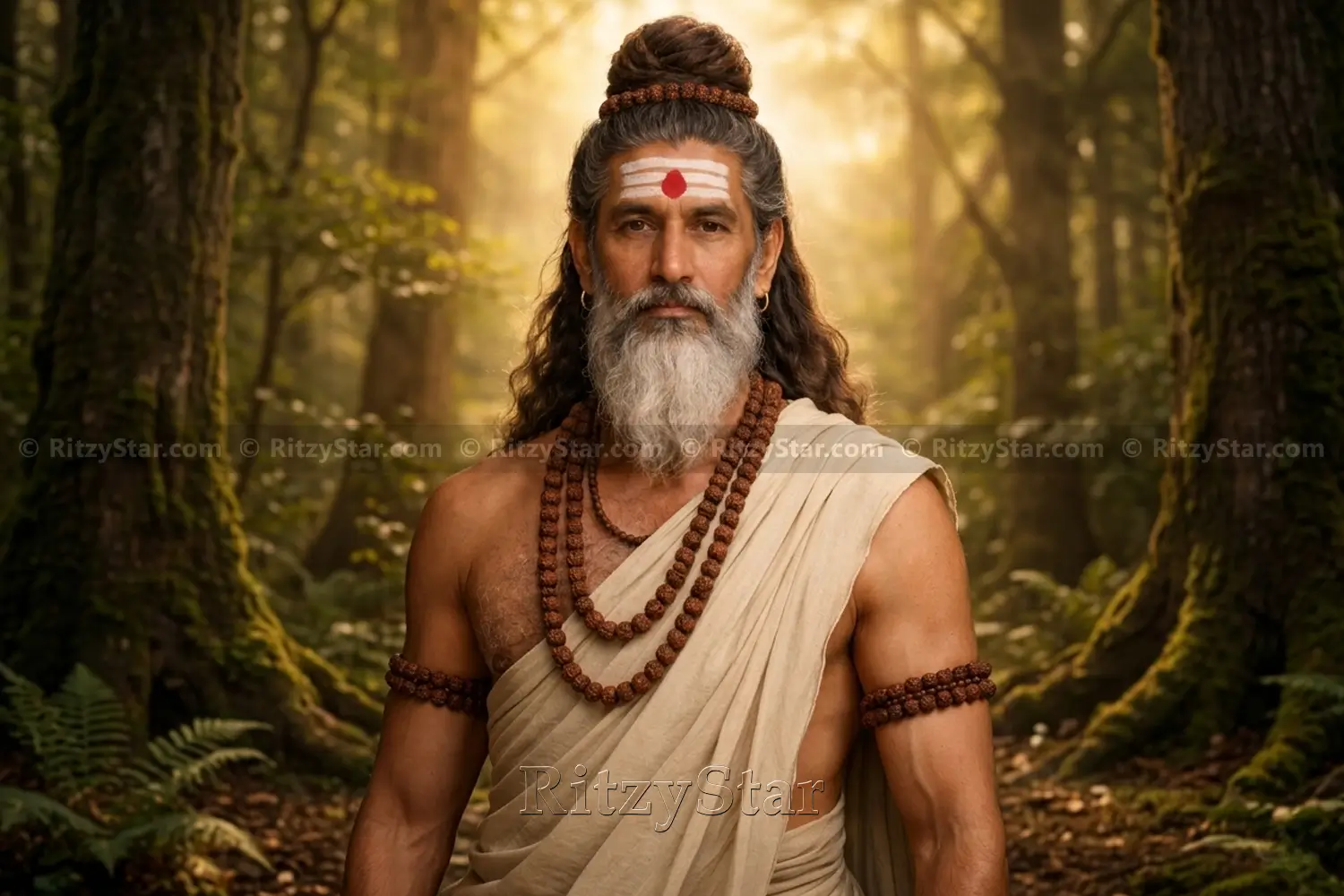
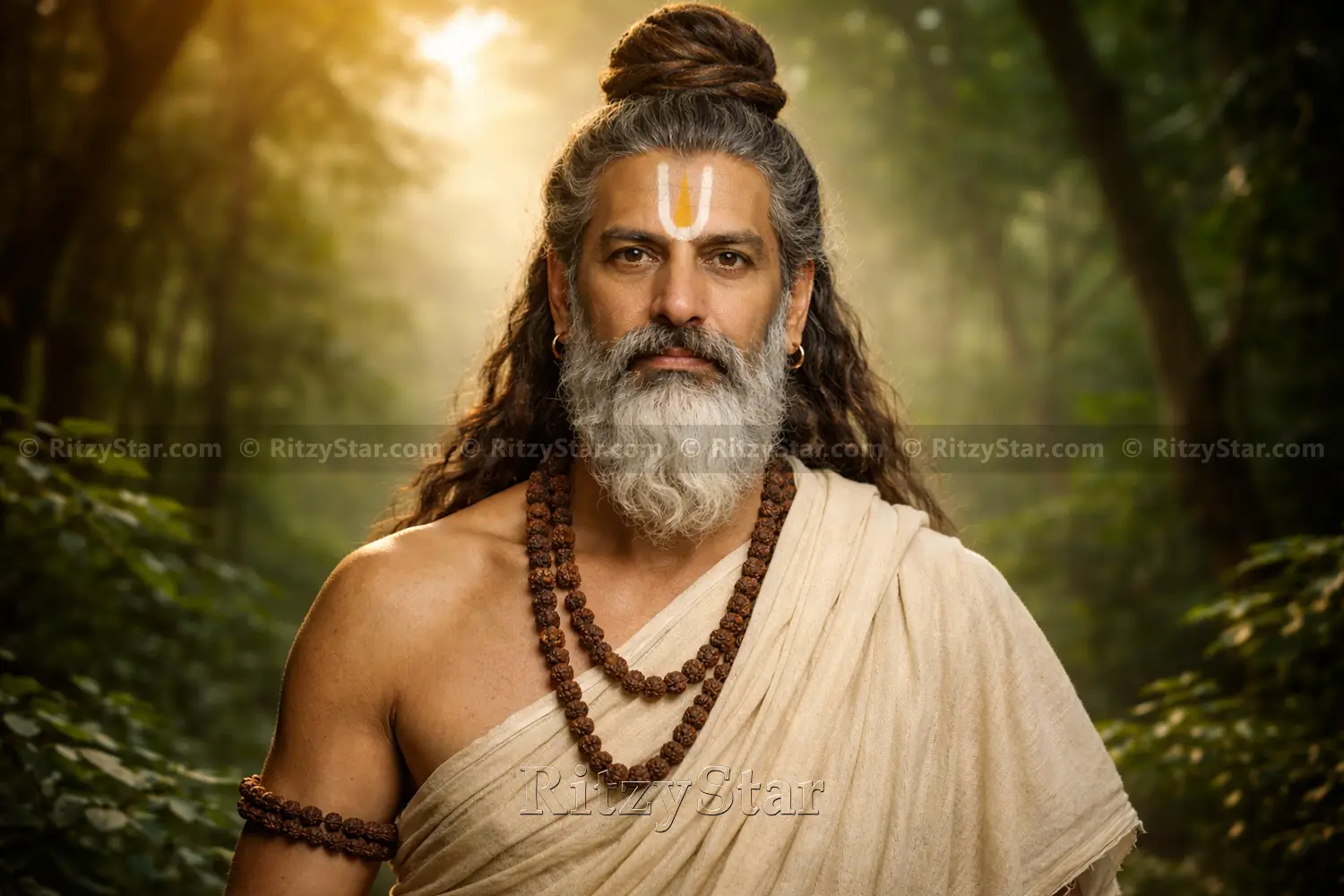
Keeper of the Brahmadanda, Priest of the Gods, The Immortal Heart of the Vedas
“वसिष्ठो ब्रह्मपुत्रोऽभूद्ब्रह्मर्षीणां महत्तमः।
येन तपोबलादेव जगत्स्थितिमवाप्नुयात्॥”
— Ancient Verse
Meaning: Vasishtha, the son of Brahma, the greatest among Brahmarishis, through whose power of austerity the very existence of the world is maintained.
🌿 Introduction: The Sage Who Was Born of Divine Will
He is not born of woman. He is not conceived in the ordinary way. He emerges fully formed from the mind of Brahma, a being of pure consciousness, a son created not by desire but by necessity. And yet, for all his divine origin, he will know sorrow deeper than any mortal. He will lose all his children. He will watch his hermitage burn. He will be tormented by a king’s arrogance, haunted by a curse he cannot escape, and driven to the edge of existence itself.
This is the story of Vasishtha.
The most revered sage of the Vedic age. The family priest of the Solar Dynasty. The author of hymns that still echo in temples and homes across India. The keeper of the Brahmadanda—the staff of cosmic authority that even gods fear. And yet, a man who once tried to end his own life, so profound was his grief.
“वसिष्ठो ब्रह्मपुत्रोऽभूद्ब्रह्मर्षीणां महत्तमः।
येन तपोबलादेव जगत्स्थितिमवाप्नुयात्॥”
— by Author
Meaning: Vasishtha, the son of Brahma, the greatest among Brahmarishis, through whose power of austerity the very existence of the world is maintained.
In the vast tapestry of Hindu mythology, where gods and demons wage eternal war, Vasishtha stands apart. He is not a warrior, not a king, not a deity in the conventional sense. He is something rarer—a man whose will shapes reality, whose curse can fell armies, whose blessings can raise dynasties. He is the bridge between the divine and the human, the mortal who became immortal, the sage who refused to die even when he wanted to.
📜 Who Was Vasishtha? The Mind-Born Son of Brahma
The origins of Vasishtha are unlike any other. While most beings are born from wombs, Vasishtha was born from the mind of Brahma, the creator god. He is one of the Prajapatis—the primordial progenitors—entrusted with the task of populating and guiding the cosmos.
The Ten Mind-Born Sons
According to the Puranas, Brahma created ten sons from his mind—beings of pure consciousness, without the need for physical birth. These were the great sages Marichi, Atri, Angiras, Pulastya, Pulaha, Kratu, Bhrigu, Daksha, Narada—and Vasishtha.
“ब्रह्मणो मानसाः पुत्रा दश ते ब्रह्मवादिनः।
तेषां वसिष्ठः प्रवरस्तपोयोगबलान्वितः॥”
— by Author
Meaning: The mind-born sons of Brahma were ten, all proclaimers of the Vedas. Among them, Vasishtha was the foremost, endowed with the power of austerity and yoga.
Each of these sages would go on to found lineages, create dynasties, and shape the course of cosmic history. But Vasishtha’s role was unique. He was appointed as the Kula-guru (family priest) of the Solar Dynasty, the Ikshvaku kings who ruled from Ayodhya. From the first king, Ikshvaku, to the last, Rama, Vasishtha would be there—guiding, advising, and protecting.
The Name Vasishtha
His name itself carries meaning. “Vasishtha” means “the most excellent,” “the best,” “the supremely wealthy.” Not wealthy in gold or land, but wealthy in wisdom, in tapas, in spiritual power. He is the embodiment of the ideal sage—learned, powerful, serene, and unshakeable.
But as we shall see, even the most excellent can be shaken.
🔥 The Power of Vasishtha – More Than a Sage
Vasishtha was not merely a scholar or a priest. He possessed powers that rivaled the gods themselves. His tapas (austerity) had accumulated over millennia, granting him abilities that transcended ordinary human limits.
The Brahmadanda – The Staff of Brahma
The most potent symbol of Vasishtha’s power was the Brahmadanda—the staff of Brahma. This was not an ordinary staff. It was a weapon of cosmic authority, capable of countering any other weapon, including the divine astras of the gods.
“ब्रह्मदण्डं महादिव्यं ब्रह्मणा परमेष्ठिना।
वसिष्ठाय प्रदत्तं यद्विष्णुचक्रादिवारकम्॥”
— by Author
Meaning: The supremely divine Brahmadanda, given by Brahma himself to Vasishtha, was capable of countering even Vishnu’s discus.
According to tradition, Brahma bestowed this staff upon Vasishtha as a symbol of his authority as the chief priest of the Solar Dynasty. The staff represented the power of Brahma himself—the power of creation, preservation, and destruction wielded through dharma. Whoever held the Brahmadanda could not be defeated by force. They could only be challenged through righteousness.
The Kamadhenu – Nandini, The Wish-Fulfilling Cow
Vasishtha’s hermitage was home to Nandini, the daughter of Kamadhenu, the celestial wish-fulfilling cow. Nandini was not an ordinary cow. She could provide anything her master desired—food, wealth, weapons, armies. She was a living treasury, a mobile kingdom, a source of infinite abundance.
“नन्दिनी कामधेन्वंशा वसिष्ठाश्रमवासिनी।
यस्याः प्रसादतः सिद्धिर्वसिष्ठस्य महात्मनः॥”
— by Author
Meaning: Nandini, descendant of Kamadhenu, dwelt in Vasishtha’s hermitage. Through her grace, the great-souled Vasishtha attained all accomplishments.
This cow would become the center of one of the most famous conflicts in Hindu mythology—the confrontation between Vasishtha and King Vishwamitra, a conflict that would transform a king into a sage and test the limits of a sage’s patience.
The Power of the Curse
Vasishtha’s words carried the force of reality. When he cursed, his curses could not be undone—not by gods, not by demons, not by time itself. Yet, paradoxically, Vasishtha was known for his restraint. He rarely cursed. His default response to provocation was patience, forgiveness, and silence. This made his curses all the more devastating when they did come.
👑 The Conflict with Vishwamitra – When Kings Challenge Sages
The story of Vasishtha and Vishwamitra is one of the most dramatic narratives in Hindu mythology. It is a tale of pride and humility, of ambition and surrender, of a king who tried to steal a sage’s power and ended up becoming a sage himself.
The Meeting at Vasishtha’s Hermitage
King Vishwamitra was one of the most powerful monarchs of his age. A descendant of the Lunar Dynasty, he ruled a vast kingdom and commanded armies that could conquer the world. One day, while traveling through his territories, he came upon Vasishtha’s hermitage.
“विश्वामित्रो महाराजो वसिष्ठाश्रममागमत्।
दृष्ट्वा तं सर्वसम्पन्नं विस्मयं परमं गतः॥”
— by Author
Meaning: The great king Vishwamitra came to Vasishtha’s hermitage. Seeing its abundance, he was filled with supreme wonder.
The hermitage was not what the king expected. It was not a simple hut in the forest. It was a thriving community—with gardens, halls, schools, and countless disciples. And at its heart was Nandini, the celestial cow, whose presence made all this abundance possible.
The King’s Desire
Vishwamitra was overcome with desire. He wanted Nandini. He offered Vasishtha unimaginable wealth—elephants, gold, entire provinces—in exchange for the cow. But Vasishtha refused.
“नन्दिनी मम सर्वस्वं तपसश्च फलं महत्।
नाहं दास्यामि राजेन्द्र न धनेन न राज्यतः॥”
— by Author
Meaning: “Nandini is my everything, the great fruit of my austerity. I will not give her, O king, not for wealth, not for a kingdom.”
The refusal stung Vishwamitra’s pride. He was the most powerful king on earth. He was not accustomed to being denied. What happened next would change the course of both their lives.
The Attempt to Take Nandini
Vishwamitra ordered his soldiers to seize Nandini by force. The cow, seeing her master’s distress, approached him and asked what she should do.
“भगवन् किमहं कुर्यां राज्ञोऽमी बलदर्पिताः।
नयन्ति मां बलाद्राजन् त्वं मां रक्षितुमर्हसि॥”
— by Author
Meaning: “O lord, what shall I do? These men, drunk with power, are taking me by force. O king, you must protect me.”
Vasishtha simply said: “They are not taking you by force. You are the one who decides whether to go or stay.”
The Army of the Cow
And then Nandini acted. From her body emerged entire armies—Pahlavas, Shakas, Yavanas, Kambojas—warriors from every corner of the known world. They fell upon Vishwamitra’s forces and decimated them. Son after son of the king was killed in the battle that followed. Vishwamitra himself barely escaped with his life.
“नन्दिन्याः क्रोधजाः सैन्या विनिघ्नन्ति नृपात्मजान्।
विश्वामित्रो रणे हत्वा पुत्रान् सर्वानपि क्रमात्॥”
— by Author
Meaning: The armies born of Nandini’s wrath slaughtered the king’s sons. Vishwamitra saw all his sons killed, one by one, in battle.
The Turning Point
Humbled and enraged, Vishwamitra retreated to the forest. He had lost everything—his pride, his army, his sons. And in that loss, a seed was planted. He began to practice austerity, not to gain power over others, but to surpass Vasishtha himself. He would not rest until his own tapas matched the sage’s.
“तपश्चरामि घोरं वै यावन्न भवति मे बलम्।
वसिष्ठतुल्यं राजेन्द्र तदा शान्तिर्भविष्यति॥”
— by Author
Meaning: “I will perform fierce austerity until I gain power equal to Vasishtha’s. Then, O king, there will be peace.”
What followed was centuries of penance, interrupted periodically by worldly distractions and renewed determination. Vishwamitra would rise to immense spiritual heights, only to fall into anger or desire, and then rise again. Each time, he approached closer to his goal.
The Final Test
After thousands of years of austerity, Vishwamitra had accumulated tapas that rivaled the gods. He had created a new heaven, a new universe in his own mind. He had become a Rajarshi (royal sage). But he was not yet a Brahmarshi (Brahmin sage)—the highest order of sagehood, the rank Vasishtha held.
He approached Vasishtha one last time. But this time, he did not come as a king demanding wealth. He came as a seeker.
“वसिष्ठ मुनिशार्दूल राजर्षिरहमागतः।
ब्रह्मर्षित्वं कथं प्राप्यं तन्मे ब्रूहि महामुने॥”
— by Author
Meaning: “Vasishtha, tiger among sages, I have come as a royal sage. How can one attain Brahmarshi status? Tell me, great sage.”
Vasishtha looked at him—this king who had tried to steal his cow, who had been humbled, who had spent lifetimes in penance. And he spoke the words that would transform Vishwamitra forever:
“ब्रह्मर्षित्वं न राज्येन न तपसा न विद्यया।
केवलं क्षमया प्राप्यं विनयेन दयेन च॥”
— by Author
Meaning: “Brahmarshi status is not attained through kingdom, not through austerity, not through knowledge alone. It is attained through forgiveness, through humility, through compassion.”
And Vishwamitra, the king who had once tried to steal by force, understood. He bowed before Vasishtha. And in that moment of surrender, he became a Brahmarshi.
“विश्वामित्रो नमश्चक्रे वसिष्ठस्य महात्मनः।
ब्रह्मर्षित्वं तदा प्राप्तं वसिष्ठस्यानुकम्पया॥”
— by Author
Meaning: Vishwamitra bowed to the great-souled Vasishtha. Then, by Vasishtha’s grace, he attained Brahmarshi status.
💔 The Tragedy of Vasishtha – The Curse of the Hundred Sons
For all his power, Vasishtha was not immune to sorrow. In fact, his sorrow is perhaps greater than any other sage’s. He was cursed to lose his sons—not once, but repeatedly. And this curse came from a source he could not escape: his own anger.
The Curse of King Kalmashapada
The story begins with King Kalmashapada (also known as Saudasa), a ruler of the Solar Dynasty. Vasishtha had served as the family priest for generations, and his relationship with the king was one of mutual respect.
But the king was cursed by a demon. Tricked by a flesh-eating demon named Kinkara, Kalmashapada was transformed into a rakshasa—a man-eating monster. In this state, he lost all reason and all memory of his dharma.
One day, while wandering in the forest in his monstrous form, Kalmashapada encountered Vasishtha’s son, Shakti. The king, driven by hunger and the demon’s influence, attacked and devoured Shakti.
“काल्माषपादो राजर्षी राक्षसत्वमुपागतः।
शक्तिं वसिष्ठपुत्रं तु भक्षयामास दारुणम्॥”
— by Author
Meaning: The royal sage Kalmashapada, having become a rakshasa, brutally devoured Shakti, the son of Vasishtha.
When Vasishtha learned what had happened, grief overwhelmed him. He cursed the king, saying that he would remain a rakshasa until the end of the kalpa—an eternity. But this curse did not bring his son back. And worse, it was only the beginning.
The Cycle of Loss
The king, now cursed, continued his rampage. One by one, Vasishtha’s hundred sons encountered the rakshasa king in the forest. And one by one, they were devoured.
“शतं पुत्रा वसिष्ठस्य शक्तिपूर्वा महात्मनः।
सर्वे भक्षिताः काल्माषपादेन दुष्टचेतसा॥”
— by Author
Meaning: The hundred sons of Vasishtha, led by Shakti, all great-souled—all were devoured by the evil-minded Kalmashapada.
Imagine this grief. A father losing one son is tragedy. Losing a hundred, one after another, is annihilation. Vasishtha, the great sage, the keeper of the Brahmadanda, the priest of kings—was utterly destroyed by sorrow.
The Attempt to End Life
In his grief, Vasishtha could see no purpose in continuing. His lineage was wiped out. His children were gone. What was the point of his vast powers, his accumulated tapas, if he could not protect his own?
“नष्टाः पुत्राः कुले नास्ति वंशधारी ममापरः।
किमनेन शरीरेण धार्येण विधुरेण च॥”
— by Author
Meaning: “My sons are destroyed, there is no one to carry on my lineage. What is the use of this body, now empty and without purpose?”
He resolved to end his life. But even death would not come easily to one so powerful. He tried to drown himself in the Ganges, but the river rejected him. He tried to fall from a mountain, but the mountain held him. He tried to enter fire, but the flames would not burn him. He tried to drown in the ocean, but the waves cast him back to shore.
“गङ्गां प्रविष्टो गङ्गापि चिक्षेप पुलिने पुनः।
अग्निं प्रविष्टो न दग्धः शैलाच्च स्कन्दितोऽपतत्॥”
— by Author
Meaning: He entered the Ganges, but the Ganges cast him back onto the bank. He entered fire, but was not burned. He fell from a mountain, but landed unharmed.
The cosmos itself refused to let Vasishtha die. He was too important. His role in maintaining dharma was too crucial. The gods themselves intervened to keep him alive.
The Birth of New Sons
In time, Vasishtha was persuaded to continue. Through various means—some accounts say through the power of his own tapas, others say through union with his wife Arundhati—he fathered new sons. Among them were the great sages Chitraketu, Surocis, Virajas, and others who would carry forward his lineage.
“तपसा पुनराधत्त पुत्रान् सप्त महात्मनः।
ये वंशधारिणः सर्वे वसिष्ठस्य महात्मनः॥”
— by Author
Meaning: Through austerity, he again obtained seven great-souled sons. All became lineage-holders of the great-souled Vasishtha.
The curse of Kalmashapada was eventually lifted. The king, purified by his suffering and Vasishtha’s eventual forgiveness, returned to his human form and ruled righteously. But the memory of that grief—the loss of a hundred sons—remained with Vasishtha forever.
❤️ Arundhati – The Ideal of Marital Fidelity
In all the stories of Vasishtha, one figure stands beside him with unwavering constancy: his wife, Arundhati. She is the embodiment of pativratya—the ideal of wifely devotion—and her name has become synonymous with marital fidelity in Hindu tradition.
The Star of Faithfulness
In the night sky, there is a small star near the constellation of the Great Bear (Saptarishi Mandala). This star is called Arundhati. It is the wife of Vasishtha, who is one of the seven stars of the Great Bear. In Hindu weddings, the groom shows the bride the Arundhati star, symbolizing the ideal of marital constancy and devotion.
“अरुन्धती वसिष्ठस्य पत्नी धर्मपरायणा।
सप्तर्षिमण्डले नित्यं ज्योतिरूपेण राजते॥”
— by Author
Meaning: Arundhati, the wife of Vasishtha, devoted to dharma, shines eternally in the form of a star in the constellation of the Seven Sages.
Arundhati was not merely a passive figure. She was herself a great sage, possessing spiritual power and wisdom that commanded respect. She was the daughter of the sage Kardama and the sister of the great sage Kapila. She chose Vasishtha as her husband through her own free will—a fact that speaks to her agency and discernment.
The Unbroken Bond
Throughout Vasishtha’s trials—the conflict with Vishwamitra, the loss of his sons, his attempts at self-destruction—Arundhati remained by his side. She did not waver. She did not blame him for their children’s deaths. She shared his grief, sustained his spirit, and helped him rebuild.
“यस्याः सतीत्वमाहात्म्याद् वसिष्ठस्तपसि स्थितः।
तां नमाम्यरुन्धतीं वै पत्नीं धर्मपरायणाम्॥”
— by Author
Meaning: Through whose power of chastity Vasishtha remained established in austerity, I bow to that Arundhati, the wife devoted to dharma.
When Vasishtha was overwhelmed by grief and tried to end his life, it was Arundhati who ultimately brought him back to sanity. Her love anchored him. Her presence reminded him that he was not alone.
👨👩👦 The Family of Vasishtha
| Sl.No | Name | Relationship | Children | Remarks |
|---|---|---|---|---|
| 1 | Arundhati (Daughter of Sage Kardama, sister of Sage Kapila) | First Wife (Patni) | 1. Shakti – The eldest son, devoured by King Kalmashapada (Saudasa) during the king’s rakshasa phase. Grandfather of the sage Parashara and great-grandfather of Veda Vyasa. 2. Chitraketu – A great sage, born after Vasishtha’s initial loss of a hundred sons. 3. Surocis – Another son born after the loss; became a great sage in his own right. 4. Virajas – Son born after the tragedy; continued the Vasishtha lineage. 5. Mitra – Son born through Vasishtha’s renewed tapas. 6. Uru – Son born through Vasishtha’s renewed tapas. 7. Sambhu – Son born through Vasishtha’s renewed tapas. | According to the Mahabharata and Puranas, Vasishtha originally had one hundred sons led by Shakti. All were devoured by King Kalmashapada. After this tragedy, Vasishtha, through his tapas and union with Arundhati, produced seven (or in some texts, eight) new sons. These seven are the ancestors of the various Vasishtha lineages. Arundhati is revered as the ideal of wifely devotion and is represented as a star in the Saptarishi constellation. |
| 2 | Urja (Other names: Kala, Kshama) | Second Wife (in some traditions) | According to the Vishnu Purana, Vasishtha had a second wife named Urja, who bore him several sons. However, Arundhati remains the principal and most celebrated consort. The children from Urja are sometimes listed separately, but the primary lineage comes through Arundhati. | Some Puranic texts mention multiple wives for Vasishtha, but the overwhelming emphasis in scripture and tradition is on his relationship with Arundhati. The Vasishtha lineage (Vasishtha gotra) traces its descent through the sons of Arundhati. |
Important Notes on Vasishtha’s Family:
- The Original Hundred Sons – Vasishtha initially had one hundred sons, led by Shakti. All were devoured by the rakshasa king Kalmashapada (Saudasa). This event is one of the great tragedies of Puranic literature.
- The Seven Sons After the Tragedy – Through his tapas and union with Arundhati, Vasishtha produced seven new sons: Chitraketu, Surocis, Virajas, Mitra, Uru, Sambhu, and others. These sons carried forward the Vasishtha lineage.
- Parashara and Vyasa – Shakti, the eldest of the original hundred sons, had a son named Parashara (born before Shakti’s death). Parashara was the father of Veda Vyasa, the compiler of the Vedas and author of the Mahabharata. Thus, Vasishtha is the great-grandfather of Vyasa, making him the ancestor of the greatest literary figure in Hindu tradition.
- The Vasishtha Gotra – Many Brahmin families today trace their lineage to Vasishtha through his sons. The Vasishtha gotra is one of the most prominent gotras in India.
- Arundhati’s Significance – Arundhati is not merely a wife but a symbol. In Hindu weddings, the couple is shown the Arundhati star as a reminder of the ideal of marital fidelity. Her name is invoked in prayers for long life and harmony in marriage.
📖 Vasishtha as Author – The Hymns of the Rigveda
Vasishtha is not merely a character in mythology; he is a historical figure in the spiritual history of India. He is credited as the author of the Seventh Mandala (Book) of the Rigveda, the oldest sacred text in the world.
The Vasishtha Mandala
The Seventh Mandala of the Rigveda contains 104 hymns, most of which are attributed to Vasishtha and his descendants. These hymns are among the most beautiful and profound in the entire Vedic corpus. They include prayers to Agni (fire), Indra (the king of gods), Varuna (the cosmic order), and the Ashvins (the divine healers).
“वसिष्ठो ह भगवान् ऋषिः सप्तमं मण्डलं जगौ।
यत्राग्निरिन्द्रो वरुणश्च स्तूयन्ते सप्तभिर्गणैः॥”
— by Author
Meaning: The blessed sage Vasishtha sang the Seventh Mandala, where Agni, Indra, and Varuna are praised in seven groups of hymns.
One of the most famous hymns in this Mandala is the Vasishtha Hymn to Varuna (Rigveda 7.86), where the sage confesses his human weaknesses and seeks forgiveness from the divine guardian of cosmic order:
“किमापो दुष्कृतं मयेदमुपास्मै देवा अजुषन्त यद्वा।
अपो न मित्रं वरुणो नयन्ति ब्रह्मद्विषः शपथानि क्षिणन्ति॥”
— Rigveda 7.86.5
Meaning: “What transgression have I committed, O gods? What wrong have I done to the divine ones? Lead me, O Mitra and Varuna, to the waters; destroy the curses of those who hate the sacred word.”
This hymn reveals a deeply personal side of Vasishtha—a man who, despite his power, acknowledged his own failings and sought the mercy of the divine. It is this humility that makes him relatable, even across millennia.
The Vasishtha Dharmasutra
In addition to Vedic hymns, Vasishtha is credited with the Vasishtha Dharmasutra, one of the oldest texts on dharma (law and ethics). This text covers topics ranging from the duties of kings to the rituals of daily life, from the rules of marriage to the consequences of sin.
“वसिष्ठधर्मसूत्रं यद् धर्मशास्त्रं पुरातनम्।
तत्र राज्ञां प्रजानां च धर्मा व्याख्याताः सुविस्तरात्॥”
— by Author
Meaning: The Vasishtha Dharmasutra, the ancient text of dharma, explains in detail the duties of kings and subjects alike.
This text is still studied today by scholars of ancient Indian law and ethics. It reflects Vasishtha’s vision of a society governed by righteousness, where every individual—king, priest, merchant, servant—has a role to play in maintaining cosmic order.
🕉️ Vasishtha as Guru – The Teacher of Kings
Vasishtha’s primary role in the world was as the Kula-guru (family priest) of the Solar Dynasty. He served as the guide, counselor, and spiritual preceptor to generations of Ikshvaku kings, including the legendary Rama.
The Teacher of Rama
In the Ramayana, Vasishtha appears as the aged but wise preceptor who performs Rama’s coronation, counsels the king, and guides the royal family through their trials. He is present at Rama’s birth, at his education, at his marriage to Sita, and at his eventual return to Ayodhya.
“वसिष्ठो राजपुत्राणां वेदविद्याप्रदो गुरुः।
रामं सीतां च राजानं दशरथं च सोऽन्वशात्॥”
— by Author
Meaning: Vasishtha, the teacher, gave Vedic knowledge to the royal princes. He guided Rama, Sita, King Dasharatha, and the royal family.
When Dasharatha was childless and desperate for an heir, it was Vasishtha who advised him to perform the Putrakameshti yajna (the sacrifice for sons). When Rama was exiled, it was Vasishtha who counseled the grieving king. When Bharata refused to accept the throne, it was Vasishtha who guided him in the proper conduct.
The Sage Who Knew No Boundaries
Vasishtha’s role extended beyond the Solar Dynasty. He was a counselor to gods and demons alike. He was present at the churning of the ocean. He was a witness to the great wars of the Puranas. He was the sage who sat at the center of cosmic events, his counsel sought by all, his wisdom revered by all.
“सुरासुराणामृषीणां राज्ञां चैव महात्मनाम्।
गुरुः सर्वत्र विख्यातो वसिष्ठो ब्रह्मणः सुतः॥”
— by Author
Meaning: Of gods and demons, of sages and great-souled kings, Vasishtha was everywhere renowned as the guru, the son of Brahma.
🌊 The Yoga Vasishtha – The Sage’s Greatest Teaching
Perhaps Vasishtha’s most enduring legacy is not his role in events but his teachings. The Yoga Vasishtha (also known as the Vasishtha Ramayana) is a philosophical text that records the teachings of Vasishtha to the young Rama.
The Context
When Rama returned from his travels with Vishwamitra, he was overcome with a sense of disillusionment. He saw the world as transient, suffering as inevitable, and life as meaningless. His father, King Dasharatha, was alarmed by his son’s despair and called upon Vasishtha to counsel him.
“रामः शोकेन संतप्तो जगत्पश्यन्ननित्यकम्।
वसिष्ठं शरणं जग्मुः पित्रा दशरथेन सः॥”
— by Author
Meaning: Rama, tormented by sorrow, seeing the world as transient, was led by his father Dasharatha to seek refuge in Vasishtha.
What followed was a dialogue of profound depth. Vasishtha taught Rama the nature of reality, the illusion of the world, the path to liberation, and the means to live in the world without being bound by it.
The Core Teaching
The Yoga Vasishtha teaches that the world is like a dream—appearing real while we are in it, but dissolving upon awakening. Suffering arises from attachment to this dream. Liberation comes from recognizing one’s true nature as pure consciousness, untouched by the events of the world.
“ब्रह्म सत्यं जगन्मिथ्या जीवो ब्रह्मैव नापरः।
इति वाक्यं वसिष्ठेन रामाय प्रतिपादितम्॥”
— by Author
Meaning: “Brahman is truth, the world is illusion, the individual is none other than Brahman.” This teaching was imparted by Vasishtha to Rama.
The text is vast—over 30,000 verses in some versions—and covers every aspect of philosophy, psychology, and spiritual practice. It has been studied for centuries by seekers of liberation and is considered one of the greatest works of Advaita Vedanta (non-dualism).
🪷 The Immortal Sage – Vasishtha’s Enduring Presence
Unlike most sages who live for a few hundred years and then pass away, Vasishtha is considered chiranjivi—immortal. He is one of the seven long-lived sages (Saptarishis) who continue to exist through the ages, guiding humanity from their celestial abodes.
The Seven Sages
In Hindu astronomy, the seven stars of the Great Bear (Ursa Major) are identified as the Saptarishis—the seven great sages who were born from Brahma’s mind and who guide the cosmos through each age. Vasishtha is one of them, and his star shines eternally in the northern sky.
“सप्तर्षीणां वसिष्ठोऽग्र्यो ध्रुवं ध्यायति चेतसा।
तारकालोकवद् भूमौ ज्योतिरूपेण राजते॥”
— by Author
Meaning: Vasishtha, the foremost among the Seven Sages, meditates on the pole star. He shines in the form of light on earth as well.
According to tradition, the Saptarishis do not die. They continue to exist, sometimes visible to the human eye, sometimes hidden, always present. They will remain until the end of this cosmic cycle, when the universe dissolves and is reborn.
Vasishtha Today
Even today, Vasishtha’s presence is felt in Indian culture. The Vasishtha Guha (cave) near the Ganges in Uttarakhand is a pilgrimage site where devotees meditate in the cave where the sage is believed to have meditated. The Vasishtha Temple in Guwahati, Assam, is another major pilgrimage site, associated with the sage’s journey to the east.
“गुहा वसिष्ठगंगायां तपोभूमिः पुरातनी।
यत्रास्ते स मुनिर्नित्यं भक्तानामिष्टदायकः॥”
— by Author
Meaning: The cave at Vasishtha Ganga is the ancient place of austerity where the sage eternally abides, granting the wishes of devotees.
His gotra (lineage) is one of the most prominent among Brahmins, and his hymns are recited daily in Vedic rituals across the world.
📜 The Deeper Meaning – What Vasishtha’s Story Teaches Us
Vasishtha’s story is not merely a collection of mythological events. It is a tapestry of lessons about life, suffering, power, and liberation.
The Lesson of Humility
Vishwamitra, the mighty king, tried to take by force what could only be given freely. He learned—after millennia of struggle—that true power lies not in conquest but in surrender. Vasishtha, who could have destroyed the king with a curse, instead waited, endured, and eventually forgave.
“क्षमा वीरस्य भूषणम्” — Forgiveness is the ornament of the brave.
The Lesson of Resilience
Vasishtha lost a hundred sons. He tried to die. But the cosmos refused. He rebuilt his life, fathered new sons, and continued his role as the guide of humanity. His story teaches that even the greatest grief can be overcome, even the deepest wounds can heal.
“दुःखानि तपसा हन्ति तपो मूलमिदं जगत्।
वसिष्ठोऽपि महादुःखं जितवान् तपसा बलात्॥”
— by Author
Meaning: Suffering is conquered by austerity; austerity is the root of this world. Even Vasishtha conquered great suffering through the power of austerity.
The Lesson of Detachment
The Yoga Vasishtha teaches that the world is a dream. But this does not mean we should abandon the world. It means we should engage with it without attachment, play our roles without identifying with them. Vasishtha, despite his power, remained detached from the fruits of his actions.
“यथा सूर्यो जगत्कर्म न करोति करोति च।
तथा स्थितो वसिष्ठोऽपि कर्ताऽकर्ता च सर्वदा॥”
— by Author
Meaning: Just as the sun both does and does not perform the world’s actions, so too did Vasishtha always remain both a doer and a non-doer.
The Lesson of the Eternal
Vasishtha is immortal—not because his body never dies, but because his wisdom lives on. His hymns are still sung. His teachings are still studied. His lineage continues. He represents the eternal nature of truth, which transcends time and death.
“न जायते म्रियते वा विद्वान्नायं कुतश्चन।
वसिष्ठो ज्ञानरूपेण सर्वकालेषु राजते॥”
— by Author
Meaning: The wise one is neither born nor dies; he never comes from anywhere. Vasishtha, in the form of knowledge, shines through all ages.
🌅 Conclusion – The Sage Who Guides Still
Vasishtha is not a character from a distant past. He is a living presence in the consciousness of India. His hymns echo in temples. His teachings guide seekers. His star shines in the night sky. His lineage continues in countless families. His wisdom is woven into the fabric of Hindu thought.
“वसिष्ठो ब्रह्मपुत्रोऽभूद्ब्रह्मर्षीणां महत्तमः।
यस्योपदेशतो रामो मोक्षमार्गमपद्यत॥”
— by Author
Meaning: Vasishtha, the son of Brahma, the greatest among Brahmarishis, through whose teaching Rama attained the path of liberation.
He was born from Brahma’s mind—pure consciousness manifest. He suffered as no sage should suffer—losing a hundred sons, driven to the edge of existence. He conquered through endurance, transforming a king into a sage through the power of patience. He taught the prince of Ayodhya the deepest truths of existence, truths that continue to liberate seekers today.
“यो वसिष्ठं स्मरेन्नित्यं यो वसिष्ठमनुस्मरेत्।
तस्य पापानि नश्यन्ति ज्ञानं च परमं भवेत्॥”
— by Author
Meaning: Whoever remembers Vasishtha daily, whoever contemplates Vasishtha, his sins are destroyed and supreme knowledge arises.
In the end, Vasishtha is not just a sage. He is a principle—the principle of wisdom that endures through all suffering, the principle of patience that outlasts all provocation, the principle of detachment that engages fully with the world yet remains untouched by it.
He is the star that guides. The voice that teaches. The presence that protects. And he will continue, as he has for millennia, to shine in the consciousness of those who seek the truth.
“नमो वसिष्ठाय महामुनये नमः सदा।
यस्य ज्ञानप्रभावेण तरन्ति भवसागरम्॥”
— by Author
Meaning: Salutations to Vasishtha, the great sage, salutations always. Through the power of whose knowledge, beings cross the ocean of existence.
Discover more from RitzyStar
Subscribe to get the latest posts sent to your email.