“चन्द्रमा मनसो जातश्चक्षोः सूर्यो अजायत।
मुखादिन्द्रश्चाग्निश्च प्राणाद्वायुरजायत॥”
— Rig Veda (Purusha Sukta)
Meaning: The Moon was born from the mind (of the cosmic Purusha), the Sun from His eyes; from His mouth came Indra and Agni, and from His breath was born Vayu.
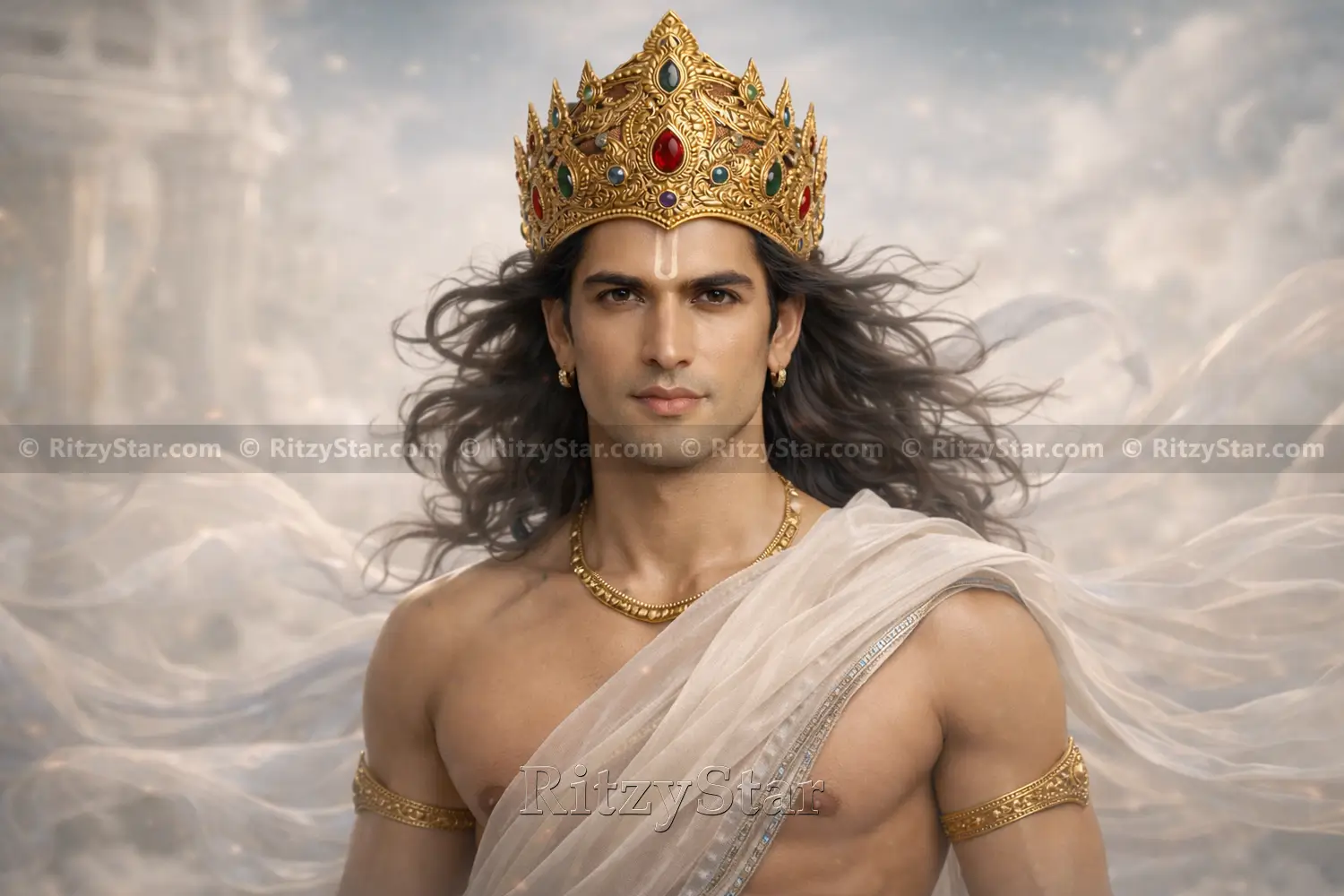
Oh, what celestial beauty and mysterious power dwell in the silvery orb that graces our night skies! Among the countless luminous beings who inhabit the vast expanse of Hindu cosmology, one name glows with a gentle, soothing radiance—Chandra Dev, the Moon God, whose cool light touches every corner of the universe and every chamber of the human heart. His presence is not merely astronomical but deeply spiritual—he is the presiding deity of the mind, the lord of the night, the master of the stars, and the eternal companion of Shiva himself.
“नक्षत्राणामहं चन्द्रो वेदानां वेद्य एव च।
देवानां प्रवरो विष्णुर्ज्योतिषां रविरंशुमान्॥”
— Bhagavad Gita (10.21)
Meaning: Among the stars, I am the Moon; among the Vedas, I am the Sama Veda; among the gods, I am Vishnu; among the luminaries, I am the radiant Sun.
Thus speaks Krishna in the Gita, placing Chandra among the foremost manifestations of the divine. Who is this enigmatic deity whose light controls the tides of the ocean and the waves of human emotion? His story flows like a river of nectar through the scriptures—born three times, cursed and blessed, waxing and waning, forever dancing between darkness and light.
Who is Chandra Dev – The Cosmic Mind and Nectar-Bearer of the Heavens?
“सोमात्मिका च या देवी चन्द्रात्मा च महेश्वरः।
एक एव परं ब्रह्म द्विधा भूतः सनातनः॥”
— by Author
Meaning: She who is the essence of Soma, and He who is the Moon, the great Lord—the one supreme eternal Brahman has become twofold.
Chandra Dev, also known as Soma, Indu, and Rajnipati (Lord of the Night), is one of the Navagrahas—the nine planetary deities who govern cosmic influences in Hindu astrology. But he is far more than a celestial body. In the Vedas, he is the embodiment of Soma, the divine nectar that grants immortality to gods and inspiration to sages. In the Puranas, he is a living deity with a complex personality—handsome beyond compare, passionate in love, cursed to wane, and blessed to wax again.
“सर्वौषधीनां सोमो राजा देवानां बृहस्पतिः।
सर्पाणां वासुकिः श्रेष्ठो गन्धर्वाणां च तुम्बुरुः॥”
— Mahabharata
Meaning: Soma is the king of all herbs, Brihaspati of the gods, Vasuki of the serpents, and Tumburu of the Gandharvas.
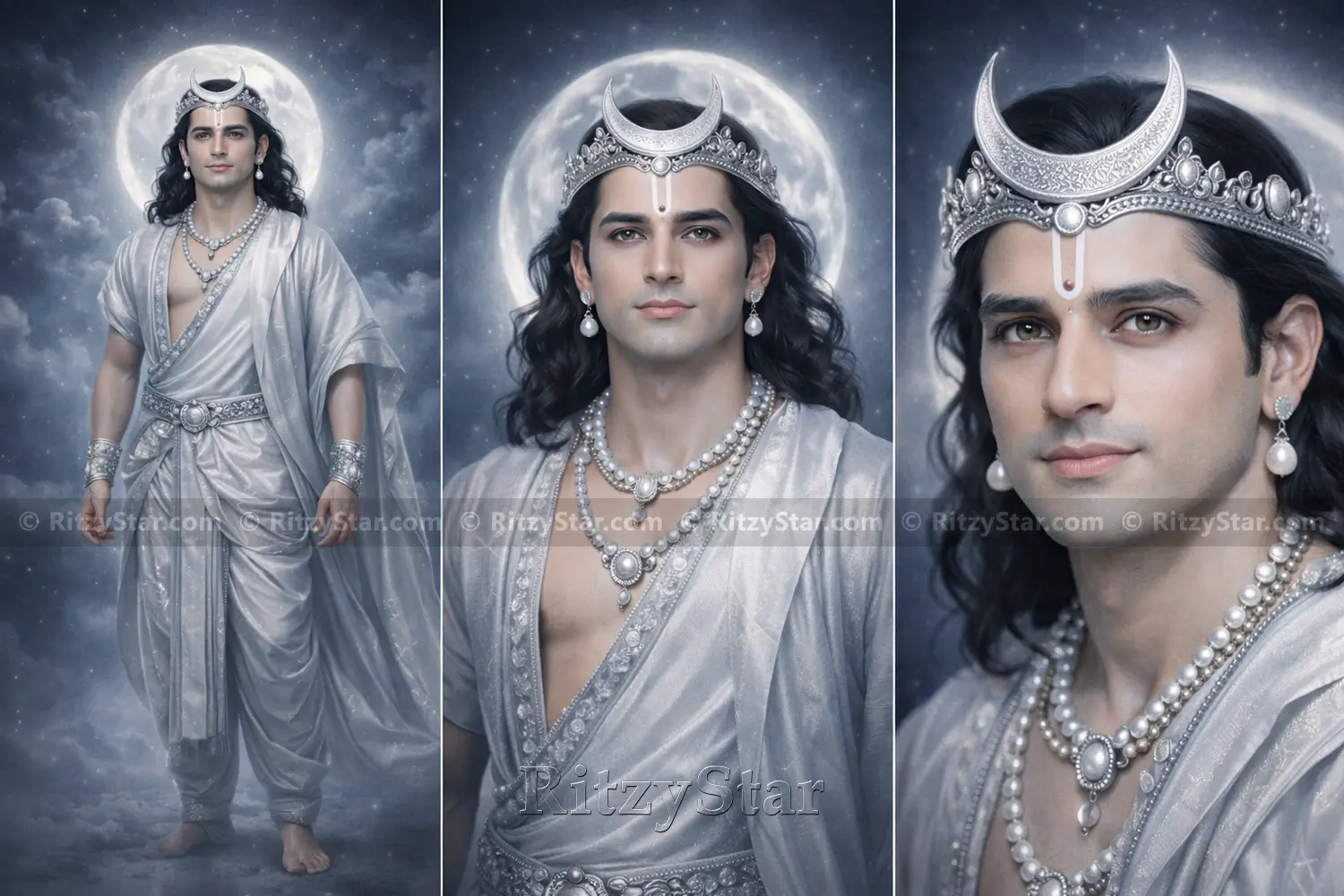
In Indian art, Chandra appears as a youthful, radiant deity with a gentle smile, his complexion fair as milk or crystal. He is adorned in white garments, with a garland of pearls around his neck, and a crescent moon adorning his forehead. He rides a chariot drawn by ten white horses—sometimes by antelopes—across the night sky, dispensing his cool, healing rays upon the earth.
But who is this luminous being, and how did he come to occupy such a pivotal position in the cosmic order? His origins are as multifaceted as his nature.
The Many Names of Chandra Dev – A Reflection of His Multifaceted Nature
“नामान्यस्यानेकरूपाणि लोकेषु परिकीर्तितानि।
चन्द्रः सोम इन्दुः क्षपाकर इति प्रसिद्धानि॥”
— by Author
Meaning: His numerous names are celebrated across the worlds—Chandra, Soma, Indu, Kshapakara—each revealing a different facet of his divine nature.
Just as the Moon itself appears different each night, yet remains the same celestial body, Chandra Dev is known by many names, each capturing a distinct aspect of his essence. These names are not mere labels but windows into his cosmic functions and mythological significance.
| Name | Meaning | Origin & Significance |
|---|---|---|
| Chandra | The shining one | Derived from the Sanskrit root “चद्” (cad) meaning to shine or glitter. This most common name emphasizes his radiant, luminous nature that brightens the night sky. |
| Soma | The distilled nectar | His most sacred Vedic name, referring to the divine elixir of immortality. In the Rig Veda, Soma is both a god and the sacred plant whose juice was offered in sacrifices. Chandra embodies this nectar, carrying it within his rays. |
| Indu | The bright drop | A name signifying the Moon as a single luminous drop in the cosmic ocean. It emphasizes his purity and brilliance. |
| Rajnipati | Lord of the Night | Reflecting his sovereignty over the nighttime, when he rules the sky unchallenged. |
| Kshapakara | Maker of the Night | Another name highlighting his role as the one who creates and presides over the night. |
| Nakshatranatha | Lord of the Constellations | As husband to the 27 Nakshatras (lunar constellations), he is their master and companion. |
| Tarakadhipa | Lord of the Stars | Though technically distinct from the fixed stars, Chandra is often considered their king due to his prominence. |
| Oshadhipati | Lord of Herbs | The Moon governs the growth of all medicinal plants and herbs, which flourish under his cool rays. |
| Dvijaraja | King of the Brahmins | Soma is considered the king of Brahmins, associated with Vedic wisdom and priestly knowledge. |
| Kaladhara | Bearer of Digits | Referring to the sixteen kalas (digits or phases) of the Moon, which wax and wane according to cosmic cycles. |
| Sudhanshu | Having nectar-rays | His rays are believed to contain divine nectar (sudha) that nourishes both gods and living beings. |
| Himanshu | Having cool rays | Emphasizing the cooling, soothing quality of moonlight, in contrast to the Sun’s fierce heat. |
| Kalanidhi | Treasury of digits | The Moon as the repository of all sixteen kalas, representing completeness and wholeness. |
| Mriganka | Marked with a deer | The dark spots on the Moon are said to resemble a deer (mriga), giving him this poetic name. |
| Shashanka | Hare-marked | Similarly, the lunar markings are compared to a hare (shasha), another common poetic name. |
| Kumudapati | Lord of the lotuses | The night-blooming lotuses (kumuda) open only under moonlight, acknowledging him as their lord. |
| Vachaspati | Lord of Speech | Since Chandra governs the mind (manas), and speech arises from thought, he is considered the deity of articulate expression. |
| Manahpriya | Beloved of the Mind | The Moon is naturally dear to the mind, which finds peace and pleasure in his gentle light. |
“सोम इन्दुरथो चन्द्रः कलानिधिरहःप्रियः।
एतानि चन्द्रनामानि पठतां शृण्वतां सदा॥”
— by Author
Meaning: Soma, Indu, Chandra, Kalanidhi, Ahahpriya—these names of Chandra, when read or heard always, bring blessing.
Thus, in his very names we find the story of his being—lord of herbs and stars, bearer of nectar and digits, the cool-rayed one whose light soothes the burning world. Each name is a thread in the luminous tapestry of his identity, and together they weave the portrait of one of the most beloved and complex deities in the Hindu pantheon.
The Threefold Birth – Chandra’s Mysterious Origins
“त्रिधा जातः सोमो देवो ब्रह्मणो मानसात् सुतः।
अत्रेः पुत्रस्तथा चैव समुद्रादपि चोद्धृतः॥”
— by Author
Meaning: The god Soma was born three times—as the mind-born son of Brahma, as the son of Atri, and as the one raised from the ocean.
One of the most intriguing aspects of Chandra Dev is his three distinct births mentioned in various scriptures. Each origin story reveals a different dimension of his cosmic significance.
First Birth: From the Mind of Brahma
According to the Purusha Sukta of the Rig Veda, Chandra was born from the mind of the cosmic Purusha—the primordial being whose sacrifice created the universe. This is not merely a poetic fancy but a profound philosophical statement: the Moon represents the cosmic mind, the principle of thought, consciousness, and reflection.
“चन्द्रमा मनसो जातः” — The Moon is born from the Mind.
In this sense, Chandra is eternal, uncreated, coeval with the universe itself. He is the archetypal mind, the template upon which all individual minds are patterned.
Second Birth: As Son of Sage Atri and Anusuya
The Puranas narrate that the great sage Atri performed severe penance for a thousand divine years. During this period, he pushed his virility upward in his physique, and that magnificent deposit materialized in the form of drops from his eyes. These drops spread extraordinary illumination in all ten directions.
Lord Brahma, witnessing this unprecedented development, enabled that radiance to take the form of Chandra Deva. Thus Chandra was born as the son of the illustrious sage Atri and his devoted wife Anusuya—the same blessed couple who also gave birth to Dattatreya (an incarnation of Brahma-Vishnu-Shiva) and the fearsome sage Durvasa.
This human-divine lineage establishes Chandra’s connection to the earthly realm of penance and spirituality. He is not a distant, alien god but one with intimate ties to the lineage of sages.
Third Birth: From the Churning of the Ocean
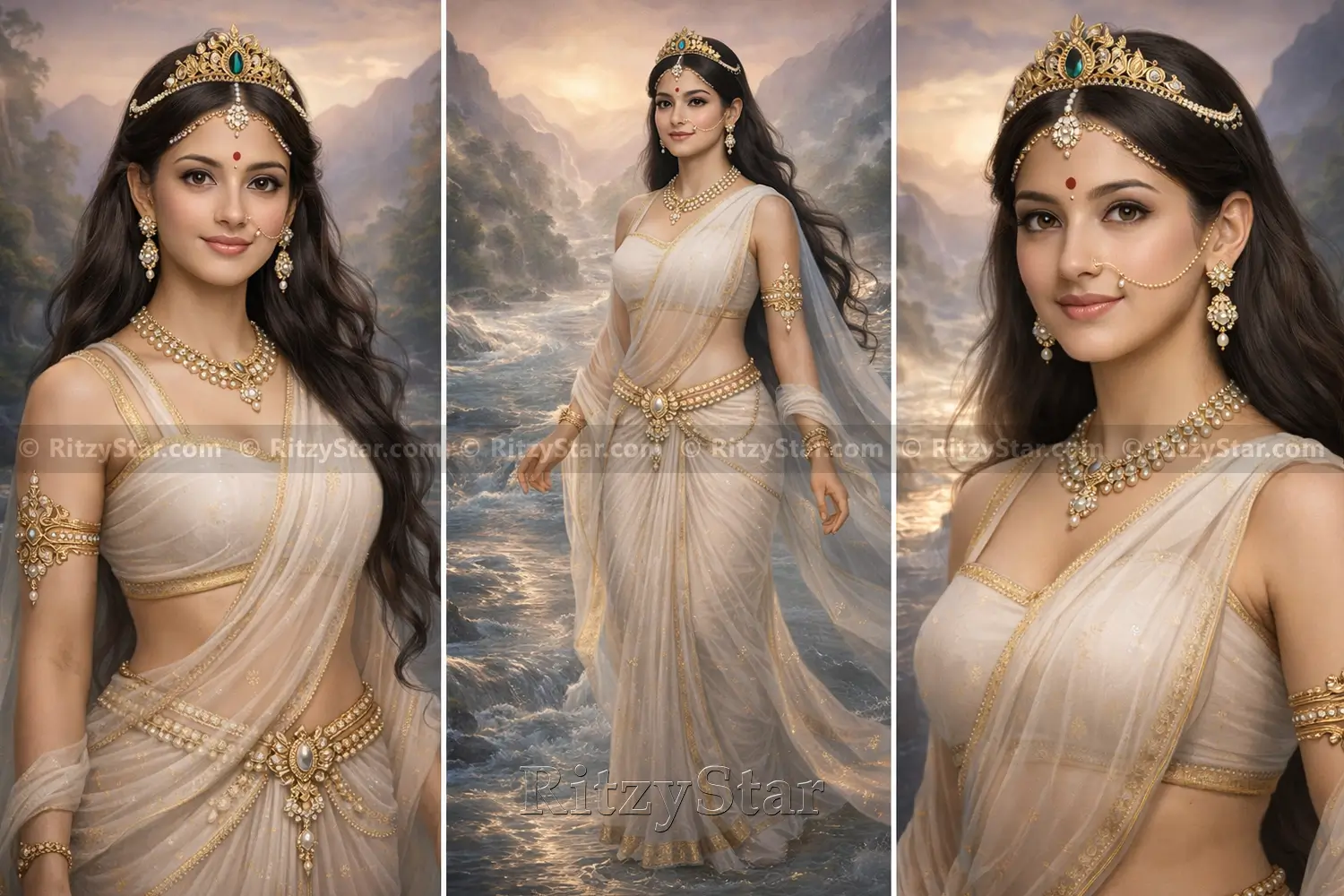
During the Samudra Manthana—the great churning of the cosmic ocean by gods and demons—fourteen precious treasures emerged from the depths. Among them was Chandra, resplendent and cool, rising from the foaming waters alongside Lakshmi, the goddess of fortune, and the pot of amrita, the nectar of immortality.
In this birth, Chandra is the brother of Lakshmi and thus the brother-in-law of Vishnu. He emerges as a jewel of the ocean, a gift to the universe, his very essence composed of the primordial waters.
Each birth carries profound meaning: Chandra is at once a cosmic principle (mind-born), a sage’s blessed son (born of penance), and a jewel of the deep (ocean-born). He embodies wisdom, purity, divine radiance, and the mysterious depths of consciousness.
The Rajasuya Yagna – Chandra’s Rise to Glory
“राजसूयेन यज्ञेन यष्टव्यमिति निश्चयः।
चन्द्रेण कृतवांस्तात सर्वदेवसमागमे॥”
— by Author
Meaning: “I must perform the Rajasuya sacrifice,” thus did Chandra resolve, and he accomplished it in the assembly of all gods.
After his birth(s), Chandra Dev decided to perform the greatest of all sacrifices—the Rajasuya Yagna, a ceremony so powerful that only the most exalted beings could undertake it. He first visited Satyaloka to invite Lord Brahma and receive his blessings. Then he proceeded to Devaloka to invite Indra and all the other gods.
Chandra then approached Brihaspati, the guru of the gods, and requested him to preside as the main priest for the yagna. Brihaspati agreed, for Chandra was not only his cousin but also his disciple, having been taught the Vedas and divine skills by him.
The yagna was magnificent beyond description. Lakhs of Brahmanas assembled, and dakshinas (gifts) of cash and valuables were distributed in abundance. Nine illustrious women of universal repute arrived to serve Chandra—Sini, Kuhu, Dyuti, Pushti, Prabha, Vasu, Kirti, Dhruti, and Lakshmi.
At the culmination of the sacrifice, when Chandra was given the Avabhruta Snaan (sacred bathing), all the Devas and Rishis worshipped him. He displayed extraordinary humility and gratitude.
But alas! Such glory often breeds conceit. In course of time, Chandra’s attitude changed due to his might and prosperity. And it was this arrogance that led to his greatest transgression.
The Transgression – Chandra and Tara
“गुरुपत्नीं तारां नाम यशस्विनीम्।
जहार चन्द्रः सौन्दर्यमदेन मोहितः॥”
— Mahabharata (adapted)
Meaning: Chandra, intoxicated by the pride of his beauty, abducted the illustrious Tara, wife of his guru.
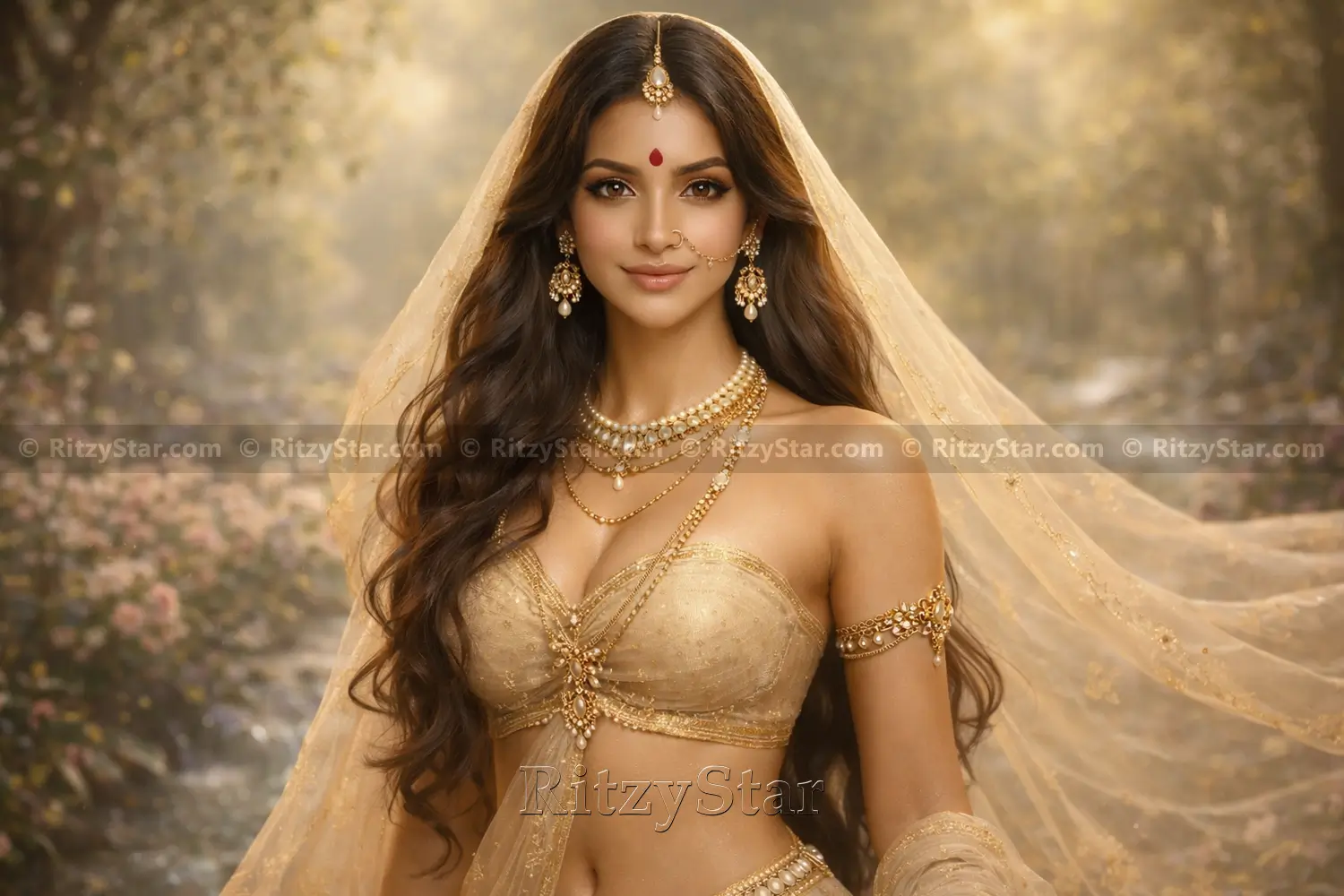
The most controversial episode in Chandra’s life involves Tara, the beautiful wife of Brihaspati. As the yagna progressed and Chandra’s divine beauty intensified, all the celestial women, including Tara, found themselves mesmerized by his radiance.
Tara, trapped in what she felt was a loveless marriage with the aging Brihaspati, fell deeply in love with Chandra and left her husband to be with him. For Brihaspati, this was not merely a personal loss—it was a crisis of cosmic proportions. In Vedic times, a wife was essential for performing sacrificial rituals; without her, no ceremony was complete. Brihaspati thus lost not only his wife but also his position as the officiating priest for the gods.
When Brihaspati sent messengers demanding Tara’s return, Chandra replied, “I am not keeping Tara forcefully. She is staying with me of her own accord. If Tara wishes to go, she may—I shall not stop her.”
Brihaspati then sought Indra’s intervention. The king of gods confronted Chandra and ordered him to return Tara. Chandra, however, reminded Indra of his own liaison with Ahalya, the wife of Sage Gautama—a pointed retort that silenced the god.
The situation escalated until a celestial war threatened to erupt. Finally, Brahma himself intervened and compelled Tara to return to Brihaspati. But upon her return, it was discovered that she was pregnant. When questioned about the father, Tara initially remained silent, but eventually confirmed that the child was Chandra’s.
This child was Budha (Mercury)—a being who would later become a full-fledged Graha (planet), placed in the sky opposite his father Chandra, symbolically representing the separation and the complex relationship between emotion (Moon) and intellect (Mercury).
The Tara episode reveals Chandra’s passionate, impulsive nature—his willingness to transgress boundaries for love, and his defiance of authority when driven by desire. It also establishes the celestial lineage that would eventually lead to the Lunar Dynasty (Chandravamsha), from which arose great heroes like Pururavas, Nahusha, Yayati, and ultimately the Kauravas and Pandavas.
The 27 Queens – Chandra’s Marriage to the Nakshatras
“दक्षस्य दुहितरश्चन्द्रः सप्तविंशतिः।
ताभिः सह समं वर्तितुं प्रतिज्ञातवान् पुरा॥”
— Mahabharata (adapted)
Meaning: Chandra married the twenty-seven daughters of Daksha, and promised to treat them all equally.
After the Tara episode, a heartbroken Chandra eventually married the twenty-seven daughters of Prajapati Daksha. These daughters are no ordinary beings—they are the Nakshatras, the twenty-seven lunar constellations that form the backdrop of the Moon’s monthly journey across the sky.
Their names are:
- Ashvini
- Bharani
- Krittika
- Rohini
- Mrigashirsha
- Ardra
- Punarvasu
- Pushya
- Ashlesha
- Magha
- Purva Phalguni
- Uttara Phalguni
- Hasta
- Chitra
- Svati
- Vishakha
- Anuradha
- Jyeshtha
- Mula
- Purva Ashadha
- Uttara Ashadha
- Shravana
- Dhanishtha
- Shatabhisha
- Purva Bhadrapada
- Uttara Bhadrapada
- Revati
When Daksha gave his daughters in marriage to Chandra, he extracted a solemn promise: Chandra would treat all his wives with equal love and never show favoritism. Chandra agreed.
The Fatal Favoritism – Chandra’s Love for Rohini
“रोहिण्यां तु विशेषेण सक्तश्चन्द्रो बभूव ह।
अन्यासां तु सुतानां स दाक्षायणीनां तदा॥”
— Mahabharata, Shalya Parva
Meaning: Chandra became especially attached to Rohini, while neglecting his other wives, the daughters of Daksha.
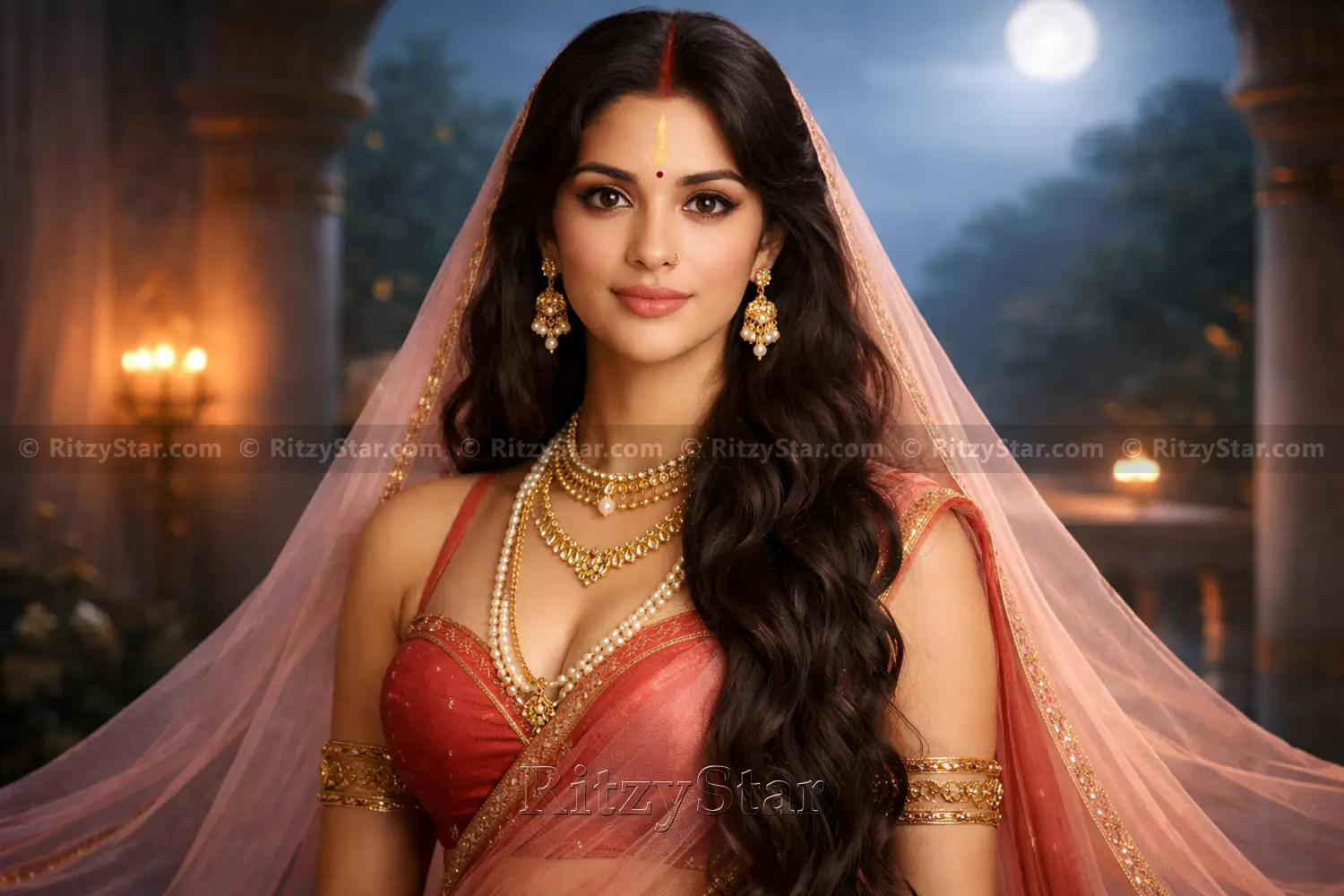
Despite his promise, Chandra found himself irresistibly drawn to Rohini, the fourth Nakshatra. Her beauty, her grace, her very essence captivated him completely. He spent most of his time with her, neglecting his other twenty-six wives.
The neglected wives bore this injustice silently for some time, but eventually their sorrow turned to anger. They approached their father, Daksha, and poured out their hearts. They complained that Soma (Chandra) hardly paid any attention to them and lived mostly with Rohini.
Daksha, as a loving father, was deeply pained by his daughters’ suffering. He repeatedly warned Chandra to treat all his wives equally. But Chandra, blinded by his love for Rohini, paid no heed to these warnings.
This was not merely a domestic dispute—it had cosmic implications. The Nakshatras are not just wives but markers of time and seasons. Their well-being affects the very fabric of cosmic order.
Family Table of Chandra Dev (Soma)
| Sl.No | Name | Relationship | Kids | Remarks |
|---|---|---|---|---|
| 1 | Rohini – Daughter of Daksha Prajapati; foremost among the 27 Nakshatras. | Chief Consort | 1. Varchas – Son who is described as an embodiment of Chandra’s own brilliance and vital energy. | Rohini is Chandra’s favorite, and his special attention to her is cited as the origin of the moon’s waxing and waning. |
| 2 | Asvini – Daughter of Daksha. | Consort | 1. Nagaya – Mentioned in some genealogies as a son. | The 27 Nakshatras (lunar constellations) were all married to Chandra simultaneously upon Daksha’s request. Chandra’s neglect of the 26 other wives (except Rohini) led to Daksha’s curse, causing Chandra to wane. The curse was later modified so he would wax and wane cyclically. |
| 3 | Bharani – Daughter of Daksha. | Consort | 1. Bharani Putra – A son mentioned in some texts. | |
| 4 | Krittika – Daughter of Daksha. | Consort | 1. Krittaujas 2. Krittibhasa – Sons mentioned in some lists. | |
| 5 | Mrigashirsha – Daughter of Daksha. | Consort | 1. Mrigakrit – A son. | |
| 6 | Ardra – Daughter of Daksha. | Consort | 1. Ardraka – A son. | |
| 7 | Punarvasu – Daughter of Daksha. | Consort | 1. Punarvasuki – A son. | |
| 8 | Pushya – Daughter of Daksha. | Consort | 1. Pushyakrit – A son. | |
| 9 | Ashlesha – Daughter of Daksha. | Consort | 1. Ashleshabhava – A son. | |
| 10 | Magha – Daughter of Daksha. | Consort | 1. Maghaja – A son. | |
| 11 | Purva Phalguni – Daughter of Daksha. | Consort | 1. Phalguni Putra – A son. | |
| 12 | Uttara Phalguni – Daughter of Daksha. | Consort | 1. Uttaraphalgunija – A son. | |
| 13 | Hasta – Daughter of Daksha. | Consort | 1. Hastaja – A son. | |
| 14 | Chitra – Daughter of Daksha. | Consort | 1. Chitrabhanu – A son. | |
| 15 | Swati – Daughter of Daksha. | Consort | 1. Swatikrit – A son. | |
| 16 | Vishakha – Daughter of Daksha. | Consort | 1. Vishakhaja – A son. | |
| 17 | Anuradha – Daughter of Daksha. | Consort | 1. Anuradhesha – A son. | |
| 18 | Jyeshtha – Daughter of Daksha. | Consort | 1. Jyeshthaja – A son. | |
| 19 | Mula – Daughter of Daksha. | Consort | 1. Mulaka – A son. | |
| 20 | Purva Ashadha – Daughter of Daksha. | Consort | 1. Ashadhaja – A son. | |
| 21 | Uttara Ashadha – Daughter of Daksha. | Consort | 1. Uttarashadhija – A son. | |
| 22 | Shravana – Daughter of Daksha. | Consort | 1. Shravanaka – A son. | |
| 23 | Dhanishta – Daughter of Daksha. | Consort | 1. Dhanishthaja – A son. | |
| 24 | Shatabhisha – Daughter of Daksha. | Consort | 1. Shatabhishaja – A son. | |
| 25 | Purva Bhadrapada – Daughter of Daksha. | Consort | 1. Bhadrapadaja – A son. | |
| 26 | Uttara Bhadrapada – Daughter of Daksha. | Consort | 1. Uttarabhadrapadaja – A son. | |
| 27 | Revati – Daughter of Daksha. | Consort | 1. Revata – A son. | |
| 28 | Tara – Wife of Brihaspati (Guru of the Devas). | Lover | 1. Budha – Deity of the planet Mercury; later married Ila and fathered King Pururavas, the first great emperor of the Chandravansha (Lunar Dynasty). | Tara’s relationship with Chandra caused the famous Tarakamaya war between gods and demons. After Brahma intervened, Tara returned to Brihaspati while pregnant, and Budha was acknowledged as Chandra’s son. |
| 29 | Manohara – An Apsara; mentioned in some regional traditions. | Consort | 1. Vishala – Legendary king and founder of the city of Vishala (modern Vaishali). | This lineage is less common but appears in some texts connecting Chandra to the founders of major cities. |
Daksha’s Curse – The Waning of the Moon
“यस्मात्त्वं दाक्षायणीः सर्वा भार्या न तुल्यवत्।
वर्तसे तस्मात्त्वं क्षयं प्राप्नुहि शीघ्रम्॥”
— Mahabharata, Shalya Parva
Meaning: Since you do not treat all the daughters of Daksha equally, you shall quickly suffer deterioration.
Daksha’s patience finally snapped. In his fury, he pronounced a terrible curse upon Chandra: “You shall suffer from Kshaya—deterioration of your body. You will contract an incurable disease and vanish from the face of the universe.”
The curse took immediate effect. Chandra began to lose his radiance day by day. His beautiful form wasted away, and with it, all creatures dependent on the moon also began to decay. The balance of nature was disturbed.
Only a small portion of the Moon remained visible. In his distress, Chandra fled to the ocean and hid himself, but even there, the curse followed him.
The Previous Curses – Ganesha and Brahma
“पूर्वं गणेशशापेन ब्रह्मशापेन चैव ह।
चन्द्रः पीडितः सन् दुःखमापेदे पुनः पुनः॥”
— by Author
Meaning: Tormented by the earlier curses of Ganesha and Brahma, Chandra experienced suffering repeatedly.
This was not the first time Chandra had been cursed. Earlier in his existence, he had incurred the wrath of Lord Ganesha in an incident that explains why Hindus avoid looking at the Moon on Ganesha Chaturthi.
The story goes that Lord Ganesha, after consuming a vast quantity of sweets at a feast hosted by Kubera, was returning home on his mouse vehicle. Suddenly, a snake crossed their path, startling the mouse. Ganesha fell, and his belly burst open, scattering all the sweets he had eaten.
Chandra, watching from the sky, found this scene hilarious and burst into laughter at Ganesha’s expense.
Enraged by this mockery, Ganesha cursed Chandra: “O Chandra! You are full of pride because of your beauty. I curse you—anyone who looks at you on this day (Ganesha Chaturthi) will suffer false accusations and dishonor.”
When Chandra begged for forgiveness, Ganesha relented partially: those who suffer false blame after seeing the Moon on that day can be freed by hearing the story of the Syamantaka jewel, which teaches that truth always triumphs over falsehood.
Additionally, Chandra had also been cursed by Brahma at some point, though that curse was later lifted when Brahma recognized Chandra’s essential planetary role.
Now, with Daksha’s curse added to the previous ones, Chandra’s suffering was unbearable.
The Pilgrimage to Brahma – Seeking a Solution
“ब्रह्माणं शरणं यातश्चन्द्रो दुःखेन पीडितः।
तमुवाच पिता देवो रुद्रशरणमाविश॥”
— by Author
Meaning: Tormented by suffering, Chandra sought refuge in Brahma. The father of gods told him: “Seek refuge in Rudra.”
Following Indra’s advice, Chandra approached Lord Brahma at Brahmapura. He fell at the creator’s feet, begging for forgiveness and a solution to the curse.
Brahma replied with compassion but also honesty: “Daksha is my son, but he has received strange mystic powers and numerous boons. He is invincible, and his pride makes him deaf to any advice, even from me, his father. I cannot reverse his curse.”
However, Brahma offered hope: “There is one who can help you—Lord Shiva, Mahadeva, the destroyer of all curses and the master of time itself. Go to him. Perform the Mahamritunjaya Mantra Japam and seek his refuge.”
Lord Shiva’s Grace – The Moon on the Matted Lock
“शिवेन चन्द्रः शिरसि धृतः शापान्मुक्तोऽभवत्।
कलाक्षयवृद्धी च लेभे दक्षवचनादपि॥”
— by Author
Meaning: Held on Shiva’s head, Chandra was freed from the curse, and obtained the waxing and waning of his digits, according to Daksha’s word.
Chandra proceeded to the Prabhas region (modern-day Prabhas Patan in Gujarat), where he made a Shiva Linga from sand and began the most intense penance. For days he meditated, chanting the Mahamritunjaya Mantra with single-pointed concentration.
On the auspicious night of Mahashivaratri, Lord Shiva finally appeared before him, radiant and compassionate.
Chandra fell at his feet, weeping: “O Mahadeva! Save me from this curse. I have lost my beauty, my radiance, my very self. Without your grace, I am doomed.”
Shiva looked upon his devotee with kindness but spoke the truth: “Daksha’s curse cannot be completely nullified, for what he said must come to pass. A curse pronounced by a powerful being like Daksha cannot simply vanish.”
However, Shiva, the master of time and transformation, offered a brilliant solution:
“From tomorrow, you will wax for fifteen days, regaining your radiance day by day until you shine in full glory. Then, for the next fifteen days, you will wane, losing your radiance according to Daksha’s curse. But you will never completely disappear—when you are left with just one day’s radiance, you will stop there. My intervention ensures you will always return.”
Thus was born the lunar cycle—the waxing and waning of the Moon, the eternal rhythm of growth and decay, fullness and emptiness.
But Shiva did something more. He took Chandra and placed him on his own matted hair, adorning his head with the crescent moon. In that moment, Chandra became Chandrashekhara—one of Shiva’s most beloved forms. The Moon would forever rest near the Ganga, on the head of the Lord of Yoga.
This symbolizes the ultimate truth: the restless mind (Chandra) finds its true place when surrendered to divine consciousness (Shiva). Only then does it achieve stability and grace.
Chandra and Ganesha – The Curse Modified
“गणेशशापश्चन्द्रस्य फाल्गुनशुक्लचतुर्थ्याम्।
न चन्द्रदर्शनं कार्यं यावद्व्रतसमापनम्॥”
— by Author
Meaning: By Ganesha’s curse on Chandra, one must not look at the Moon on the Chaturthi of Shukla Paksha in Phalguna until the vow is completed.
The earlier curse of Ganesha remained, but with modifications. Ganesha, pleased by Chandra’s subsequent devotion, decreed that the Moon would wane and wax—thus incorporating the curse into the cosmic rhythm.
To this day, Hindus observe the prohibition against looking at the Moon on Ganesha Chaturthi (the fourth day of the bright fortnight in the month of Bhadrapada). It is believed that whoever sees the Moon on this day will face false accusations.
However, if someone inadvertently sees the Moon, they can free themselves from the curse’s effects by listening to or reciting the story of the Syamantaka jewel—the tale of how Lord Krishna was falsely accused of stealing the jewel and how truth ultimately prevailed.
This connection between Chandra and the Syamantaka story is profound: just as the Moon is temporarily obscured but regains its light, truth may be temporarily eclipsed but always shines again.
The Lunar Eclipse – Rahu’s Revenge
“राहुग्रस्तश्च यश्चन्द्रः कृष्णपक्षे क्षयं व्रजेत्।
ग्रहणं तत् समाख्यातं लोकानां दर्शनं प्रति॥”
— by Author
Meaning: When Rahu seizes Chandra, causing him to wane in the dark fortnight, that is called an eclipse, witnessed by all the worlds.
Another significant episode in Chandra’s cosmic journey involves the eclipse. During the Samudra Manthana, when the nectar of immortality emerged, Vishnu, in his Mohini form, began distributing it to the gods. The demon Rahu disguised himself as a god and sat among them, partaking of the nectar.
But Surya (the Sun) and Chandra saw through the deception. They immediately alerted Vishnu, who took his Sudarshana chakra and severed Rahu’s head. However, by then, Rahu had already consumed some nectar, making his head immortal.
Enraged by this betrayal, Rahu (now a head) and Ketu (his body) swore eternal vengeance against Surya and Chandra. To this day, Rahu periodically seizes and swallows the Sun and Moon, causing solar and lunar eclipses.
Yet, because Rahu’s throat was severed, the Moon always escapes—another reminder that darkness can never permanently overcome light.
Chandra and the River Chandrabhaga – A Tale of Division
“चन्द्रभागेति या नदी हिमालयात् प्रवर्तते।
चन्द्रस्य भागद्वयं तत्र शिवपत्नीषु च स्थितम्॥”
— Mahabharata (adapted)
Meaning: The river called Chandrabhaga flows from the Himalayas, where the Moon was divided into two portions—one for Shiva, one for his wives.
The Mahabharata narrates another fascinating story about Chandra. There arose a conflict between Shiva, who always carried Chandra on his head, and Chandra’s wives (the Nakshatras), who wanted their husband back.
To resolve this dispute, Lord Brahma divided Chandra into two halves. One half remained with Shiva, adorning his matted locks forever. The other half was returned to the wives.
The spot where this divine division occurred is known as Chandrabhaga, literally meaning “where the Moon was split.” A sacred river by the same name originates from this place in the Himalayas, formed by two streams called Chandra and Bhaga.
This story beautifully illustrates how the Moon belongs to both the transcendent (Shiva) and the immanent (the Nakshatras, the world of time and space). He is both the eternal adornment of the Absolute and the intimate companion of the cosmic order.
Chandra and the Goddess – Symbol of Mind’s Mastery
“चन्द्रघण्टेति या देवी नवदुर्गासु गीयते।
चन्द्रस्य शिरसि धारिणी मनसः स्थैर्यदायिनी॥”
— by Author
Meaning: The goddess called Chandraghanta, sung among the nine Durgas, wears the Moon on her head and grants stability to the mind.
The Moon’s connection with the Divine Feminine is profound and multifaceted. One of the Navadurga forms of Goddess Durga is Chandraghanta—she who bears the bell-shaped Moon on her forehead. Her very name evokes the Moon’s presence and power.
Goddess Kali and Durga are often depicted wearing the crescent moon on their foreheads. This is not mere ornamentation but profound symbolism: as warrior-goddesses who conquer demons, they also conquer the restless mind. The crescent moon on their brows signifies their complete mastery over the mind, emotions, fear, and anxiety—the supreme conquest.
In this sense, the Moon becomes an instrument of the Goddess, a symbol of her control over the ever-fluctuating human psyche. When we worship the Goddess wearing the Moon, we seek her grace to stabilize our own minds.
Chandrahaasa – The Sword of the Moon
“चन्द्रहास इति खड्गः शिवेन रावणाय च।
प्रदत्तः स महादेव्या शक्तिरूपेण संयुतः॥”
— by Author
Meaning: Chandrahaasa, the sword given by Shiva to Ravana, was imbued with the power of the great goddess.
“Chandrahaasa” literally means “the laughter of the Moon”—one of the most evocative names in Hindu mythology. According to legend, when Ravana attempted to lift Mount Kailasa, his devotion and effort so pleased Shiva that the Lord blessed him with numerous boons.
Among these was the divine sword Chandrahaasa—a weapon so potent that wielding it made Ravana even more invincible. The sword was invisible, ethereal, and carried the very essence of the Moon’s radiant laughter.
This weapon symbolizes the power that comes from devotion—the ability to laugh in the face of adversity, to shine even in darkness, to be both beautiful and deadly.
The Lunar Dynasty – Chandra’s Greatest Legacy
“चन्द्रवंशे समुत्पन्नाः पुरूरवः प्रभृतयः।
ययातिनहुषाद्याश्च पाण्डवाः कौरवास्तथा॥”
— by Author
Meaning: In the Lunar Dynasty were born Pururavas and others, Yayati, Nahusha, and also the Pandavas and Kauravas.
Perhaps Chandra’s most enduring legacy is the Chandravamsha—the Lunar Dynasty that produced some of the greatest heroes and kings of Indian mythology.
The lineage begins with Chandra’s son Budha (Mercury), who married Ila, daughter of Vaivasvata Manu. Their son was Pururavas, the mighty king who loved the Apsara Urvashi.
From Pururavas came the illustrious line that included:
- Nahusha, who ruled the heavens as Indra’s proxy
- Yayati, who exchanged his old age with his son Puru’s youth
- Puru, who continued the main line
- The Yadavas, including Sri Krishna himself
- The Kauravas and Pandavas, whose rivalry culminated in the Mahabharata war
Thus, Chandra’s descendants shaped the very course of human history in the Puranic framework. His blood flowed in the veins of heroes, sages, and gods.
Chandra in Vedic Astrology – The Lord of Mind
“चन्द्रो मनसो जनकः सोमः सौम्यत्वकारकः।
ज्योतिषां प्रवरो देवः फलदाता नृणां सदा॥”
— by Author
Meaning: Chandra is the creator of mind, Soma the bestower of gentleness; he is the foremost of luminaries, always bestowing fruits upon humans.
In Vedic astrology (Jyotisha), Chandra holds supreme importance. He is considered the most benefic planet, ruling over the mind, emotions, intuition, and the inner world of thoughts and feelings.
The Moon’s placement in a horoscope determines:
- Mental constitution and emotional nature
- Relationship with mother and family
- Ability to find peace and contentment
- Instincts and subconscious patterns
- Receptivity and nurturing capacity
A strong Chandra in a birth chart bestows emotional stability, mental clarity, compassion, and a calm disposition. A weak or afflicted Moon can lead to anxiety, mood swings, restlessness, and mental disturbance.
The Moon governs the fourth house of the horoscope—the house of mind, heart, home, and mother. He is considered the karaka (significator) of these areas of life.
Chandra’s day is Monday (Somavara), a day dedicated to his worship. His color is white, his metal is silver, his gem is the pearl (moti), and his element is water.
Worship and Festivals – Honoring the Moon God
“सोमव्रतं च कर्तव्यं चन्द्रतुष्ट्यर्थमादरात्।
कर्कचतुर्थीकरवाचौर्व्रतानि च पृथक् पृथक्॥”
— by Author
Meaning: Somavara vrata should be observed for pleasing Chandra, and also Karva Chauth and other vows separately.
Chandra Dev is worshipped through various rituals and festivals:
Somavara Vrat: Mondays are dedicated to Chandra. Devotees fast, offer white flowers, rice, and milk to the Moon, and chant the Chandra Beej Mantra: “ॐ श्रां श्रीं श्रौं सः चन्द्राय नमः”.
Karva Chauth: Married women fast from sunrise to moonrise for the long life of their husbands. They break their fast only after sighting and making offerings to the Moon.
Sharad Purnima: On this full moon night, Chandra is believed to be complete with all sixteen kalas. It is said that the Moon showers nectar (amrita) on this night, and devotees keep their food in moonlight to absorb its blessings.
Chandra Darshan: The first sighting of the new moon each month is considered auspicious, especially for starting new ventures.
Navagraha Puja: Chandra is worshipped along with the other eight planetary deities to mitigate negative influences and strengthen positive ones.
Offering milk, white sandalwood paste, rice, and white flowers to the Moon is believed to calm the mind and bring emotional peace.
The Spiritual Symbolism of Chandra
“यथा चन्द्रः कलाक्षयवृद्धिभ्यां नित्यं युक्तः।
तथा मानवजीवनमपि ह्रासवृद्धिभ्यां युज्यते॥”
— by Author
Meaning: Just as the Moon is ever subject to the waning and waxing of its digits, so too is human life subject to loss and gain.
Chandra Dev is not merely a mythological figure or astronomical body—he is a profound symbol of the human condition:
The Waxing Moon represents growth, hope, expansion, and the brightening of consciousness. It teaches us that even from darkness, light can emerge.
The Full Moon symbolizes completeness, spiritual illumination, and the fulfillment of potential. It is the moment when all sixteen kalas—all aspects of the self—are fully expressed.
The Waning Moon represents letting go, introspection, and the necessary periods of contraction that precede renewal. It teaches that loss is not permanent and that darkness has its purpose.
The New Moon symbolizes rebirth, fresh starts, and the promise of return. Even in apparent absence, the Moon is present, preparing to shine again.
The Moon’s phases mirror the cycles of human life—birth, growth, decline, death, and rebirth. They remind us that change is the only constant and that every ending contains a new beginning.
Moreover, Chandra’s relationship with Shiva teaches the ultimate lesson: the restless mind (Chandra) finds peace only when surrendered to divine consciousness (Shiva). The crescent on Shiva’s head is not just an ornament—it is a promise that when we offer our minds to the Divine, we are held safe forever.
The Eternal Light of Chandra
“यस्य स्मरणमात्रेण मनः शान्तिं प्रयाति हि।
तं चन्द्रदेवं वन्देऽहं सोमं नक्षत्रनायकम्॥”
— by Author
Meaning: I bow to Chandra Deva, that Soma, lord of the constellations, by whose mere remembrance the mind attains peace.
Chandra Dev moves through the heavens with quiet dignity, his light gentle yet persistent, his presence constant yet ever-changing. He has been loved, cursed, blessed, and worshipped through the ages. His story contains love and transgression, punishment and redemption, loss and restoration.
He is the deity of the cool-rayed night, the lord of the starry host, the husband of the constellations, the ornament of Shiva’s head. He is the mind of the cosmic Purusha, the son of the sage, the jewel of the ocean. He is Soma, the nectar of immortality, flowing through all living things.
“नमश्चन्द्राय सोमाय चन्द्रिकाभृतये नमः।
नमो नक्षत्रनाथाय शान्तिदाय नमो नमः॥”
— by Author
Meaning: Salutations to Chandra, to Soma, to the bearer of moonlight. Salutations to the lord of constellations, the bestower of peace—salutations again and again.
When we gaze upon the Moon, let us remember the stories it holds—the laughter of Ganesha, the love of Rohini, the curse of Daksha, the grace of Shiva. Let us see in its phases the rhythm of our own lives—sometimes full, sometimes empty, but always moving, always returning, always shining.
For Chandra Dev teaches us that even in our darkest nights, the light is waiting to return. Even under the shadow of curses, grace is possible. Even the restless mind can find its place on the head of the Divine.
May the cool rays of Chandra bring peace to your mind, calm to your heart, and serenity to your soul.
“चन्द्रेण भासितं सर्वं जगत् स्थावरजङ्गमम्।
तस्मै चन्द्राय देवाय नमो भुवनचक्षुषे॥”
— by Author
Meaning: All this world, moving and unmoving, is illuminated by Chandra. To that god Chandra, the eye of the universe, I offer my salutations.
Discover more from RitzyStar
Subscribe to get the latest posts sent to your email.