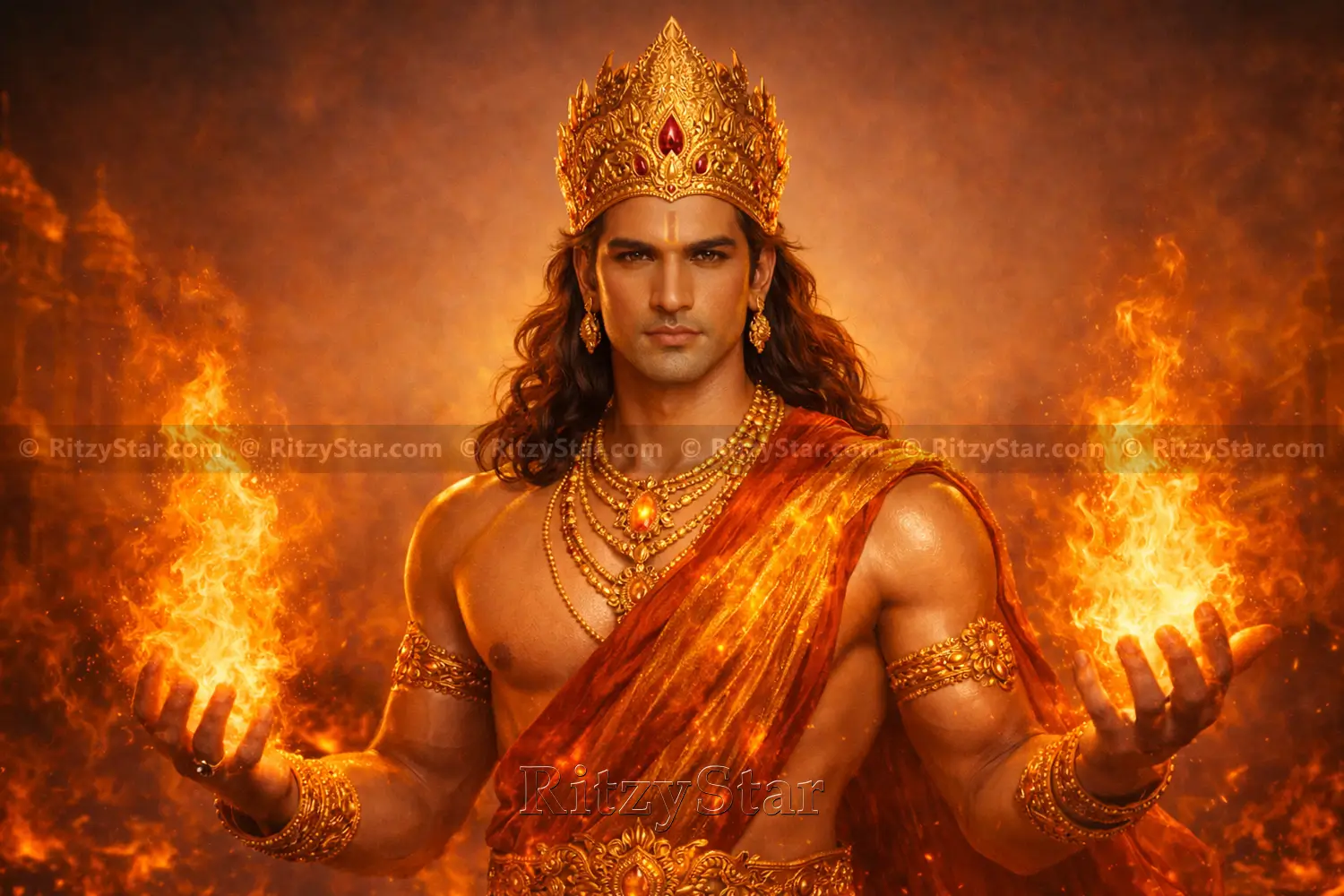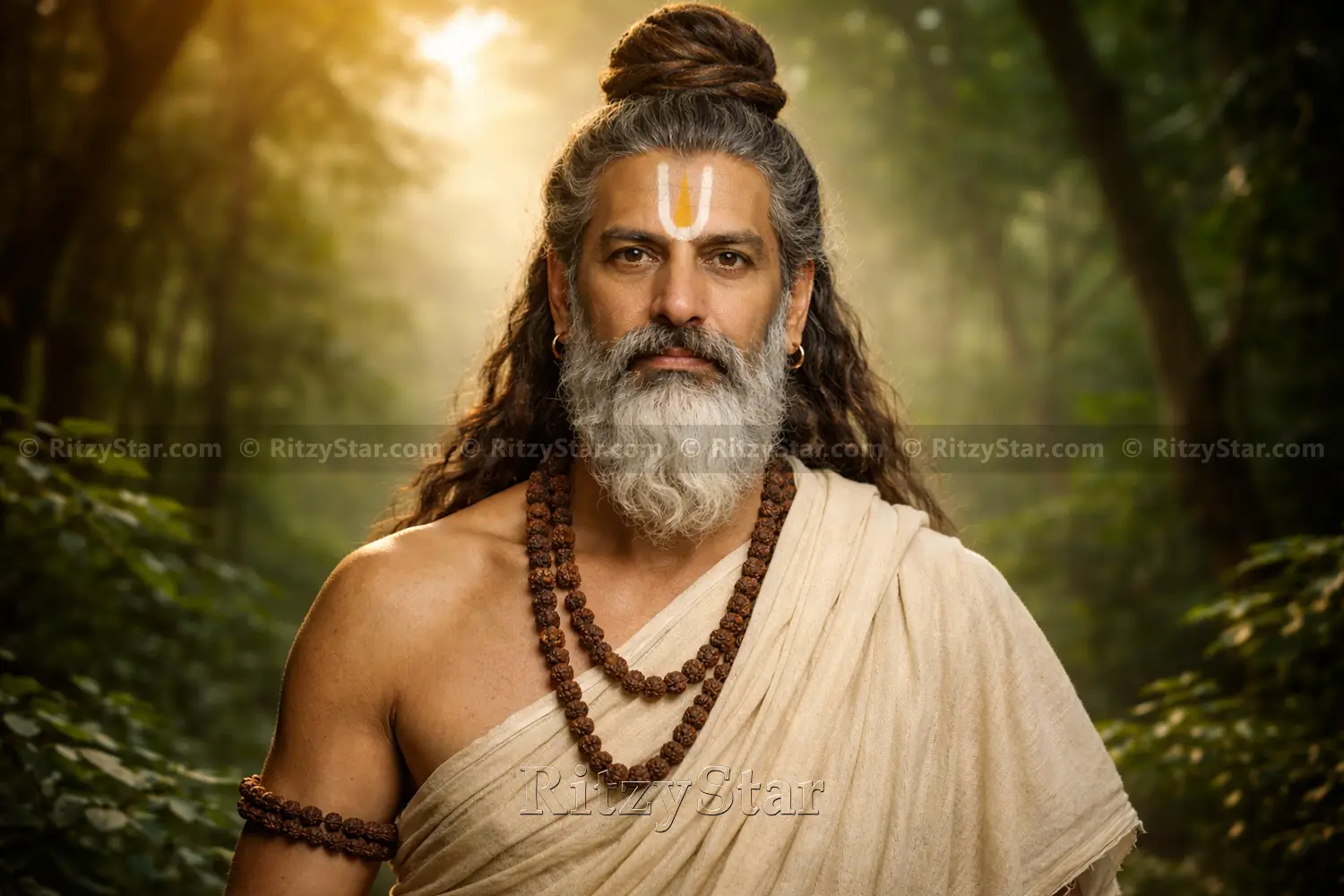
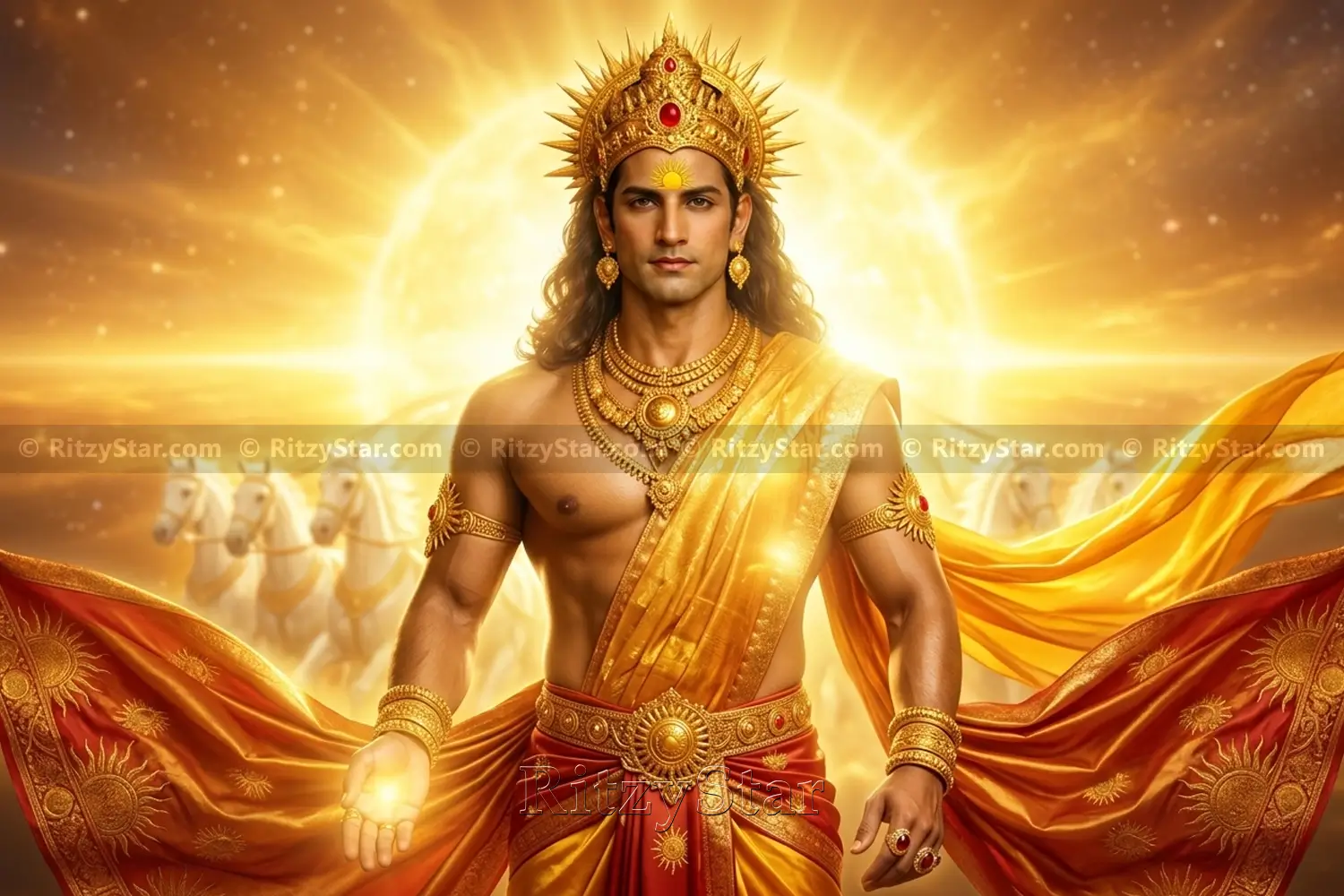
The Sun God, Charioteer of Dawn, Source of All Life
“आदित्यानां अहं विष्णुः ज्योतिषां रविरंशुमान्।”
— Bhagavad Gita 10.21
Meaning: Among the Adityas, I am Vishnu; among luminous bodies, I am the radiant Sun.
🌞 Introduction: The Eye of the Universe
Before the first dawn broke upon the primordial darkness, before the stars scattered across the night sky, before the moon waxed and waned in its eternal rhythm—there was Surya. The Sun God. The eye of the universe. The source of light, life, and consciousness itself.
In the vast pantheon of Hindu deities, Surya occupies a unique position. He is not merely one god among many—he is the visible manifestation of the divine, the one deity whose presence we experience every day without fail. While other gods reside in distant heavens or secret realms, Surya is here, now, in the sky above us. He is the witness to all our actions, the giver of all life, the inexhaustible source of energy that sustains the cosmos.
“उद्यन्नद्य त्रिभुवनं विचरन्न् अन्तरिक्षे।
सूर्यो विरोचते रश्मिभिर् अग्निकल्पः॥”
— by Author
Meaning: Rising and traversing the three worlds through the sky, Surya shines with his rays, blazing like fire.
For thousands of years, Hindus have greeted the rising sun with prayers, offerings, and the sacred Gayatri Mantra—the most revered hymn in the Vedic tradition. Every day, as the golden orb ascends above the horizon, millions of voices chant:
“ॐ भूर्भुवः स्वः तत्सवितुर्वरेण्यं भर्गो देवस्य धीमहि धियो यो नः प्रचोदयात्॥”
This is not mere ritual. It is recognition—acknowledgment that without Surya, there is no life, no consciousness, no possibility of liberation. He is the Pratyaksha Brahman—the visible divine.
👁️ Who Is Surya? The Eternal Witness
Surya is the chief of the Navagrahas (the nine celestial bodies that influence human destiny) and the leader of the Adityas (the solar deities). He is the son of the sage Kashyapa and Aditi, the mother of gods, which makes him an Aditya—one of the twelve solar deities who govern the months of the year.
“कश्यपाददितिर्यस्य माता देवी महायशाः।
सूर्यो नाम महातेजा आदित्यानां प्रधानकः॥”
— by Author
Meaning: Born of Kashyapa and the greatly renowned goddess Aditi, Surya of great splendor is the foremost among the Adityas.
But Surya is more than a celestial body. He is:
- The Eye of the Universe – The Vedas declare that the sun is the eye of the cosmic Purusha (the primordial being). Through him, the divine witnesses all of creation.
- The Giver of Life – Without his light, nothing grows. Without his warmth, nothing lives. He is the source of all biological existence.
- The Dispeller of Darkness – Not only physical darkness but also the darkness of ignorance. He illuminates the mind as well as the world.
- The Supreme Purifier – His rays are believed to purify everything they touch. This is why Hindus traditionally expose water, food, and even themselves to the morning sun.
- The Gateway to Liberation – The Gayatri Mantra, addressed to Savitr (the Sun’s aspect as the activator), is considered the most powerful mantra for spiritual awakening.
“सप्ताश्वरथमारूढं प्रचण्डं कश्यपात्मजम्।
श्वेतपद्मधरं देवं तं सूर्यं प्रणमाम्यहम्॥”
— by Author
Meaning: Riding the chariot drawn by seven horses, the fierce one, son of Kashyapa, holding a white lotus—to that Sun God, I bow.
🚗 The Celestial Chariot – Seven Horses of Light
One of the most iconic images in Hindu iconography is Surya’s chariot—a magnificent vehicle that races across the sky each day, pulled by seven horses. This image is rich with symbolism that speaks to the deepest truths of existence.
The Chariot Itself
Surya’s chariot is said to be constructed of gold, blazing with its own inner light. It has a single wheel—the wheel of time (the Kalachakra)—which rotates eternally, marking the passage of days, months, years, and ages. The chariot is driven by the divine charioteer Aruna (the personification of dawn), who sits at the front, guiding the horses across the firmament.
“अरुणः सारथिर्यस्य सप्ताश्वा वहनं रथम्।
सूर्यो देवो महातेजा रोचते भुवनत्रये॥”
— by Author
Meaning: Aruna is his charioteer, seven horses draw his chariot; the Sun God of great splendor shines across the three worlds.
The Seven Horses
The seven horses that draw Surya’s chariot are not ordinary steeds. They represent:
| Horse | Symbolic Meaning |
|---|---|
| Gayatri | The Vedic meter of spiritual awakening; represents the power of sacred sound |
| Brihati | Expansiveness; represents the boundless nature of cosmic consciousness |
| Ushnih | The dawn; represents new beginnings and the awakening of awareness |
| Jagati | The world of living beings; represents all moving creation |
| Tristubh | The threefold nature of existence (physical, subtle, causal) |
| Anushtubh | Following the rhythm; represents the order of the cosmos |
| Pankti | The fivefold manifestation (earth, water, fire, air, ether) |
More commonly, the seven horses are understood to represent:
- The Seven Colors of Light – The visible spectrum that emerges from white light
- The Seven Chakras – The energy centers in the subtle body
- The Seven Days of the Week – The rhythm of time
- The Seven Meters of Vedic Poetry – The structure of sacred utterance
- The Seven Worlds – The multiple dimensions of existence
“सप्ताश्वाः सप्त रश्मयः सप्त लोकाः सप्त चक्रकाः।
सूर्यस्य रथमारूढं सर्वतेजोमयं प्रभुम्॥”
— by Author
Meaning: Seven horses, seven rays, seven worlds, seven chakras—the lord mounted on the chariot of the Sun is resplendent with all radiance.
Aruna – The Charioteer of Dawn
Aruna, the charioteer, is himself a fascinating figure. He is the personification of the reddish glow that precedes sunrise—the dawn that announces the coming of the Sun. According to legend, Aruna was born prematurely from the sage Kashyapa and his wife Vinata. His brother is Garuda, the mighty eagle who serves as Vishnu’s mount.
Aruna is depicted as having only the upper half of his body—his legs were cursed to be incomplete by his mother. Yet, despite this, he sits at the front of Surya’s chariot, guiding the seven horses with unwavering skill. He represents the anticipation of light, the promise of dawn, the first stirrings of consciousness.
🌟 The Many Names and Forms of Surya
Surya is known by countless names in Hindu tradition, each revealing a different facet of his divine nature. In the Vedas, he is addressed by twelve primary names—the twelve Adityas who correspond to the twelve months of the year and the twelve zodiac signs.
The Twelve Adityas (Forms of Surya)
| Name | Meaning | Significance |
|---|---|---|
| Indra | The King | Surya as the sovereign ruler of the cosmos |
| Dhata | The Creator | Surya as the establisher of all things |
| Parjanya | Rain-Giver | Surya as the source of weather and fertility |
| Pusha | Nourisher | Surya as the sustainer of all beings |
| Twashta | Shaper | Surya as the architect of forms |
| Vishnu | The Pervader | Surya as the one who pervades the universe |
| Aryaman | The Noble One | Surya as the upholder of social order and friendship |
| Bhaga | The Dispenser | Surya as the bestower of fortune and prosperity |
| Vivasvan | The Radiant | Surya as the shining one—his most ancient Vedic name |
| Amshuman | The Boundless | Surya as possessing infinite rays |
| Mitra | The Friend | Surya as the cosmic friend who witnesses all without judgment |
| Varuna | The Encompasser | Surya as the one who covers all creation |
“द्वादशात्मा महातेजा सूर्यो देवः प्रकीर्तितः।
आदित्यानां प्रधानश्च विश्वकर्मा प्रजापतिः॥”
— by Author
Meaning: Possessing twelve forms, of great splendor, the Sun God is celebrated; he is the foremost of Adityas, the cosmic architect, the lord of beings.
Other Important Names
- Savitr – The Activator; the aspect of the Sun that awakens consciousness and sets all things in motion. This is the name invoked in the Gayatri Mantra.
- Bhaskara – The Maker of Light; the one who illuminates the world.
- Dinanatha – The Lord of Day; the ruler of daylight.
- Ravi – The Roaring One; the Sun in his aspect as the celestial singer.
- Martanda – The One Born from the Dead Egg; a reference to his origin story.
- Aditya – The Son of Aditi; his patronymic name.
- Lokachakshu – The Eye of the World; the Sun as the cosmic witness.
- Grahapati – The Lord of Planets; his position as the chief among celestial bodies.
🌄 The Origins of Surya – Born of Cosmic Darkness
The birth of Surya is a story that speaks to the very nature of creation—that light emerges from darkness, order from chaos, consciousness from the void.
The Story of Aditi and Kashyapa
Surya was born to the sage Kashyapa and his wife Aditi, the mother of the gods. Kashyapa, the son of Brahma’s mind-born son Marichi, was one of the great Prajapatis—the progenitors of all creation. Aditi was the embodiment of boundlessness, the infinite expanse from which all things emerge.
“अदितिर्देवमाता च कश्यपो ब्रह्मणः सुतः।
तयोः समागमाज्जातः सूर्यो लोकप्रकाशकः॥”
— by Author
Meaning: Aditi, the mother of gods, and Kashyapa, the son of Brahma—from their union was born Surya, the illuminator of the worlds.
According to the Rigveda, Aditi gave birth to twelve Adityas, of which Surya is the foremost. These twelve solar deities govern the twelve months of the year and represent the Sun’s journey through the zodiac.
The Legend of Martanda
There is another, more poignant account of Surya’s origin. In some traditions, when Aditi was pregnant, she carried the embryo for an unusually long time. When she finally gave birth, the child was born lifeless—a dead egg. Aditi was devastated.
But then, the divine power within the egg stirred. The egg broke open, and from it emerged a radiant being of incomparable brilliance. This is why Surya is sometimes called Martanda—the one born from a dead egg. His birth represents the victory of light over darkness, life over death.
“मृताण्डाद् यः समुत्पन्नः मार्तण्डः सूर्य उच्यते।
मृत्योरपि च यः पारं नयत्यात्मप्रकाशकः॥”
— by Author
Meaning: Born from a dead egg, he is called Martanda; even beyond death he leads, as the illuminator of the Self.
👑 Surya’s Consorts – The Powers That Complement the Sun
Surya is married to three principal consorts, each representing a different aspect of solar energy and each giving birth to important deities. These relationships are rich with symbolism and have inspired some of the most moving narratives in Hindu mythology.
The Family of Surya
| Sl.No | Name | Relationship | Children | Remarks |
|---|---|---|---|---|
| 1 | Sanjana (Saranyu) – Daughter of Vishvakarma, the cosmic architect | First Wife (also known as Saranyu, Saraniya, or Sangya) | 1. Vaivasvata Manu (Yama-Sraddhadeva) – The progenitor of humanity; the seventh Manu who rules the current age. He is the lord of dharma and the keeper of cosmic law. 2. Yama – The god of death and righteousness; the judge of the departed who presides over the southern direction. 3. Yami (Yamuna) – The river goddess; the sacred Yamuna river that flows through northern India. 4. Revanta – The youngest son; the god of horsemanship and hunting; depicted as a handsome youth on horseback. | Sanjana, unable to bear Surya’s intense radiance, created Chhaya (her shadow) to take her place while she retreated to the forest to perform austerities. Her children are among the most important figures in Hindu cosmology. |
| 2 | Chhaya – The Shadow (created by Sanjana) | Second Wife (created to replace Sanjana) | 1. Shani – The planet Saturn; the most feared of the Navagrahas, representing discipline, karma, and the consequences of one’s actions. 2. Tapati – The river goddess of the Tapti river; she became the wife of Samvarana and mother of Kuru, the ancestor of the Kauravas and Pandavas. 3. Savarni Manu – The eighth Manu who will rule in the next age; he is the progenitor of the future humanity. | Chhaya, though created by Sanjana, developed her own consciousness and preferences. She favored her own children over Sanjana’s, leading to a curse upon Yama that shaped his destiny as the lord of death. |
| 3 | Prabha – The Light (in some traditions) | Third Wife (mentioned in certain Puranas) | 1. Prabhata – The personification of dawn; represents the first light of morning. 2. Dyu – The sky; represents the celestial realm illuminated by the Sun. | This third consort is less prominent in mainstream texts but appears in various Puranic genealogies. In some traditions, Surya’s wives are counted as three—Sanjana, Chhaya, and Ragyi (a form of celestial power). |
Detailed Notes on Each Union:
Sanjana (Saranyu) – The First Consort
Sanjana, the daughter of Vishvakarma (the divine architect), was given in marriage to Surya. But Surya’s radiance was so intense that she could not bear to look upon him or be near him. She closed her eyes whenever he approached, and her inability to endure his light caused friction between them.
Unable to tolerate the heat and brilliance of her husband, Sanjana created a woman exactly like herself—Chhaya (the Shadow)—and instructed her to take her place. She then retreated to the forest, taking the form of a mare, to perform austerities and escape the Sun’s overwhelming presence.
“न सेहे सा प्रभां भर्तुः सूर्यस्यातितरां तदा।
निर्ममे च्छायया सदृशीं च्छायां स्वां तपसे वनम्॥”
— by Author
Meaning: She could not bear her husband Surya’s excessive brilliance; she created Chhaya in her likeness and went to the forest for austerities.
Chhaya – The Shadow-Wife
Chhaya, created by Sanjana, was initially indistinguishable from her. She took Sanjana’s place in Surya’s household, bearing his children and fulfilling her duties. However, when Chhaya bore her own children—Shani and Tapati—she began to show favoritism toward them.
When Yama, Sanjana’s son, was disrespectful toward Chhaya, she cursed him in anger—revealing that she was not his true mother. This revelation led to the famous story of Yama’s foot being afflicted and later healed by Surya, and it established Chhaya as a distinct entity in the cosmic order.
The Reconciliation
When Surya discovered that the woman in his home was not his true wife, he searched for Sanjana and found her in the forest in the form of a mare. Assuming the form of a horse himself, he united with her. From this union, the Ashvins—the twin gods of medicine and healing—were born.
Vishvakarma, Sanjana’s father, then took Surya’s chariot and ground away some of his radiance, reducing his brilliance to a level that his family could bear. This is why the Sun, though still dazzling, is no longer unbearable to look upon.
👶 The Children of Surya – Shapers of Destiny
Surya’s children are among the most important figures in Hindu mythology, each governing a fundamental aspect of existence.
Vaivasvata Manu – The Progenitor of Humanity
Vaivasvata Manu (also called Yama-Sraddhadeva) is the seventh Manu—the progenitor of the current human race. He is the son of Surya and Sanjana. According to legend, he was saved from the great flood by Lord Vishnu (in the Matsya avatar), and from him, all of humanity in the current age is descended.
“वैवस्वतो मनुर्यज्ञे यः पुरा समजायत।
सूर्यपुत्रो महातेजाः सप्तमो मनुरुच्यते॥”
— by Author
Meaning: Vaivasvata Manu, who was born in the sacrifice, the greatly radiant son of Surya, is known as the seventh Manu.
Yama – The Lord of Death
Yama, the elder twin of Yami, is the god of death and the keeper of dharma. He presides over the southern direction and judges the souls of the departed, assigning them to appropriate realms based on their karma. Despite his fearsome reputation, Yama is also a profound philosopher—the Katha Upanishad records his teachings on the nature of the Self and the path to immortality.
“यमो राजा पितॄणां च सूर्यपुत्रो महायशाः।
धर्मराज इति ख्यातः प्रेतानां पतिरुच्यते॥”
— by Author
Meaning: Yama, the king of the ancestors, the greatly renowned son of Surya, known as Dharmaraja, is called the lord of the departed.
Yami (Yamuna) – The River Goddess
Yami, also known as Yamuna, is the goddess of the sacred Yamuna river. She is one of the most revered rivers in India, intimately associated with Lord Krishna’s childhood pastimes. Her waters are considered purifying, and she is worshipped as a mother who sustains life.
Revanta – The Lord of Horsemanship
Revanta, the youngest son of Sanjana, is the god of horsemanship and hunting. He is depicted as a handsome youth riding a horse, often accompanied by hunting dogs. He represents the royal arts, the nobility of sport, and the joy of physical prowess.
Shani – The Planet Saturn
Shani, the son of Chhaya, is the most feared of the Navagrahas. He represents discipline, karma, and the inevitable consequences of one’s actions. His gaze is said to bring hardship and delay, but these are understood as necessary lessons that lead to spiritual growth. Those who have endured Shani’s influence emerge stronger, wiser, and more grounded.
“शनैश्चरो मन्दगतिः सूर्यपुत्रो महाबलः।
कर्मणां फलदाता च ग्रहराजः प्रकीर्तितः॥”
— by Author
Meaning: Shanaishchara, the slow-moving, the son of Surya of great power, the bestower of the fruits of actions, is celebrated as the lord among planets.
Tapati – The River Tapti
Tapati, the daughter of Chhaya, is the goddess of the Tapti river. She became the wife of King Samvarana and the mother of Kuru, the ancestor of the Kauravas and Pandavas. Through her, Surya’s lineage flows into the Lunar Dynasty, connecting the two great royal houses of Indian mythology.
The Ashvins – The Twin Healers
The Ashvins (Nasatya and Dasra) are the twin gods of medicine, healing, and the dawn. They were born from Surya and Sanjana when both had taken the form of horses. They are among the most beloved deities in the Rigveda, invoked for health, longevity, and the restoration of youth.
“अश्विनौ देववैद्यौ तु सूर्यपुत्रौ महाबलौ।
नासत्यदश्रनामानौ रोगहर्तारौ स्मृतौ॥”
— by Author
Meaning: The Ashvins, the divine physicians, the mighty sons of Surya, named Nasatya and Dasra, are remembered as the removers of disease.
🔥 The Trimming of Surya’s Radiance – A Cosmic Adjustment
One of the most famous stories about Surya explains why the Sun, though bright, is not so bright that we cannot look at him. It involves his father-in-law, Vishvakarma, the cosmic architect.
The Problem of Brilliance
Surya’s original radiance was so intense that no one could bear to look at him. His wife Sanjana, as mentioned earlier, could not tolerate his heat and brilliance. She closed her eyes in his presence, and even that was insufficient. Her inability to endure him led to the creation of Chhaya and her retreat to the forest.
Vishvakarma’s Solution
When Surya discovered what had happened, he went to Vishvakarma, Sanjana’s father, and asked for a solution. Vishvakarma placed Surya on his lathe—the same cosmic tool with which he creates all forms—and began to grind away some of his radiance.
“विश्वकर्मा महातेजा सूर्यं संस्थाप्य चक्रके।
निजघर्ष तदा तेजः शान्त्यर्थं कुलदैवतः॥”
— by Author
Meaning: Vishvakarma of great radiance, placing Surya on his lathe, ground away his brilliance to bring peace to the family.
The fragments of Surya’s radiance that were ground off fell to earth and became the weapons of the gods. According to tradition:
- Vishnu’s Sudarshana Chakra (discus) was created from these fragments
- Shiva’s Trishula (trident) was forged from the same radiant material
- Kartikeya’s Shakti (spear) also came from Surya’s diminished radiance
- The Pushpaka Vimana (the flying chariot of Kubera and later Ravana) was constructed using this divine light
“सुदर्शनं महाचक्रं विष्णोरस्त्रं महात्मनः।
त्रिशूलं शूलपाणेश्च शक्तिश्चैव स्वयंभुवः॥”
— by Author
Meaning: The great discus Sudarshana of the great-souled Vishnu, the trident of the trident-bearing Shiva, and the spear of the Self-born (Kartikeya)—all were created from that radiance.
After this reduction, Surya’s brilliance became bearable. His family could approach him. The cosmos could accommodate his presence. And yet, even in his diminished form, he remains the most radiant object in the sky.
🌸 Surya in the Vedas – The Supreme Deity
In the Rigveda, the oldest of the Vedas, Surya is one of the most celebrated deities. He is not merely a celestial body but a manifestation of the supreme reality. The hymns to Surya are among the most beautiful in all of Vedic literature.
The Gayatri Mantra – The Supreme Invocation
The Gayatri Mantra, found in the Rigveda (3.62.10), is addressed to Savitr—the aspect of Surya as the activator of consciousness. It is considered the most sacred mantra in Hinduism:
“ॐ तत्सवितुर्वरेण्यं भर्गो देवस्य धीमहि।
धियो यो नः प्रचोदयात्॥”
Meaning: We meditate upon the most excellent radiance of the divine Savitr; may he activate our intellects.
This mantra is not a prayer for material wealth or even for health. It is a prayer for intelligence—for the awakening of the highest faculty of consciousness. The Gayatri Mantra asks Surya, as Savitr, to illuminate the mind so that it may perceive truth.
Surya as the Supreme Self
The Vedas identify Surya with the Atman—the supreme Self. The Chandogya Upanishad declares:
“आदित्यो ब्रह्मेत्यादेशः”
— Chandogya Upanishad 3.19.1
Meaning: “The Sun is Brahman”—this is the teaching.
Surya is not separate from the ultimate reality; he is its visible manifestation. When we worship the Sun, we are not worshiping a material object but the divine light that animates all of creation.
🕉️ Surya in the Puranas – The Benevolent Lord
The Puranas expand upon the Vedic understanding of Surya, filling in his biography, his relationships, and his role in the cosmic order.
Surya’s Daily Journey
According to the Puranas, Surya’s chariot travels across the sky at a speed of 3,942,456 miles per day—a figure that ancient astronomers arrived at through careful calculation. He completes his journey around Mount Meru (the cosmic axis), illuminating first one set of continents and then another.
“सप्ताश्ववाहनो देवो मेरुं परिभ्रमन्नहः।
करोति दक्षिणावर्तो रात्रिं चोत्तरतः स्थितः॥”
— by Author
Meaning: The god mounted on seven horses, circling Meru, makes the day when he turns to the south and night when he is situated to the north.
Surya and the Yugas
Surya plays a crucial role in the cycle of the four Yugas (ages). The decline from Satya Yuga (the age of truth) to Kali Yuga (the age of darkness) is reflected in the Sun’s diminishing influence. In Satya Yuga, Surya’s rays were pure and life-giving; in Kali Yuga, his rays are diminished and sometimes harmful.
Yet even in Kali Yuga, Surya remains the source of all energy. The Surya Siddhanta, one of the most important texts of Indian astronomy, begins with a dialogue between Surya and a demon who seeks knowledge of the cosmos—demonstrating that Surya’s wisdom is available to all who seek it.
🛐 The Worship of Surya – Practices and Traditions
Surya worship is among the oldest and most widespread traditions in Hinduism. It has given rise to distinct practices, festivals, and architectural marvels.
Surya Namaskar – Salutations to the Sun
Perhaps the most widely practiced form of Surya worship today is Surya Namaskar (Sun Salutation)—a sequence of twelve yoga postures performed in the morning, each accompanied by a mantra addressed to a different name of the Sun. This practice combines physical health, mental focus, and spiritual devotion.
“प्रणामं यः करोत्येव सूर्यस्य प्रतिवासरम्।
व्याधयो नाशमायान्ति दीर्घायुर्जायते नरः॥”
— by Author
Meaning: He who performs salutations to Surya every day—diseases are destroyed and he attains long life.
The Twelve Mantras of Surya Namaskar
| Posture | Mantra | Name Invoked |
|---|---|---|
| 1 | ॐ मित्राय नमः | Mitra (The Friend) |
| 2 | ॐ रवये नमः | Ravi (The Roaring One) |
| 3 | ॐ सूर्याय नमः | Surya (The Source of Light) |
| 4 | ॐ भानवे नमः | Bhanu (The Illuminator) |
| 5 | ॐ खगाय नमः | Khaga (The One Who Moves Through Sky) |
| 6 | ॐ पूष्णे नमः | Pusha (The Nourisher) |
| 7 | ॐ हिरण्यगर्भाय नमः | Hiranyagarbha (The Golden Womb) |
| 8 | ॐ मरीचये नमः | Marichi (The Ray of Light) |
| 9 | ॐ आदित्याय नमः | Aditya (Son of Aditi) |
| 10 | ॐ सवित्रे नमः | Savitr (The Activator) |
| 11 | ॐ अर्काय नमः | Arka (The Worthy One) |
| 12 | ॐ भास्कराय नमः | Bhaskara (The Maker of Light) |
Festivals of Surya
Chhath Puja – The most important festival dedicated to Surya, celebrated primarily in Bihar, Uttar Pradesh, and Nepal. Devotees fast and offer prayers to the setting and rising sun, standing in rivers and offering arghya (water offerings).
Ratha Saptami – Celebrated on the seventh day of the bright half of Magha (January-February), this festival marks Surya’s birthday. Devotees perform special rituals and processions with Surya’s chariot.
Makara Sankranti – Celebrated when the Sun enters Capricorn (Makara), this festival marks the beginning of the harvest season and the Sun’s northward journey (Uttarayana)—the period considered most auspicious for spiritual practice.
Temples of Surya
The most famous Surya temple in India is the Konark Sun Temple in Odisha, built in the 13th century. Its architecture is designed as a colossal chariot with twelve pairs of intricately carved wheels, drawn by seven horses—a perfect representation of Surya’s celestial chariot. The entire temple was conceived as a monument to the Sun God, though much of it now lies in ruins.
“कोणार्के सूर्यदेवस्य मन्दिरं चक्रशोभितम्।
सप्ताश्वरथमारूढं स्थापितं शिल्पिभिः शुभैः॥”
— by Author
Meaning: In Konark, the temple of Sun God, adorned with wheels, mounted on a chariot of seven horses, was established by skilled architects.
Other important Surya temples include:
- Martand Sun Temple in Kashmir (now in ruins)
- Modhera Sun Temple in Gujarat
- Sun Temple at Gwalior in Madhya Pradesh
- Navagraha Temples across India, where Surya is the central deity
🌏 Surya in Other Traditions – Beyond Hinduism
Surya’s influence extends far beyond Hinduism. He appears in various forms across different traditions, demonstrating the universal significance of the Sun as a symbol of the divine.
Surya in Buddhism
In Buddhist tradition, Surya is one of the celestial bodhisattvas. He is often depicted alongside Chandra (the Moon) flanking the Buddha or important bodhisattvas. In Tibetan Buddhism, the Sun and Moon are symbols of wisdom and compassion, respectively.
Surya in Jainism
In Jain cosmology, Surya is a celestial being (deva) who resides in the upper realms. The Jains have a detailed astronomy that describes the Sun’s chariot, his speed, and his influence on the world.
Surya in Zoroastrianism
The ancient Persian religion of Zoroastrianism shares deep roots with Vedic religion. The Sun God Hvare-khshaeta (the Shining Sun) is one of the Yazatas (worshipful beings) and is closely parallel to Surya.
Surya in Greek and Roman Traditions
The Greek Helios and Roman Sol are direct counterparts of Surya. Like Surya, Helios drove a chariot across the sky, pulled by four horses. The story of Phaethon, who tried to drive his father Helios’s chariot and lost control, has parallels in Hindu tradition.
🌅 The Deeper Meaning – Surya as Symbol and Reality
The stories of Surya are not merely myths—they are profound teachings about the nature of reality, the self, and the path to liberation.
Surya as the Self
The Upanishads teach that the Sun is the external manifestation of the Atman—the inner Self. Just as the Sun illuminates the world, the Self illuminates the mind. Just as the Sun is unaffected by the good and evil it witnesses, the Self remains untouched by the actions and experiences of the body.
“य आदित्ये तिष्ठन्नादित्यादन्तरो यमादित्यो न वेद यस्यादित्यः शरीरं य आदित्यमन्तरो यमयति स त आत्मान्तर्याम्यमृतः॥”
— Brihadaranyaka Upanishad 3.7.9
Meaning: He who dwells in the Sun, within the Sun, whom the Sun does not know, whose body is the Sun, who controls the Sun from within—He is your Self, the inner controller, the immortal.
Surya as the Gateway to Liberation
The Gayatri Mantra is considered the gateway to liberation. By meditating on Surya’s radiance, the practitioner purifies the mind, sharpens the intellect, and prepares for the direct perception of truth. Surya is the door through which we pass from ignorance to wisdom.
Surya as the Witness
Surya is called Lokachakshu—the Eye of the World. He witnesses everything without judgment, without attachment, without involvement. In this, he is the model for the spiritual aspirant—to witness the events of life without being entangled in them, to shine steadily regardless of what passes before us.
Surya as the Sustainer
Every day, without fail, Surya rises. His dependability is his greatest gift. In a world of change and uncertainty, the Sun is the one constant we can rely upon. His daily journey is a promise—that light will always return, that darkness is never permanent, that life will continue.
“उद्यन्नद्य त्रिभुवनं विचरन्न् अन्तरिक्षे।
सूर्यो विरोचते रश्मिभिर् अग्निकल्पः॥”
— by Author
Meaning: Rising and traversing the three worlds through the sky, Surya shines with his rays, blazing like fire.
🌄 Conclusion – The Eternal Radiance
Surya is not just a god to be worshipped—he is the fundamental reality of existence. Every morning, as the first rays of sunlight touch the earth, we are witnessing the continuation of a process that has been ongoing for billions of years. That light traveled 93 million miles to reach us. It is the same light that nourished the first living cells, that warmed the first humans as they emerged into consciousness, that witnessed the rise and fall of civilizations, that will continue long after we are gone.
“आदित्यं ज्ञानरूपेण स्वं प्रकाशं विभावयेत्।
यथा सूर्यस्तथा ज्ञानी जगत्प्रकाशयेत् सदा॥”
— by Author
Meaning: One should contemplate the Sun as the form of knowledge, as one’s own light. Just as the Sun, so does the wise one constantly illuminate the world.
When we offer water to the rising sun, when we chant the Gayatri Mantra, when we perform Surya Namaskar, we are not engaging in empty ritual. We are aligning ourselves with the fundamental forces of the cosmos. We are acknowledging that the same energy that powers the Sun also powers our own lives. We are recognizing that the light that illuminates the world is the same light that illuminates consciousness.
Surya teaches us that there is no distinction between the outer and the inner, between the material and the spiritual, between the physical Sun and the eternal Self. Both are manifestations of the same reality. Both shine with the same light. Both are worthy of our reverence.
“य एषोऽन्तरादित्ये हिरण्मयः पुरुषो दृश्यते।
तमेवाहं वेद्मि यः स ब्रह्मा यः स सर्वः सोऽहमस्मि॥”
— by Author
Meaning: The golden person who is seen within the Sun—I know that he is Brahman, he is everything, and I am he.
In the end, Surya is not separate from us. He is our origin, our sustainer, and ultimately, our destination. To know him is to know ourselves. To worship him is to honor the divine light that dwells in every heart.
Let us bow to the radiant Lord who rides the chariot of dawn, who scatters the darkness of ignorance, who gives life to all beings. Let us offer our salutations to Surya—the eye of the universe, the source of all light, the eternal witness.
Discover more from RitzyStar
Subscribe to get the latest posts sent to your email.