Lord of Thunder, Master of Svarga, The Eternal Warrior
“सहस्राक्षः सहस्रार्चिः सहस्रवदनो महान्।
इन्द्रः शचीपतिर्देवो वज्री वृत्रहा सुरः॥”
— Rigveda
Meaning: The thousand-eyed one, with thousand flames, thousand-faced and great; Indra, lord of Shachi, the god who wields the thunderbolt and slayer of Vritra.
⚡ Introduction: The Most Powerful – And Most Vulnerable – of Gods
He is the king of heaven. The wielder of the thunderbolt. The slayer of the serpent Vritra who had imprisoned the cosmic waters. He has drunk more soma than any being in existence. He has defeated more demons than any warrior in the celestial realms. And yet, for all his power, Indra is perhaps the most tragic figure in Hindu mythology.
Because Indra’s story is not one of steady triumph. It is a story of rise and fall, of glory and humiliation, of a king who loses his throne more times than he can count. It is the story of a god who is eternally insecure, perpetually threatened, constantly in danger of being overthrown by demons, by sages, by his own arrogance, and even by mortals whose austerities shake his celestial throne.
“इन्द्रः शचीपतिर्देवो राजा सुरगणस्य च।
तथापि दुःखितो नित्यं चिन्तया परया युतः॥”
— by Author
Meaning: Indra, lord of Shachi, king of the hosts of gods, yet ever sorrowful, consumed by constant anxiety.
What makes Indra fascinating is not his power—it is his vulnerability. Unlike Vishnu who preserves, Shiva who destroys, or Brahma who creates, Indra is not an absolute deity. He is a position—a title that can be won and lost. His kingship is not guaranteed by birth but by merit, and he must constantly prove himself worthy of it. Every time a mortal performs severe austerities, Indra trembles. Every time a demon gains a boon that makes him invincible, Indra quakes. Every time a sage curses him, Indra submits.
This is the story of Indra: the king who has everything and fears losing it all. The warrior who has won every battle but knows another is coming. The god who is worshipped across the Vedas yet is constantly humbled by those who are spiritually greater.
🌩️ Who Is Indra? The King of the Celestial Realm
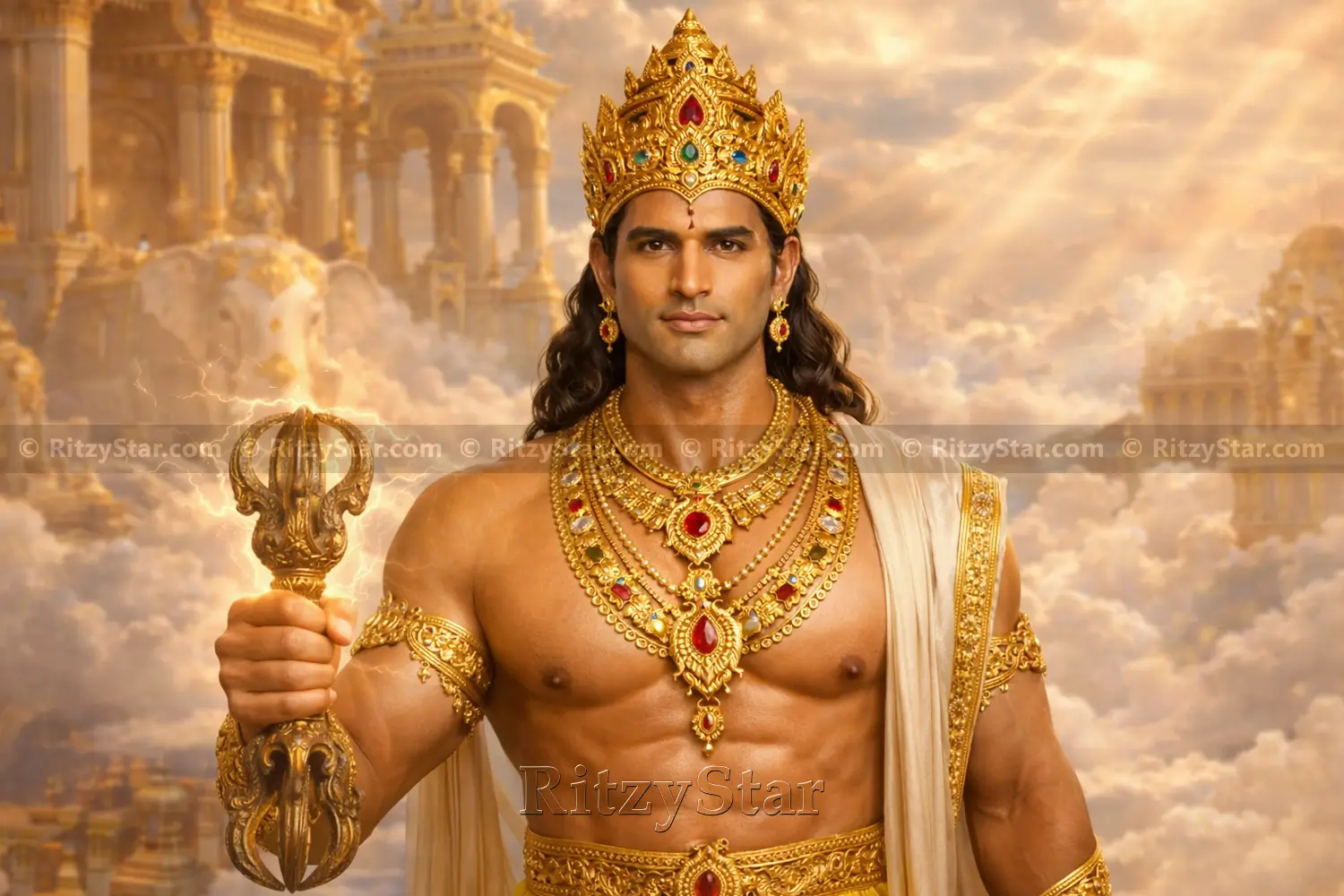
Indra is the foremost deity in the Rigveda, with more hymns dedicated to him than any other god. He is the king of the Devas (gods), the ruler of Svarga (heaven), and the lord of the three worlds. His domain is the sky, his weapon is the thunderbolt (Vajra), his mount is the white elephant Airavata, and his city is Amaravati—the celestial capital that shimmers with unimaginable beauty.
“शक्रः पुरन्दरो देवो वासवः सुरपूजितः।
मघवा स्वर्गपतिर्जिष्णुरिन्द्रः सहस्रनेत्रकः॥”
— by Author
Meaning: He is Shakra (the all-powerful), Purandara (the destroyer of cities), Vasava (lord of the Vasus), worshipped by gods, Maghavan (the generous), lord of heaven, Jishnu (the triumphant), Indra the thousand-eyed.
His names reveal his character:
- Shakra – The all-powerful one
- Purandara – The destroyer of cities (especially the ninety-nine fortresses of the demon Shambara)
- Vasava – Lord of the Vasus (eight elemental deities)
- Maghavan – The generous one (he who gives abundantly)
- Jishnu – The triumphant
- Sahasraksha – The thousand-eyed one
- Vritrahan – The slayer of Vritra
- Shachipati – Lord of Shachi (his consort)
Indra’s character is complex. He is heroic yet fearful, generous yet envious, powerful yet insecure. He is the protector of the gods but also the tempter of sages. He is celebrated in the Vedas as the greatest of warriors, yet the Puranas are filled with stories of his humiliations.
🌟 The Birth of Indra – Born to Lead the Gods
Indra’s origins are found in the primordial conflict between the Devas and Asuras—the eternal struggle between order and chaos, light and darkness.
The Sons of Kashyapa
Kashyapa, the ancient sage, married thirteen daughters of Daksha. From these unions came the Devas, Asuras, Nagas, and all other beings. Among his wives, Aditi gave birth to the Adityas—the twelve solar deities—and among these twelve, the most powerful was Indra.
“अदितेः पुत्रतां प्राप्तः सर्वदेवेश्वरः प्रभुः।
जज्ञे शक्र इति ख्यातः सुराणां पतिरिन्द्रकः॥”
— by Author
Meaning: Born as the son of Aditi, the lord of all gods, he was known as Shakra, Indra, the king of the celestial beings.
But Indra was not merely born—he was chosen. The Devas, constantly at war with the Asuras, needed a leader who could unite them, who could wield the thunderbolt against their enemies. Indra, with his strength, courage, and charisma, was the natural choice.
The Churning for Immortality
One of the great defining moments of Indra’s early kingship was the Samudra Manthan—the Churning of the Ocean of Milk. When the Devas, cursed by Sage Durvasa, had lost their strength and were being defeated by the Asuras, Indra sought the help of Vishnu. Together, they devised the plan to churn the ocean for the nectar of immortality (amrita).
“समुद्रमन्थने यत्नः कृतः सुरासुरैः सह।
इन्द्रस्य प्रार्थनादेव विष्णुना परिपालितः॥”
— by Author
Meaning: The effort of churning the ocean was undertaken by gods and demons together; at Indra’s request, it was protected by Vishnu.
The churning was a cosmic enterprise. Mount Mandara became the churning rod. Vasuki, the serpent king, became the rope. The Devas held the tail, the Asuras the head. And from the ocean emerged treasures beyond imagination: Lakshmi, the goddess of fortune; Dhanvantari with the pot of amrita; the celestial horse Uchchaishravas; the wish-fulfilling tree Kalpavriksha; the white elephant Airavata—who became Indra’s mount.
“ऐरावतो गजेन्द्रश्च सुरेन्द्रस्य वाहनः।
उत्पन्नः क्षीरसागरादिन्द्रस्य प्रीतिवर्धनः॥”
— by Author
Meaning: Airavata, the king of elephants, mount of the king of gods, emerged from the ocean of milk, increasing Indra’s joy.
But Indra’s joy was short-lived. The nectar was claimed by the Asuras, and only through Vishnu’s intervention as Mohini—the enchanting form—was it recovered and distributed to the Devas. Indra and the Devas drank the nectar and regained their immortality and strength.
🐉 The Great Battle – Indra the Dragon Slayer
The defining moment of Indra’s mythology—the act that established him as the supreme warrior of the gods—is his slaying of Vritra, the great serpent who had imprisoned the waters of the world.
The Terror of Vritra
Vritra was a demon of immense power, son of the sage Kashyapa and the asura Danu. He was a dragon who coiled himself around the mountains, holding all the waters of the world captive. Rivers dried up. The earth withered. All creation suffered from drought and despair.
“वृत्रो नाम महादैत्यः पापात्मा दानवेश्वरः।
आपः संस्तम्भयामास सर्वाः स्रोतस्विनीस्तथा॥”
— by Author
Meaning: Vritra, the great demon, that evil-souled lord of the Danavas, stopped all the waters and all the flowing rivers.
The Devas, powerless against Vritra’s might, turned to Indra. But Vritra was no ordinary demon. He had received a boon that made him nearly invincible: no weapon made of wood, metal, or stone could harm him; he could not be killed by day or night; no creature born from any womb could slay him.
The Forging of Vajra
The sage Dadhichi, knowing the Devas’ need, offered his own body. His bones, he declared, were the only substance that could create a weapon capable of killing Vritra. He gave up his life, and his spine was used by the divine craftsman Tvashta to forge the most powerful weapon ever created: the Vajra—the thunderbolt.
“दधीचेर्महर्षेरस्थ्ना वज्रं निर्मितवान् त्वष्टा।
येन वृत्रं जघानेन्द्रो देवानां जयकाङ्क्षया॥”
— by Author
Meaning: From the bones of the great sage Dadhichi, Tvashta forged the thunderbolt, with which Indra slew Vritra, desiring victory for the gods.
The Vajra was unlike any weapon. It was unbreakable. It was unstoppable. And it was destined to become Indra’s eternal companion.
The Slaying of Vritra
Indra approached Vritra. The battle was cataclysmic. The heavens shook. The earth trembled. The oceans roared. For days they fought, neither gaining advantage. Then Indra saw his moment. At twilight—neither day nor night—he hurled the Vajra at the demon. The thunderbolt pierced Vritra, and the great serpent fell.
“वृत्रं हत्वा महादैत्यं इन्द्रो वज्री महाबलः।
आपो मुमोच वेगेन पूरयामास सागरान्॥”
— by Author
Meaning: Having slain the great demon Vritra, Indra the thunderbolt-wielder, immensely powerful, released the waters, filling the oceans with their flow.
With Vritra’s death, the waters were freed. Rivers flowed again. Life returned to the earth. Indra was hailed as Vritrahan—the slayer of Vritra—and his position as the king of the gods was secured.
👸 The Family of Indra
Indra’s family is central to his story—his relationships with his wives, sons, and daughters reveal his character, his vulnerabilities, and his complex role in the celestial hierarchy.
| Sl.No | Name | Relationship | Children | Remarks |
|---|---|---|---|---|
| 1 | Devi Shachi (Indrani) | Chief Consort | 1. Jayanta – Leader of the celestial armies; fought against the demon king Ravana when he attacked Amaravati. He is the deity of victory and protection. | Shachi is the daughter of the asura Puloman. She is one of the seven Matrikas (mother goddesses) and is associated with jealousy, wrath, and fierce protection of her husband. When Nahusha temporarily usurped Indra’s throne, Shachi played a crucial role in restoring her husband. |
| 2. Rishabha – A celestial being; mentioned in various Puranas as one of Indra’s sons who participated in divine battles. | ||||
| 3. Midhusha – Associated with abundance and generosity; his name reflects Indra’s epithet “Maghavan” (the generous). | ||||
| 4. Jayanti – Daughter; married the asura Shukracharya’s disciple, the sage Kacha. Her story is intertwined with the famous tale of Kacha and Devayani. | ||||
| 5. Devasena – Daughter; married to the war god Kartikeya (Skanda). She is the personification of the celestial armies. | ||||
| 2 | Surya (the Sun God) | Not a consort but Indra is sometimes considered Surya’s brother or ally | Not applicable | There is a complex relationship where Indra and Surya are often invoked together in the Vedas; Indra controls the rain, Surya provides the light. |
| 3 | Ahalya | Temporary consort (by deception) | Shatananda – Sage; father of the great sage Satyadhriti. Shatananda became the chief priest of King Janaka of Mithila and was the one who discovered Sita during the plowing of the field. | This is the most controversial episode in Indra’s life. Disguised as the sage Gautama, Indra deceived Ahalya, the sage’s wife. When Gautama discovered the deception, he cursed Indra with a thousand marks of shame that transformed into a thousand eyes. This curse is the origin of Indra’s epithet “Sahasraksha” (the thousand-eyed). |
| 4 | Urvashi | Temporary consort | Shayu – A sage mentioned in the Rigveda; associated with the creation of certain Vedic hymns. | Urvashi, the celestial nymph, was sent to distract Indra from his austerities. Their union produced Shayu, who later became a great rishi. |
| 5 | Varuna’s Daughter (name varies in texts) | Consort | Vali – The mighty monkey king of Kishkindha; father of Sugriva and the mighty warrior who was killed by Rama. | This union happened when Indra was cursed to take the form of a monkey for insulting the sage Gautama (in some versions, the same curse that gave him thousand eyes also made him take monkey form temporarily). From this union was born Vali, who inherited the strength and power of his divine father. |
The Story of Shachi – The Queen Who Saved Her King
Shachi (also known as Indrani, Pulomaja) is not merely Indra’s chief consort—she is his equal, his protector, and the one who restored him to his throne when all seemed lost.
“शची नाम सुरेन्द्राणी पुलोमदुहिता शुभा।
सौभाग्यं सर्वदेवीनां रूपं तेजश्च धारयत्॥”
— by Author
Meaning: Shachi, the queen of the king of gods, the auspicious daughter of Puloman, possessed the fortune, beauty, and radiance of all goddesses.
The most significant event in Shachi’s life was the period when Indra lost his throne to Nahusha, a mortal king who had been elevated to the position of Indra through his merit. Nahusha, overcome with power, demanded that Shachi come to him. She refused. For years, she resisted, using her intelligence and spiritual power to protect herself.
“नहुषो राज्यमापन्नः शचीं चक्रे मनोगताम्।
शची तु तपसा देवं शरण्यं समुपस्थिता॥”
— by Author
Meaning: Nahusha, having obtained the kingdom, set his mind on Shachi. But Shachi, through austerities, approached the protective god for refuge.
Shachi performed severe austerities and prayed to the gods for her husband’s return. She sought the help of Brihaspati, the guru of the gods. Through her efforts, a plan was devised: the sage Agastya was approached to bring Indra back, and Nahusha was cursed by Agastya to become a serpent. Indra returned to his throne, all because of Shachi’s unwavering loyalty.
The Curse of Ahalya – How Indra Gained a Thousand Eyes
Perhaps the most famous—and most shameful—episode in Indra’s life is his seduction of Ahalya, the wife of the sage Gautama.
“अहल्या नाम तपसा देवैरपि नमस्कृता।
तां कामयामास सुरो गौतमस्य महात्मनः॥”
— by Author
Meaning: Ahalya, by her austerities, was honored even by the gods. The lord of gods desired her, the wife of the great-souled Gautama.
Indra, seeing Ahalya’s extraordinary beauty, became consumed with desire. He knew that Gautama was away from his hermitage, performing his morning rituals at the river. Disguising himself as the sage, Indra approached Ahalya.
Some versions of the story suggest that Ahalya knew it was Indra but was either enchanted or desired him as well. Other versions portray her as completely deceived. Regardless, the union occurred.
When Gautama returned and discovered the deception—often through a sign like a crow announcing his arrival or Indra fleeing in the form of a cat—his fury was absolute.
“गौतमः क्रोधसंयुक्तः शशापेन्द्रं च तां तथा।
अहल्या पाषाणतां याता इन्द्रो नेत्रसहस्रभाक्॥”
— by Author
Meaning: Gautama, filled with rage, cursed Indra and her. Ahalya was turned to stone, and Indra was covered with a thousand marks of shame.
But Indra’s curse was transformed by the grace of the gods. The thousand marks of shame—the yoni (vulva) symbols that covered his body—were turned into a thousand eyes. Thus, Indra became Sahasraksha—the thousand-eyed one—forever marked by his transgression but granted a form of redemption.
“सहस्रं योनिरूपाणि नेत्राणि विधिनाभवन्।
तस्मादिन्द्रः सहस्राक्षः सर्वैः संपूज्यते सुरैः॥”
— by Author
Meaning: The thousand shame-marks became eyes by divine decree; thus Indra, the thousand-eyed, is worshipped by all gods.
This episode reveals Indra’s fundamental flaw: his inability to control his desires, particularly for women who are not his own. It is a flaw that recurs throughout his mythology and leads to many of his downfalls.
🍃 The Curse of Gautama – The Origin of the Thousand Eyes
The curse of Ahalya is not the only time Indra suffered for his transgressions. Throughout the Puranas, Indra is repeatedly cursed by sages whose penance he interrupted, whose wives he desired, whose authority he challenged.
The Curse of Sage Durvasa
Perhaps the most significant curse came from the irascible Sage Durvasa. Indra, seated on his elephant Airavata, once passed by Durvasa who was carrying a garland of fragrant flowers given to him by a celestial nymph. Indra, in his arrogance, took the garland and placed it on Airavata’s head. The elephant, irritated by the scent, threw the garland to the ground.
“दुर्वासा क्रोधसंरब्धः शशापेन्द्रं सुदारुणम्।
यथा त्वं मम माल्यं तु अवमन्यसि दुर्मते।
तथा तव श्रियः सर्वा विनाशं यान्तु सत्वरम्॥”
— by Author
Meaning: Durvasa, inflamed with rage, cursed Indra terribly: “As you, evil-minded one, have insulted my garland, so let all your prosperity be quickly destroyed.”
This curse was the immediate cause of the Samudra Manthan. With Indra’s prosperity destroyed, the Devas lost their strength to the Asuras, and only through the churning of the ocean and the drinking of amrita were they restored.
The Curse of Sage Kashyapa
In another story, Indra tried to seduce the wives of the sage Kashyapa. The sage, discovering this, cursed Indra to be captured by his enemies and to lose his throne. This curse led to Indra’s temporary defeat by the demon Ravana, who invaded Amaravati and carried off Shachi.
“कश्यपेन शशापेन्द्रः शत्रुहस्तं गमिष्यसि।
राज्यं भ्रष्टं भवेत् ते तु स्त्रीहेतोः पापनिश्चयात्॥”
— by Author
Meaning: Cursed by Kashyapa, Indra was told: “You shall fall into the hands of your enemies. Your kingdom shall be lost because of your evil desire for women.”
This curse was fulfilled when Ravana attacked Amaravati. The demon king defeated Indra, took his throne, and captured Shachi. Only through the intervention of Brahma and the eventual mediation of Ravana’s own brother Vibhishana was Shachi returned and Indra restored.
🏛️ The Thousand Humiliations – Indra’s Endless Falls from Grace
Indra’s story is not one of continuous victory. It is a cycle: rise, fall, rise again. Each time he becomes arrogant, each time he abuses his power, each time he neglects his duties, something comes to humble him.
The Humiliation by Ravana
Ravana, the ten-headed demon king of Lanka, was not content to rule only the earth. He desired heaven itself. Through his immense power and the boons he had received from Brahma and Shiva, he challenged Indra for the throne.
“रावणो राक्षसेन्द्रश्च स्वर्गमाक्रम्य दुर्मतिः।
इन्द्रं जित्वा तदा शचीमपहृत्य ययौ पुरीम्॥”
— by Author
Meaning: Ravana, the evil-minded king of demons, invaded heaven, defeated Indra, and carried off Shachi to his city.
Indra, humiliated, fled from his own kingdom. Ravana sat on Indra’s throne, ruled from Amaravati, and paraded his power before the gods. It was only through the intervention of Brahma—and the eventual birth of Rama, Vishnu’s avatar, who would kill Ravana—that Indra’s rule was restored.
The Humiliation by Nahusha
Perhaps the most complete humiliation Indra faced came from Nahusha, a mortal king who had performed such great austerities that he was offered the position of Indra.
“नहुषो मानवो राजा तपसा दग्धकिल्बिषः।
स्वर्गं प्राप्य सुरेन्द्रत्वमिन्द्रस्यैव परिच्युतम्॥”
— by Author
Meaning: Nahusha, the mortal king whose sins were burned by his austerities, attained heaven and the kingship of gods that Indra had lost.
Indra, cursed by various sages and weakened by his own misdeeds, was forced to hide. He disguised himself and lived in obscurity while Nahusha ruled in his place. Nahusha, however, grew arrogant. He demanded that Shachi come to him. When she refused, he threatened her. But Shachi’s intelligence and devotion saved Indra.
She approached the sage Agastya and devised a plan. Nahusha, in his arrogance, had been cursed to become a serpent when he kicked the sage. Shachi arranged for Agastya to encounter Nahusha, and the sage’s curse was fulfilled. Indra returned from hiding and resumed his throne.
The Humiliation by Bali
The demon king Bali—son of Virochana, grandson of Prahlada—was one of the most powerful rulers in all of existence. Through his devotion to Vishnu and his immense power, he conquered heaven and dethroned Indra.
“बलिर्वैरोचनो राजा सर्वान् देवान् पराजयत्।
इन्द्रं च सहसा जित्वा स्वर्गलोकमवाप्तवान्॥”
— by Author
Meaning: Bali, the son of Virochana, defeated all the gods. Conquering Indra suddenly, he obtained the celestial world.
This time, Indra could not regain his throne on his own. He was forced to seek the help of Vishnu, who incarnated as the dwarf Vamana. Vamana approached Bali and asked for three paces of land. Bali, known for his generosity, granted the request. Vamana then expanded to cosmic size: in one step, he covered the earth; in the second, the heavens; in the third, he pushed Bali into the netherworld. Indra’s throne was restored—but only through Vishnu’s intervention.
The Humiliation by Krishna
Perhaps the most profound humiliation came not from a demon or a mortal king, but from a cowherd boy—Krishna, the avatar of Vishnu.
“इन्द्रो गोवर्धनं द्रष्टुमाजगाम सुरैः सह।
कृष्णेन युद्धमकरोत् स वज्री सर्वदेवराट्॥”
— by Author
Meaning: Indra came to see Govardhan with the gods; that wielder of the thunderbolt, king of all gods, fought with Krishna.
The story is well-known. The cowherds of Vrindavan, under Krishna’s guidance, ceased their worship of Indra and instead worshipped the Govardhan hill. Indra, enraged, sent forth the deluge—storm clouds of unimaginable fury to drown the cowherds and their village.
But Krishna lifted the Govardhan hill on his little finger, sheltering all the people and animals for seven days and nights. Indra’s greatest power—his control over rain and storms—was rendered useless by a boy holding a mountain as if it were an umbrella.
“धारयामास गोवर्धनं शैलेन्द्रं कृष्ण एव सः।
सप्ताहं वारि वर्षन्तमिन्द्रं परभवं निनाय॥”
— by Author
Meaning: Krishna himself held up the great mountain Govardhan; for seven days, he brought defeat to Indra who was pouring rain.
Defeated and humiliated, Indra approached Krishna. He bowed before the boy, acknowledged Krishna’s supremacy, and offered his blessings to the cowherds. This event marked a shift in Indra’s role: he was no longer the supreme deity but a servant of Vishnu and his avatars.
🍷 The Soma Drink – Indra’s Ambrosia and Addiction
Throughout the Rigveda, Indra is described as a drinker of soma—the sacred ritual drink that bestows power, inspiration, and immortality. Soma is both a physical substance (extracted from a plant, likely the ephedra) and a divine essence, the nectar that flows through the cosmos.
“सोमपा इन्द्रो महान् सोमं पिबति वीर्याय।
तेन शत्रून् विनाशयति तेन सर्वं प्रकाशयति॥”
— by Author
Meaning: Indra, the great drinker of soma, drinks the soma for strength. With it, he destroys his enemies; with it, he illuminates all.
Indra’s association with soma is so strong that he is called Somapa—the drinker of soma. The Vedas describe him drinking vast quantities before battle, his strength growing with each draught, his thunderbolt flashing with renewed power.
But the soma also represents Indra’s dependency. Without it, he is diminished. This dependence makes him vulnerable—and makes his position as king contingent on continued access to the celestial drink.
🐘 The Many Forms of Indra – Thousand Eyes, Thousand Forms
Indra’s epithets tell the story of his character:
| Name | Meaning | Significance |
|---|---|---|
| Shakra | The all-powerful | Reflects his position as king of gods |
| Vasava | Lord of the Vasus | His connection to the eight elemental deities |
| Purandara | Destroyer of cities | Commemorates his destruction of ninety-nine demon fortresses |
| Vritrahan | Slayer of Vritra | His greatest heroic act |
| Sahasraksha | Thousand-eyed | Origin in the curse of Ahalya |
| Maghavan | The generous | His role as the giver of boons and abundance |
| Jishnu | The triumphant | His victories in battle |
| Shachipati | Lord of Shachi | His connection to his chief consort |
| Airavata | Mount of Indra | Named after his white elephant |
| Divaspati | Lord of Heaven | His rulership over the celestial realm |
🌊 Indra in the Vedas – The Hero of a Thousand Hymns
The Rigveda, the oldest of the sacred texts, dedicates more hymns to Indra than to any other deity. In these ancient verses, Indra is a warrior without peer, a hero who fights for cosmic order (Rita) against the forces of chaos (Anrita).
“इन्द्रं वयं महाधनमिन्द्रं वयं सुखं रयिम्।
इन्द्रं वयं सहस्रिणमुपास्महे सुमेधसम्॥”
— Rigveda
Meaning: Indra, the great wealth; Indra, the easy prosperity; Indra, the thousand-fold—we approach him, the supremely wise.
In the Vedas, Indra is not yet the fallible figure of the Puranas. He is the supreme deity, the one who creates the universe, who slays the serpent, who releases the dawn, who supports the sky, who upholds the earth. He is the friend of humanity, the giver of rain, the bringer of abundance.
But even in the Vedas, there are hints of his vulnerability. He is constantly drinking soma to maintain his strength. He is constantly being invoked by the priests because his power is not permanent—it must be renewed through ritual and praise.
📜 The Puranic Indra – The Fallen King
The shift from the Vedic Indra to the Puranic Indra is dramatic. In the Puranas (the later mythological texts), Indra is no longer the supreme deity. He has been supplanted by the Trimurti—Brahma, Vishnu, Shiva—and his role is reduced to that of a regional administrator, a king who governs heaven but is subject to greater powers.
“पुराणेषु तु वृत्तान्तः सुरेन्द्रस्य च दुःखदः।
जित्वापि दानवान् सर्वान् ह्रियते राज्यमस्य वै॥”
— by Author
Meaning: In the Puranas, the story of the king of gods is sorrowful. Even after defeating all demons, his kingdom is taken from him.
The Puranic Indra is a tragic figure. He is powerful enough to be king but not powerful enough to keep his throne. He is wise enough to know his limitations but foolish enough to repeatedly overstep them. He is generous but envious, heroic but fearful, divine but all-too-human in his flaws.
🕉️ The Deeper Meaning – What Indra’s Story Teaches Us
Indra’s mythology is rich with symbolic meaning. On one level, it is the story of a particular deity. On another, it is an allegory for universal truths.
The Cycle of Ego and Humility
Indra’s repeated falls and restorations teach a fundamental lesson: power without humility is unsustainable. Every time Indra grows arrogant, he is humbled. Every time he is humbled, he learns—at least temporarily—the value of humility.
“यावदहंकारमात्रं तावदिन्द्रस्य पातनम्।
यावद्विनयमात्रं तावदिन्द्रस्य स्थापनम्॥”
— by Author
Meaning: As long as there is ego, Indra falls. As long as there is humility, Indra is established.
In this reading, Indra is not a god but a state of consciousness. He represents the ego—the sense of a separate self that believes itself to be the center of the universe. And like the ego, Indra’s reign is constantly challenged, constantly threatened, constantly needing to be defended.
The Impermanence of Power
Indra’s story is a meditation on the impermanence of all worldly power. No matter how high you rise, no matter how many enemies you defeat, no matter how much soma you drink—you can fall. And you will fall. The only question is when.
“न स्थानं विद्यते नित्यं स्वर्गे वा पृथिवीतले।
इन्द्रोऽपि राज्यं भ्रश्येत किं पुनर्मानवादयः॥”
— by Author
Meaning: There is no permanent position in heaven or on earth. Even Indra loses his kingdom—what then of humans and others?
This teaching is central to Hindu philosophy. All positions are temporary. All power is fleeting. The only lasting reality is the Self (Atman) that transcends all positions and powers.
The Role of the Sage
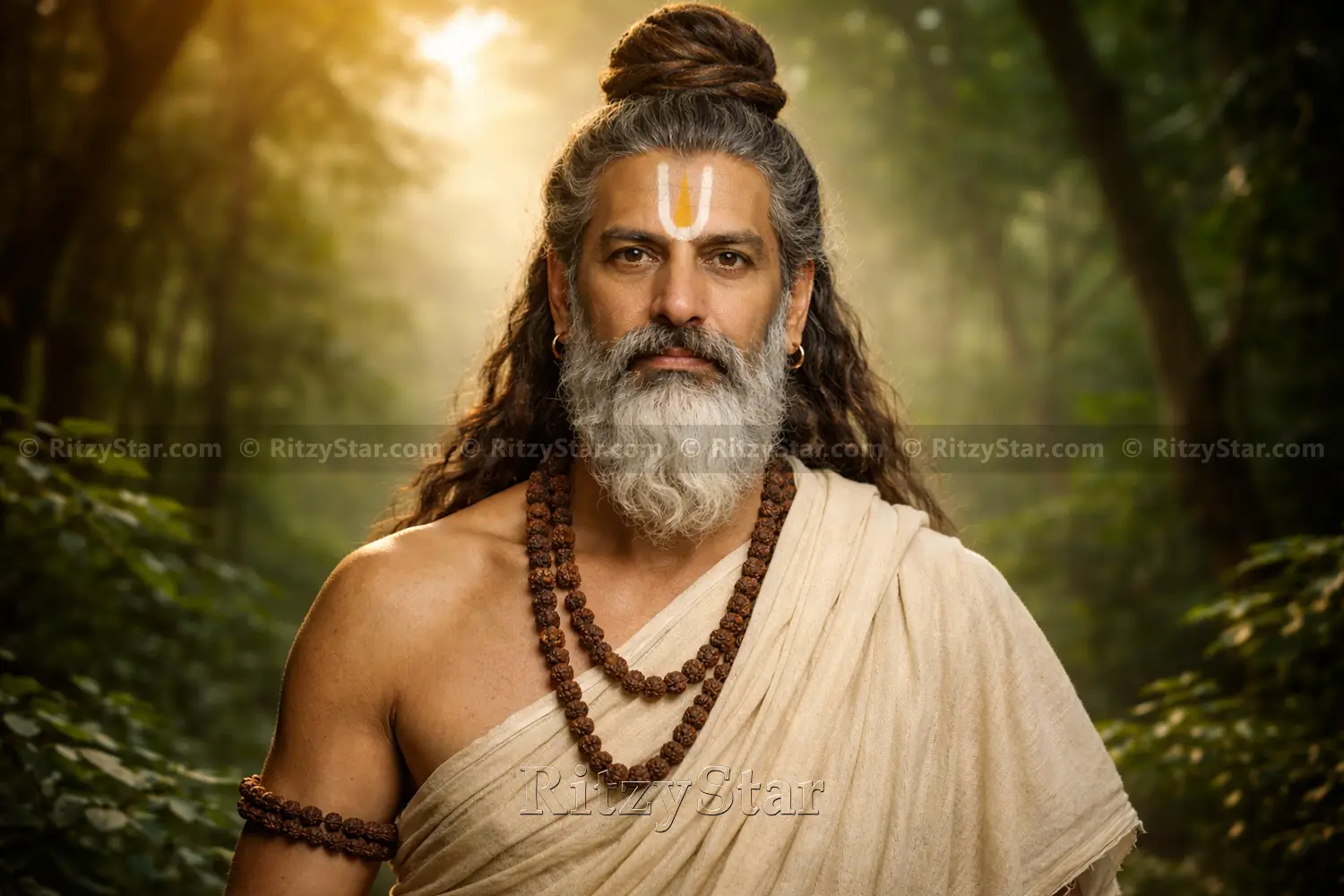
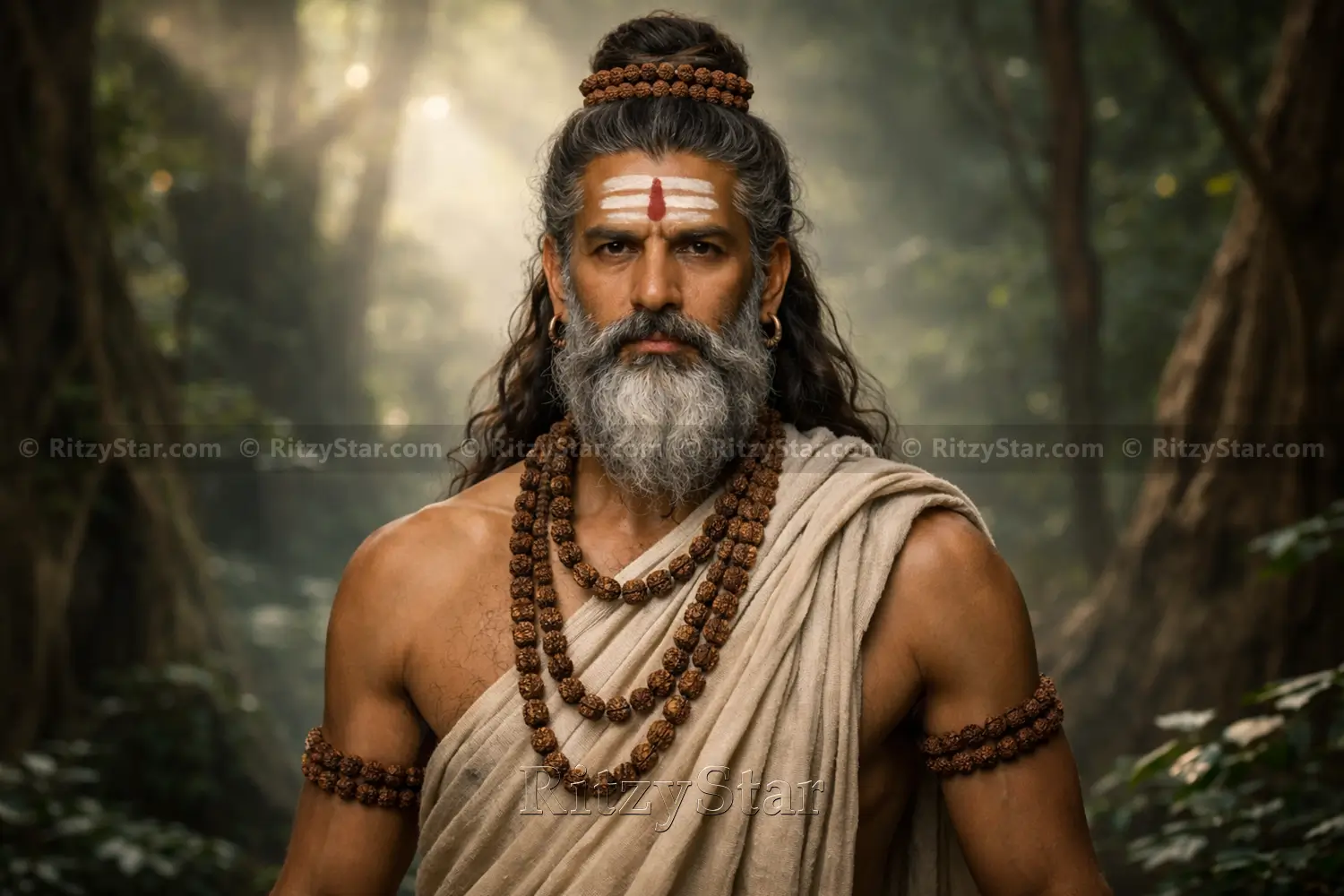
One of the most striking patterns in Indra’s mythology is the power of sages over him. Time and again, a sage’s curse brings Indra low. Time and again, a sage’s blessing restores him. The sages—through their tapas (spiritual austerity)—possess a power that even the king of heaven cannot defy.
“ऋषीणां तपसा दग्धं सुरेन्द्रस्य च राज्यकम्।
न शस्त्रैर्न च शत्रूणां बलं तपस्विनां परम्॥”
— by Author
Meaning: The kingdom of the king of gods is burned by the austerity of sages. Weapons and enemies are nothing compared to the power of those who practice tapas.
This reflects a fundamental hierarchy in Hindu thought: spiritual power is greater than temporal power. A sage sitting in a forest with nothing but a deer-skin for clothing is more powerful than the king of heaven seated on his throne in Amaravati.
🌌 Indra’s Legacy – The Eternal King
Despite his flaws, despite his falls, despite his humiliations—Indra remains the king of the gods. His position is eternal not because he is invincible but because the position itself is necessary. The universe needs a king. The gods need a leader. The forces of order need a champion against chaos.
“शक्रश्च शत्रुहन्ता च राजा देवगणस्य च।
यावत् सृष्टिस्तथा स्थानं तावदिन्द्रो विराजते॥”
— by Author
Meaning: Shakra, the slayer of enemies, king of the hosts of gods; as long as creation lasts, so does Indra’s position as the one who shines.
Indra’s story is not over. In every yuga (age), in every kalpa (aeon), there is an Indra. The position passes from one being to another, but the function remains. Indra is not a single deity—he is a role. And the current Indra, like all before him, will eventually be replaced.
This is the deepest teaching of Indra’s mythology: all positions are temporary, all roles are provisional, all power is borrowed. The only constant is change. The only certainty is impermanence.
🌅 Conclusion – The Most Human of Gods
Indra is the most human of the gods. He desires, he fears, he triumphs, he falls. He is generous and petty, brave and cowardly, wise and foolish. He loves his wife with fierce devotion and betrays her with his lust for others. He protects the gods and provokes the sages. He is everything and its opposite.
“इन्द्रः सुराणामधिपः सर्वेषामपि देवताः।
तथापि स मनुष्याणां भावानां पात्रतां गतः॥”
— by Author
Meaning: Indra is the king of gods, lord of all deities. Yet he has become the embodiment of human emotions and experiences.
This is why Indra’s story resonates across millennia. Because in Indra, we see ourselves. We see our ambitions and our failures. We see our pride and our humiliations. We see our desire for power and our inability to hold it. We see our longing for permanence in a world that offers only impermanence.
“सहस्राक्षः सहस्रार्चिः सहस्रवदनो महान्।
सहस्रैरपि पाप्मभिर्न लिप्यते यदि स्मरेत्॥”
— by Author
Meaning: The thousand-eyed, thousand-flamed, thousand-faced great one; even with a thousand sins, he is not tainted if one remembers the deeper truth.
And perhaps that is the final teaching: that Indra, for all his flaws, remains worthy of worship. Because his story teaches us that power is temporary, that ego is self-defeating, and that humility is the only path to lasting peace. That even a king of heaven can fall—and can rise again. That no sin is beyond redemption, no fall beyond recovery.
In Indra, we see the journey of the soul through the cycles of rise and fall, gain and loss, glory and shame. And in his thousand eyes, we see a thousand ways of seeing—including, perhaps, the way to see beyond the cycle itself.
Discover more from RitzyStar
Subscribe to get the latest posts sent to your email.